The Witness of the Prophets to the Perpetual Virginity of Mary
Given the witness of Mary, Joseph, the Evangelists, and Jesus himself, it’s not surprising to find the early Church Fathers firmly embracing the belief that Mary was ever-virgin. They, too, recognized the connection between Mary and the ark, and saw in Mary’s Perpetual Virginity something that attends everything else about Jesus’ life—the fulfillment of prophecy. This is most notable in the Fathers’ reading of the prophet Ezekiel.
Ezekiel lived about five hundred years before Christ. In Ezekiel’s day, the ten tribes of the northern kingdom of Israel had been scattered by the Assyrian Empire (hence the “Ten Lost Tribes of Israel” ) while the southern “rump” kingdom of Judah had itself been carted off to captivity in Babylon after the destruction of Solomon’s Temple. It seemed that Israel was doomed to be annihilated, crushed between the hammer of Assyria and the anvil of Babylon.
But then God raised up prophets like Ezekiel to promise that Israel had not been forsaken and that the Almighty would restore her fortunes, return her to her land, send her a Messiah, and use Israel to bless all the nations of the earth, just as he had promised Abraham long ago (Gen. 12:1–3). In Ezekiel’s case, this prophetic message included a lengthy vision—recorded in Ezekiel 40–48— describing a restored temple, a revived land of Israel, and a renewed city of Jerusalem.
Now the temple was indeed rebuilt (cf. Ezra and Nehemiah), but it didn’t (and couldn’t) look like the temple of Ezekiel’s prophecy. Why? Because in Ezekiel’s visionary temple things like this happen:
Then he brought me back to the door of the temple; and behold, water was issuing from below the threshold of the temple toward the east (for the temple faced east); and the water was flowing down from below the south end of the threshold of the temple, south of the altar. Then he brought me out by way of the north gate, and led me round on the outside to the outer gate, that faces toward the east; and the water was coming out on the south side.
Going on eastward with a line in his hand, the man measured a thousand cubits, and then led me through the water; and it was ankle-deep. Again he measured a thousand, and led me through the water; and it was knee-deep. Again he measured a thousand, and led me through the water; and it was up to the loins. Again he measured a thousand, and it was a river that I could not pass through, for the water had risen; it was deep enough to swim in, a river that could not be passed through. And he said to me, “Son of man, have you seen this?”
Then he led me back along the bank of the river. As I went back, I saw upon the bank of the river very many trees on the one side and on the other. And he said to me, “This water flows toward the eastern region and goes down into the Arabah; and when it enters the stagnant waters of the sea, the water will become fresh. And wherever the river goes every living creature which swarms will live, and there will be very many fish; for this water goes there, that the waters of the sea may become fresh; so everything will live where the river goes. Fishermen will stand beside the sea; from En-gedi to En-eglaim it will be a place for the spreading of nets; its fish will be of very many kinds, like the fish of the Great Sea. But its swamps and marshes will not become fresh; they are to be left for salt. And on the banks, on both sides of the river, there will grow all kinds of trees for food. Their leaves will not wither nor their fruit fail, but they will bear fresh fruit every month, because the water for them flows from the sanctuary. Their fruit will be for food, and their leaves for healing” (Ezek. 47:1–12).
There never was (and never will be) a physical temple with a river flowing out of it. So what is Ezekiel getting at? To find out, we must pay attention to a rabbi named Jesus of Nazareth as he comes to the rebuilt temple five hundred years later to celebrate the Feast of Tabernacles (John 7).
The Feast of Tabernacles is described in Leviticus 23:33–43 and Deuteronomy 16:13–16 as a commemoration of Israel’s living in tents in the wilderness (Lev. 23:43) and a thanksgiving for Israel’s permanent home in the Promised Land. In addition, the feast also offers thanks for the temple, the successor of the Mosaic Tabernacle (Ex. 25–31) as a permanent place of worship. Note that both the tabernacle and the temple were home to the ark of the covenant until the ark vanished several centuries before Christ’s birth.
As Israel wandered in the wilderness during the Exodus, the people suffered from thirst. In answer to their complaints, Moses strikes a rock, from which water flows to quench Israel’s thirst (Num. 20). By Jesus’ day this event was commemorated in the Feast of Tabernacles in a curious ritual: Every morning during the feast, a priest went down to the Pool of Siloam and brought back a golden pitcher of water to the temple (the successor of Moses’ Tabernacle). This water was poured on the altar of holocausts amidst the singing of the “Hallel” (that is, Psalms 112–117) and the joyful sound of musical instruments. Interestingly, this practice became part of the feast after the rebuilding of the temple following the Babylonian Exile—that is, after the prophecy of Ezekiel’s river flowing from the temple.
So, during the Feast of Tabernacles, Jesus announces to the crowd, “If any one thirst, let him come to me and drink. He who believes in me, as the scripture has said, ‘Out of his heart shall flow rivers of living water’” (John 7:37–38). As we already know, Jesus uses the image of living water to refer to the Holy Spirit (cf. John 4). Yet curiously, there’s no passage in Old Testament Scripture that says, “Out of his heart shall flow rivers of living water.” What, then, is Jesus referring to?
He is referring to Ezekiel 47 and following. After all, Jesus has already told us what the true temple is when he declared, “Destroy this temple, and in three days I will raise it up” (John 2:19). As John makes crystal clear, “[H]e spoke of the temple of his body” (John 2:21). So Jesus is declaring to all at the Feast of Tabernacles that Ezekiel’s vision is not a physical description of a stone building, but a spiritual description of the true temple, the Body of Christ. For the same reason, John says that Jesus “tabernacled” among us (John 1:14) when he became man. Paul makes the same connection, referring both to individual Christians and to the mystical Body of Christ as the temple (1 Cor. 3:16–17; Eph. 2:21).
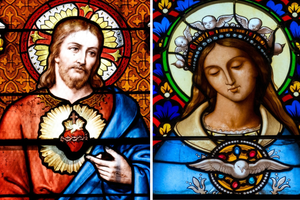
So Jesus is identifying himself with the temple of Ezekiel’s vision. He is making clear that he is the true temple and his heart is the Holy of Holies. The water of the Feast of Tabernacles, the water flowing from the rock of Moses, from the rock on which the visionary Temple of Ezekiel is founded, flows from his heart. The rock, as Paul makes clear, is Christ (1 Cor. 10:1–4). And John will make this even clearer as his Gospel reaches its climax and blood and water flow from the pierced side Christ.
In other words, the Incarnation is being likened to God coming to dwell in his temple in majesty. Or rather, the Old Testament moments in which God descended in majesty on the tabernacle and the temple in the pillar of cloud (cf. Ex. 40:34–38; 1 Kgs. 8:10–11) are revealed to be prophetic foreshadows of when God truly came to dwell in his temple: when the Word became flesh and tabernacled among us.
Now the interesting thing, the Fathers noticed, is that Ezekiel speaks directly to this image of the Lord coming in majesty to dwell in his temple. For the prophet wrote:
Then he brought me back to the outer gate of the sanctuary, which faces east; and it was shut. And he said to me, “This gate shall remain shut; it shall not be opened, and no one shall enter by it; for the Lord, the God of Israel, has entered by it; therefore it shall remain shut” (Ezek. 44:1–2).
In short, the gate into the Incarnation (i.e., Mary) shall be holy to the Lord and not for any common purpose. And in token of this, the gate of the mystical temple shall be shut to all but the Lord.
As an Evangelical, I had long regarded the reading of Ezekiel 44:1–2 to support Mary’s Perpetual Virginity as mere “proof texting.” I thought the Fathers were beginning with this passage and then trying to build a doctrine of Perpetual Virginity on it. But the more I saw how the early Church (including the New Testament authors) linked the tabernacle, the temple, and the Body of Christ, and the roles of Mary, the ark, and the gate of the temple, the more I came to realize that the Church’s faith in Mary’s Perpetual Virginity was not derived from Ezekiel 44:1–2 any more than her faith in the Virgin Birth was derived from Isaiah 7:14. Rather, as with the Virgin Birth, the Perpetual Virginity of Mary happened, and only afterward did the Church begin to realize that the events of her life, like the events of her Son’s, were strangely —one might even say prophetically—foreshadowed in Ezekiel 44:1–2. And so there dawned on me at last the recognition of a real, organic, un-manufactured connection between Mary and something the prophet Ezekiel had been inspired to see.