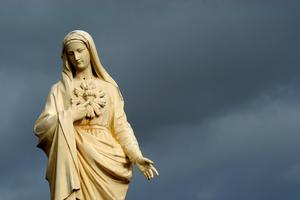
The Assumption has rightly been called "Mary's Easter." It's the great icon of the glory and joy awaiting every person saved by Jesus Christ. The Mystery of the Assumption reminds us that Christ's resurrection was not an end in itself. Jesus wasn't raised just to prove God could raise the dead. He was raised so that we would be raised with him and live, not as disembodied spooks, but as fully human beings in the glory of God forever. What Mary enjoys now, we shall enjoy when our time comes. She completes the picture of redemption for us; she is the foremost link between the God who gives living grace and the creature who receives it. In her, we see what that grace looks like in a mere creature. In her, we see what we mere creatures shall one day share.
In meditating on the Assumption, as distinct from simply acknowledging the doctrine, what strikes me is the sheer happiness of the thing. Here is the complete overcoming of death. A triumph over death that is not simply given in earnest, but is carried all the way through to the completion of the deed. In Jesus' resurrection, Mary receives the promise of her own triumph over death. But of course that triumph is only fully experienced by Mary when she herself triumphs over death in the Assumption. In the same way, we also live in the now and the not yet. Jesus has been raised. Mary has shared in that triumph over death so that we can see how the gift plays out in the life of the disciple. But we too have yet to wait for our own personal defeat of death. The temptation is to be afraid of this. But the lesson of Mary's life is that, once it is all over, we will look back with pure joy and laugh at death at a shadow that shall never trouble us again.

Comments
Post a Comment
we also live in the now and the not yet. Jesus has been raised.
I would add that we live in the now, FOR the yet… :)
Thanks Mark for your summary. This is a wonderful feast and truly one of the Church, our Church. I say that because there is no biblical account of this event that would convince a sola scriptura advocate yet, it has a rich history and a rich logic.
It seems that “disembodied spooks” was good enough for Paul:
1 Cor 15:35. “But some man will say: How do the dead rise again? Or with what manner of body shall they come? ... But God gives it a body as he will: and to every seed its proper body. ... And there are bodies celestial and bodies terrestrial:” Doesn’t that sound sensible?
Mary did not have to die – death had no hold on her. She could have gone directly to heaven, but she chose to die because her Son died. On Friday the thirteenth, shortly before her 70th birthday (though she did not age beyond 33) she died at the same hour that Our Lord died. Her body was buried and her soul went directly to heaven. At the same hour her Son was resurrected, her soul came back to claim her body and together they were both assumed into heaven. I know you don’t have to believe that, but I am allowed to and do believe it. What you say is true because she chose to die, not because she had to die.
Doug: You misread Paul. A spiritual body means a glorified body (like Christ’s, which could be touched, and which ate fish). It does not mean a ghostly vapor.
Bob,
Where r u getting your info?
Ralph: From The Mystical City of God, A private revelation of Ven. Mother Mary of Agreda, that has numerous Approbations certifying that it contains no error. This has unfortunately been a needless contention with Mark in his series on the Rosary. You don’t have to believe private revelation, but if it is approved by the Church you can. It is a four volume compilation believed to be an autobiography of the Holy Family dictated to Mother Mary by almighty God and his Blessed Mother. I believe that death had no hold on Mary because of her Immaculate Conception. I am not sure whether Mark believes that as well. One approbations determined that all things in this book are in harmony with the Holy Scriptures, the Holy Fathers, and Councils of the Church. That is good enough for me to believe. You have a choice. The Superior-General of Saint Sulpice, Abbe Emory said: “Only since I read the revelations of Agreda do I properly know Jesus and His Holy Mother.
Mark, YES! Thanks for spelling this out. The Assumption is the foretaste for all true believers! Thank you!
Easter was Christ’s resurrection. Our Blessed Mother was assumed. There is no dogmatic statement of whether it was before or after her death. It was not a resurrection. Therefore, it could not be an “Easter”.
I have always believed that Our Lady did die but that she went straight to heaven, of course. There is something on the Catholic Encyclopedia that the Apostles were present at her death and that she was buried but when the Empress ???? wanted to transfer her body to Hagia Sophia an exhumation showed that there was no body there to exhume. Just when Jesus took her body to heaven and re-united it with her soul I do not know but I would expect that it was very quickly after her burial and that her body did not decompose in any way. I have absolutely no evidence for all of this but it is merely what I think most probably happened.
Does anyone have any sound opinions as to whether Mary was assumed from Jerusalem or from Ephesus?
And which is the proper past tense Assumed or Assumpted?
Both towns have claims. There is no official teaching. The proper past tense is “assumed”.
Dismas: Mary spent only two and a half years in Ephesus and died in the cenacle in Jerusalem in the presence of all the Apostles that were called from throughout the world to be present at her death.
Jaray: You are allowed to believe the private revelation that has been approved through approbation by the Church. It is not part of the deposit of faith. I guess if you don’t believe it, you have only speculation by theologians who do not always agree. Take your best shot. Almighty God said he intended it to be reliable truth. I believe Him. You can too if you wish. I consider approbation official. Some obviously do not, but that is their free choice – I don’t have any problem with them.
Dismas:
Bob habitually presents his private opinion, based on some books by a mystic he has read, as though it were settled historical fact and the dogmatic teaching of the Church. It’s not. He’s entitled to his opinion, but that’s all it is. The Church has no settled doctrine on where, or even if, Mary died. All we know is that she was assumed. There are two traditions: one centered in Ephesus and one in Jerusalem. There are no traditions that she remained in her tomb and (significantly) no claims of any Marian relics—surely the most prized relics there would have been in an ancient Church that was gaga for relics.
Mark,
How do you know Mary was assumed if you don’t know with any certainty that she even died? Looks to me like arguments from silence and with arguments from silence anything could be said to be true.
I habitually never base anything religious on personal opinion. We have an established Magisterium that God assures us speaks for Him, and as a convert since 1949, I have tried to reflect it. An approbation is an officially recognized document of the Catholic Church, and the opinion I have been giving is its official opinion, not mine. The Church does teach that approved private revelation is worthy of belief. Obviously, those who don’t believe it, admit they know very little about the history of the Church or the life of the Holy Family. What a pity that is.
@Bob Rowland -
Have you read any of the Bl. Catherine Emmerich’s visions leading to the discovery of Mary’s House in Ephesus built by John, the Beloved Disciple? I’ve partially read The Mystical City of God and enjoy it very much. I understand our Church has declared that it contains nothing contrary to faith but I certainly don’t take that to mean that it is free from error.
Personally, I have a difficult time with idea of Mary’s ‘death’. The idea of dormition, a kind of falling asleep or an exhaustion from love and desire seems more likely to me.
What I like about you Bob is that you are not afraid to interpret church teaching.
Jay: I know it because it is the constant Tradition of the Church and was defined as dogma in 1950 by the Church which Jesus promised he would guide and lead into all truth by his Spirit. When the Church, the pillar and foundation of the truth, solemnly defines something as apostolic teaching, you can take it to the bank.
APOSTOLIC CONSTITUTION OF
POPE PIUS XII
MUNIFICENTISSIMUS DEUS
DEFINING THE DOGMA OF THE ASSUMPTION
November 1, 1950
http://www.vatican.va/holy_father/pius_xii/apost_constitutions/documents/hf_p-xii_apc_19501101_munificentissimus-deus_en.html
How can something be a constant tradition when no one knows what happened to Mary? Looks to me that the point Jay made stands.
We do know what happened to Mary. She was assumed into heaven. It’s the constant teaching of the Church.
Dismas: When an approbation states that doctrines in a book are in harmony with the Holy Scriptures, the Holy Fathers and the Councils of the Church, how would you suppose it would have error. Do you think they have error?
Thanks JF: The best way to interpret Church teaching is to repeat it, and that is the way I usually try to follow.
Its not the constant teaching of the church that Mary was assumed. No apostle ever mentions it.
Bob -
Believe what you like about City of God, it makes no difference to me. I am interested in your opinion whether you think it’s imprudent of me or contrary to Sacred Tradition and Holy Scripture to consider the possibility that Mary may not have actually died? That maybe what she experienced wasn’t actually ‘death’ as we know it but maybe more like some kind of dormition, a kind of falling asleep or an exhaustion from love and desire?
Have you read any of the Bl. Catherine Emmerich’s visions leading to the discovery of Mary’s House in Ephesus built by John, the Beloved Disciple?
Bob Rowland,
Every Catholic MUST believe that the bible is true. That is is the inspired word of God. Non negotiable. Not that it is “worthy” of belief, but that it is “mandatory”. Worthy of belief means this and ONLY this…there is nothing in it that contradicts Church teaching or Scripture.
The dictionary could say the same.
Saying it is worthy of belief only means that you MAY believe it. Or not. It’s up to you. But the Church most definitely does NOT say that it is true and that it “should” be believed. It is really, really important that you learn the difference.
For instance, the Gospel of James has given us much of what we know of Mary, her parents, her early life. It is worthy of belief. But it did NOT get put into the Canon. Why? Because it was not thought to be on par with the rest of the books.
NOTHING new will be revealed to us. Scripture and the Church have received the last public revelations. Private revelations are a whole different ball game. You really need to stop putting these statements forward as if they are “gospel truth”. Continue to post them, but make sure to add the caveat that they ARE private revelations, and NOT official Church teaching. Many of NCR’s readers are not Catholic and you muddy the waters when you present non Church teaching as official Church teaching. Can you see that?
Clear, concise, irrefutable. Well done mk, very well done indeed.
Tony:
Revelation 12 alludes to Mary as a cosmic heavenly figure. No apostle ever mentions that Ecclesiastes is inspired scripture either. The Bible is not written to be the Big Book of Everything. Catholics recognize that apostolic tradition is not simply and solely enshrined in written form. Otherwise there’s no way to know which books belong in the Bible.
mk: Whatever gave you the idea that I thought the Bible was not true or that I thought private revelation was on the same per with the Deposit of Faith. You don’t need to go on a diatribe about what the church teaches. When I converted to the Church in 1949, I received a thorough indoctrination in the Magisterium, dogma, and de fide doctrine, and I never found anything that I could not believe. You should berate the Second Vatican Council for ignoring what the First Vatican Council said about no new doctrine, not me. I understand what the Church teaches about approbation – you apparently do not. I have never believed or said that private revelation was “Gospel truth.” I would suggest that you read what I say more carefully, and don’t put your words into my mouth; There is no Gospel of St. James, only an Epistle in the Douay-Rheims Bible that says nothing about Mary.
Dismas: I would have to answer contrary to Sacred Tradition. I had and read the documents of Catherine Emmerich even before I got and read The Mystical City of God. My preference is obvious, but it is not intended to detract from Catherine Emmerich in any way.
@Bob -
There it is for all to see, clearly you’re a man of great contradiction:
Mystical City of God = inerrant
Council of the Church (VCII)= errant
There it is for all to see, clearly you’re a man of great contradiction:
Mystical City of God = inerrant
Council of the Church (VCII)= errant
Thank you Dismas. Could not have said it better myself.
Bob Rowland,
When an approbation states that doctrines in a book are in harmony with the Holy Scriptures, the Holy Fathers and the Councils of the Church, how would you suppose it would have error. Do you think they have error?
Right there you claim that an approbation means that it is inerrant. It does not. For instance, if her book were to claim that Jesus liked certain music, this would not contradict Scripture, but it doesn’t mean that it is true. I cannot believe you don’t see the difference.
And here is an example of where you make a statement of private revelation as if it is Official Teaching. All you would have had to say is “According to Mary of Agreda, in her book The Mystical City of God…blah, blah, blah. But you don’t. And I believe you don’t, purposefully. This is dishonest. All I am asking is that you clarify the difference.
And there most certainly is a Gospel of James. It is also known as the Protoevangelium of James. It is not in the Canon, but it is considered a legitimate source of information. It is not however, considered inerrant. No source outside of Scripture, Sacred Tradition and the Magesterium is considered inerrant.
Whatever gave you the idea that I thought the Bible was not true or that I thought private revelation was on the same per with the Deposit of Faith. You don’t need to go on a diatribe about what the church teaches.
I don’t know Bob. What gave you the idea that I thought you didn’t think the bible was true? I never said that nor intimated it. What I said is, there is a difference between Scripture which MUST be believed, and private revelation which MIGHT be believed, if you so choose. I’m clear on the difference. Are you?
The comments here are a good example of why so many catholics are confused about what is true and what is not. Their church allows for all kinds of beliefs. Some things are written in stone so to speak but then there are all kinds of private revelations that could be true but do not have to be believed. Its enough to make one’s head spin.
The Dogma of the Assumption is not something taken up in the 20th Century when in 1950 the pope made it official. Since the beginning of our faith there are numerous revelations and details of Mary’s “Assumption” just as their are about Jesus’ Resurrection. Unfortunately they are not contained in the canonical books of the New Testament. We have been ‘instructed’ by great men and women of faith since the beginning of the Church’s formative years. Yes there are GREAT gaps in the story, but no one was present for the actual Resurrection inside the tomb of Christ either. There is enough circumstantial evidence to satisfy the believer that in fact Christ Resurrected from the dead. He was the “FIRST Fruits” of which many of us hope to follow! Mary… RIGHTFULLY was the second.
There are many reliable sources about Mary’s Assumption that have been believed since the very early church… even at the time of her ‘death’. In 1950 the Pope just made official what the faithful have believed all along. Yes… now ” ... you can take it to the bank” as Mark said.
Thanks Mark for a wonderful mediation ... of what we HOPE awaits us all.
Jo:
I’m sorry you can’t deal with the fact that reality is complicated and that the Church takes that into account. I hope that you will someday be able to deal with the fact that reality is complex.
I can deal with reality. Its the contradictions in catholic church that can’t be dealt with.
Jo,
The reality is that there are no contradictions in the Catholic Church. There are Catholics who do not know what the Church teaches, but that is not the same as a contradiction within her teachings.
Honestly, between these statements and the nonsense that went on on the “Eucharist” post, I’m beginning to wonder if they still teach critical thinking in school! ;)
The Church is very, very clear on what she teaches. If certain people are obstinate in their refusal to accept those teachings, or to lie and claim something is a teaching that is not, it is not the fault of the Church.
@Jo -
It’s truly not as confusing as some make it out to be and we have the catechism as our constant guide. Faith is a life long commitment and responsibility and surely not always easy. Our faith must be viewed in light of our Church. Our Church doesn’t allow all kinds of belief, it allows only those beliefs that are not contrary to it’s teaching.
Our faith is based on three co-equal pillars, Sacred Scripture, Sacred Tradition, and the Magisterium, or teaching authority of our Church. All three support one another and are understood in light of one another. Together they comprise the Deposit of Faith. Part of being Catholic is believing that what the Magisterium teaches regarding faith and morals is guided by the Holy Spirit and thus inerrant. Calling the Magisterium of our Church into question is to question our Church and what it teaches in it’s entirety.
@Bob - Just a reminder, City of God is private revelation which is not part of any of these three pillars. City of God has only been said not to contain anything contrary to the Deposit of Faith. It is not, however, part of the Deposit of Faith and is not required to be believed. VCII, on the other hand, is held by the Magisterium of our Church as part of the Sacred Tradition of our Church and must be properly understood and believed.
Is there anything more boring that Catholics arguing about what they’re supposed to believe? Or sadder? Mark, you used to write some thought provoking articles, this recent diversion titled Meditations on the Rosary has been uncharacteristically dull.
mk: I have always identified The Mystical City of God as private revelation, and I know very well what the Church teaches about it. I quote Vatican Council I: “For the Holy Spirit was not promised to the successors of Peter, that by His revelation they might make known new doctrine, but that by His assistance they might inviolably keep and faithfully expound the revelation or deposit of faith delivered through Apostles.” Novus Ordo translates new order. The Eucharist and sacred vessels before VCII were handled only by consecrated hands. They were corrupted by non-consecrated hands after VCII. Before VCII belief in the Real Presence in the U.S. was virtually perfect. After VCII it has drastically dropped to about 25 percent. Can you not understand that the main feature of the Church has been corrupted by Communion in the hand. That alone makes the Council a tragedy for me – certainly not the renewal Pope John XXIII intended. Pope Pius V said that anyone who changed the Tridentine Mass would inherit the wrath of Saints Peter and Paul. Do you suppose that had anything to do with the chaos in the wake of the council? I certainly can’t blame the Holy Spirit for that. If Pope Paul VI had not had the courage to release Humanae Vitae without the recommendation of the committee to allow contraception, de fide doctrine would have been compromised, and the Church would have been in error something God promised would never happen. Believe what you want about the council. To clarify my current position,I have always been and am still firm;y committed to the Magisterium. I don’t believe we have heard the final Word about the council.
Dismas—you not only have the catechism but encyclicals, pronouncements by councils, church fathers and occasionally the bible to factor in what the catholic church believes. I don’t think any catholic takes these things into consideration and balances them all out and come to their beliefs. Have you ever read your catechism from cover to cover?
Bob brought up an excellent point on the differences between the 2 councils that adds further confusion.
Jo, please don’t be lead astray by every Catholic that comes along, claiming something as true, such as the “differences between the 2 councils”. The Church councils = none of them! - contain any “different” doctrine. And we don’t read everything then “balance them out and come to [our] beliefs” - good grief, what a notion! The Church teaching is clearly spelled out: use the Catechism! It summarizes for you.
We use the Church Fathers and other things you listed in defense of (or, for the encylicals, more indepth and relevant explanation of) what the Church has always taught. If you have trouble accepting a particular teaching from the Catechism, use the included references to read up more on that point to better understand it. So that you can think like the Church. But that is not usually necessary, because the Catechism is so good.
Jo,
Bob is an example of what I was saying about individuals who do not believe what the Church clearly teaches. Councils cannot be in error. For him to claim in one breath that VCII was flawed and in the next that he is firmly committed to the Magesterium shows that BOB is conflicted and confused…but it says nothing about the Council.
Look at the Constitution. One document. Pretty short considering. Yet 200 years later we are still discussing what the founders meant by certain parts of it. How many books, papers, essays have been written about it? How man questions have been taken to court to clarify and discern what different parts mean? I doubt you’ll be moving to Guam anytime soon because the Constitution is complicated and contradictory.
Yes, there are councils, encyclicals, the catechism…and all of these things are meant to deepen our understanding of what a 2,000 year old institution with over a billion and a half followers in every country in the world believe. To an outsider, it might seem overwhelming, but to those of us who belong to the Faith it is not only comprehensible, but edifying. Anything worth loving is worth the effort of getting to know.
Bob,
Mary did not have to die – death had no hold on her. She could have gone directly to heaven, but she chose to die because her Son died. On Friday the thirteenth, shortly before her 70th birthday (though she did not age beyond 33) she died at the same hour that Our Lord died. Her body was buried and her soul went directly to heaven. At the same hour her Son was resurrected, her soul came back to claim her body and together they were both assumed into heaven. I know you don’t have to believe that, but I am allowed to and do believe it. What you say is true because she chose to die, not because she had to die.
Where in that statement do you clarify that this was from private revelation?
mk: You are probably the only one om this blog that did not know where the information came from. You need to compare the Second Vatican Council with the Council of Trent and The first Vatican Council that are doctrinal Councils. VCII is only a pastoral council. You may then have a different opinion about what I say if you will learn the difference between doctrinal and pastoral council. Evangelization was almost destroyed by the VCII document on ecumenism that was tainted by the condemned implication that one religion is as good as another. Doctrine was unassailable before VCII. After VCII every doctrine came under critical attack from dissidents that were not properly disciplined. What a pity you know nothing about the condition of the Catholic Church before the council was called.
Bob -
Councils don’t and can’t contradict one another. Your personal interpretation and understanding of them, however, can. All of your accusations are nothing more than sweeping generalizations and personal opinions, you present no evidence for any of the statements you make and you say things you don’t and can’t know. Make no mistake, our Church has been under critical attack beginning with the Flight into Egypt to flee Herod and the killing of the Holy Innocents. Of course you remind me more of Zechariah who couldn’t believe his wife would bear a son. Our church has fended off heresy after heresy after heresy for centuries. Those which you hurl at it are neither novel or new.
Bob: you wrote: “Doctrine was unassailable before VCII.” Really?!? That will be big news to Martin Luther, John Calvin, and many others who set up separate churches along the way. Since VII, they’ve grown to well over 30,000 in the U.S. alone, but I don’t see how you can blame VII for that, because that started long before. “After VCII every doctrine came under critical attack from dissidents” - yes, and before VII every doctrine came under attack from dissidents, too. Because that’s what dissidents do.
Are you a dissident (anti-VII, which is anti-Church teaching)?
Councils do contradict one another. Trent condemned all Protestants and one of the Vatican councils calls them “separated brethren”. At one time a person had to belong to the catholic church to get to heaven and now you don’t. These a contradictions.
To clarify: VII is Church teaching, so being anti-VII is to be anti-Church teaching.
Jo: Jesus Christ established one Church. All graces flow through the Catholic Church. Those who broke away from the one, true Church, but still love Jesus, might still be saved - because God can save whomever He chooses. But if they love Jesus, then they are actually saved through the Catholic Church, because the Church gave the world the Bible.
Doctrine doesn’t change, but it can develop. Just as a sapling grows into a tree. In Acts Chapter 15 we see the first Council, developing the doctine about who can be saved. Not changing it! Better understanding what Jesus taught. Same for VII.
But stick with the Catechism, and you can’t go wrong. Listening to many other voices will only lead you astray.
MaryS,
Sorry, but catholics have a number of approved voices in their church that they must listen to. Its not so simple as you want it to be. Bob is listening to an approved voice just as some of the others are.
Was trent wrong when they condemned the protestants?
No, Trent was not wrong. Neither was VII. If you see tham as contradictory, then it is you who are wrong. Jesus promised to send the Holy Sprit to guide his Church into all truth. The protestants broke away from that truth, and continue splintering to this day. Clearly, they went astray.
About “approved voices”: some voices have authority. Bob is listening to private revelation, which does not have the authority of the Magesterium. It’d be like listening to your classmates rather than the professor. Not necessarily bad information, but not the best information.
By limiting the number of voices you listen to, you can more easily get the clarity you need. So, again, I recommend the Catechism. And Mark Shea, of course!
Wait a minute. Trent condemns the protestants and this condemnation has never been lifted and Vatican 2 (?) calls protestants separated brethren. If this is not a contradiction then such a thing does not exist.
Marys: Doctrine was unassailable by Catholics. They all believed in the Real Presence before VCII and you could tell it by their actions. Only 25 percent now believe in the Real presence and are actually practicing Catholics. That doesn’t sound like renewal to me. I still support the Magisterium, but there are some unresolved doubts about VCII.
Jo: Trent taught there was no salvation outside the Church. Is that what you mean by condemning Protestants? The VCII document on ecumenism has borderline heresy that almost destroyed Evangelization after the council.
Bob Rowland,
First may I say that if I weren’t a Catholic, but was looking into the Church, and you were the first Catholic I met, I’d run. You need to reign in that arrogance! I wouldn’t even mind so much if what you were spouting was correct, but as it’s not, you’re words are arrogant AND wrong.
Second, ditto what Dismas said. A council is a council is a council.
Third, I knew exactly where that information came from, as I have been watching you post this stuff for weeks. I have also been watching our host, Mark Shea, correcting you time after time. And I have also watched you ignore him.
Fourth, What a pity you know nothing about the condition of the Catholic Church before the council was called. Seriously? Was that necessary?
Fifth, Dissidents hijacking a council are not the same thing as a council not being infallible. For a man with an attitude you have some pretty lame critical thinking skills.
Jo,
Define “Condemned”. Protestantism is heretical. So yes, the protestant churches are separated from their Mother Church. As for believing that non Catholics cannot enter heaven, I’d need to see the source and read it in context. Then I’d need to see the source of the alleged contradiction in context. Only then could I even begin to comment…
Bob: The Church’s teaching has not changed. That some people refuse to listen to it doesn’t mean that the Church is wrong.
I just happened to think of this: we didn’t have so many polls before VII, and none before the council of Trent. So we don’t know what percentage understood the doctrine of the Real Presence.
What your “25 percent now believe” is simply a reflection of how many learned what they should. Whether the fault of their catechists or the influence of a culture gone Individualist or the work of the devil or (most likely) a mix of all these reasons… none of that changes what the Church teaches and has taught all along. The Church is not at fault in her teachings, but some of the laity (and, sadly, some of the clergy, too) are at fault in not embracing the Church’s clear teaching.
We used to only receive Holy Communion while kneeling, and only on the tongue, and the laity could never touch a consecrated Host. All of these things contributed to a greater reverence for the Eucharist, though not necessarily 100% understanding of the doctrine of the Real Presence. I lament the passing of these reverential actions. In some places, some of these things are coming back, because VII never taught that they should go away in the first place. But none of that changes the doctrine that the Church has always taught.
The Magesterium is infallible in its teaching. Human beings (the ones who act based on those teachings) are not - and have never been - infallible.
Bp Fellay and his friends at SSPX apparently have “some unresolved doubts about VCII”, but the Pope and the Magesterium do not. Are you an SSPXer? A sedevacantist? Some other kind of dissenter? Are you purposefully leading people like Jo to conclude that the Church hsa many voices? So that people like Jo will be confused? Sowing confusing and division among the ranks of the faithful is not doing God’s work. So, then: who are you working for?
<i>Bob is listening to an approved voice just as some of the others are,/i>
Nobody said he wasn’t. What we HAVE said, is that is misunderstands what that voice says and what the voices words mean.
Amen Mary S!
What’s your point Bob? You, clearly, don’t believe in the Real Presence of the Third Person of the Holy Trinity, The Holy Ghost since VCII. Renewal? Based on the contradictions and the confusion you promulgate, what have you done to contribute to this lack of belief? You clearly don’t believe in the promises Christ made to His Church. When you attend Mass and say the Confiteor, what are your actually thinking when you pray mea culpa, mea culpa, mea maxima culpa?
The VCII document on ecumenism has borderline heresy that almost destroyed Evangelization after the council.
No it doesn’t and no it didn’t. You, however, are promoting heresy and dissent by encouraging rejection of a council of Holy Church.
You are probably the only one om this blog that did not know where the information came from.
Really? So…what? Ralph was just pretending?
Posted by Ralph on Friday, Jul 20, 2012 2:49 PM (EST):
Bob,
Where r u getting your info?
mk (and others interested in the Church’s developed teaching “outside the Church, no salvation” (which is still the Church’s teaching, by the way).
Go here.
Jo: The Church has always taught that there is no salvation outside the Church. The Council of Trent spelled that out explicitly, because it was addressing the times: the Protestants breaking away from the one, true Church. Vatican II did not retract the idea, but explains is more fully in Lumen Gentium #8 - which you can read here: http://www.vatican.va/archive/hist_councils/ii_vatican_council/documents/vat-ii_const_19641121_lumen-gentium_en.html
Of the Church, it says: “This is the one Church of Christ which in the Creed is professed as one, holy, catholic and apostolic…governed by the successor of Peter and by the Bishops in communion with him, although many elements of sanctification and of truth are found outside of its visible structure.”
Think about it: our separated bretheren have baptism, faith, hope, charity, prayers, and grace. These are “elements of sanctification”, and they are outside the visible structure of the Catholic Church. But, as I said earlier, the protestants have all of that because they got those things from the Church.
If you see contradiction where the Pope and the Magesterium do not see contradiction, guess who’s wrong?
Or you can listen to Bob. Join the church of Bob, if you like, but don’t accuse the Catholic Church for contradictions among its councils just because Bob says so.
I’m praying for you, Jo. May the Holy Spirit lead you to all truth.
Thanks Mark and thanks MaryS. What I was confused by was the use of the word “condemned”...Does she/he mean excommunicated? Condemned to hell? Condemned to the death penalty? Cement shoes?
Yes, no salvation except through the Church/Jesus. That I get. That hasn’t changed. But the Church isn’t in the business of condemning souls. Relaying what is needed for salvation and what can nullify said salvation, yes, but condemning souls? No. Only God can do that.
lol Mark…just read your link…so my question shouldn’t be “define Condemned” but “define Church”.... ;)
mk: I don’t think God condemns soul. Rather, the souls condemn themselves by rejecting God.
But you are correct: the Church’s role is to help us get to Heaven, and to do that, she gives us - theough the Magesterium - the info we need. The Church ocasionally proclaims someone made it to heaven (beatification, sainthood), but has never declared anyone is in Hell, other than Satan and the fallen angels. (And, oh, am I tempted to add to that list!)
Mary S.
My bad. No, of course God doesn’t “Send” people to hell. Just got carried away clarifying that the Church certainly doesn’t.
Thank you, Mr. Shea - your Unam Sanctam article is so much better than our feeble attempts to ‘splain these things. Excellent! Especially as you start by identifying the various groups and their opinions. That helps so much, as a person can more easily see that there are a variety of different opinions out there. By the end, you make it clear where the various groups are wrong.
Jo and Bob: you need to read it!! http://www.mark-shea.com/unam.html
MaryS,
Mark Shea rocks! Someone up there said these “Rosary” posts were boring…couldn’t disagree more. I’ve LOVED them!
I have not rejected any Council Mark. I have a problem with VCII because before the council belief in the Real Presence was almost perfect. After the council it has dropped to an estimated 25 percent Do you and dismas give the Holy Spirit credit for that? What I meant by borderline heresy is that the decree on ecumenism seemed to refresh the one religion is as good as another heresy and caused Catholics to stop evangelizing Protestants. They became easy prey for Protestant proselytes because VCII shunned teaching doctrine and discipline and they did not know enough to defend their faith. I still wonder what not having the fulness of faith really means. Dose that imply they do not have to have full faith for salvation? These problems were well documented shortly after the council ended. Do You really think the Holy Spirit is responsible the obvious chaos that followed the wake of the council? Don’t toy with borderline slander.
Bob: if the Holy Spirit was not behind VCII, then where did He go? Jesus established a Church “and the gates of Hades will not prevail against it”. Did Jesus take His Holy Spirit elsewhere?
Let’s say, for the sake of argument, that you yourself wrote all of the documents at VCII, so they were perfect in every way. Then, those who desired change in the Church to their way of thinking taught what they wanted, calling it “the spirit of Bob’s Vatican II”, and so the gullible and lazy folks went right along, enjoying this new, Catholic “lite”, and evil infiltrators spurred things on further from the greate documents you wrote. Remember that the social climate in the mid-60s was far from conducive to holiness, and that social pressure took its toll. Plus, unlike today, the folkd back then didn’t have these here interwebs, and Mark Shea was not yet converted, so access to the Truth was limited, and we didn’t have Rush Limbaugh to tell us how much the media lies. So, no matter what was in the documents, there were numbers ways that things could be twisted.
But you cannot blame the content of the documents for the poor outcome!
If you accept both councils, then please - for the love of God and His beautiful Church - stop making things worse by adding confusion to those who don’t know everything like you do. Be a part of the solution, or be quiet.
I’ll be praying for you.
Here’s a fun little group of articles: http://www.semperaltius.com/trent_versus_vatican_ii.htm
Chris,
Thank you for those. I can’t tell from the link what point you are trying to make (the explanations were excellent, but the author still refused to accept VII as inspired and inerrant) but I found the articles most enlightening! I too had believed that Protestants sat on the Council as advisers and was very happy to see that no, they were simply observers.
On a past thread I was asked why I kept commenting even when it was obvious that the person I was conversing with was an insincere trouble maker and I responded that it was a way of practicing and learning my faith. My motives were purely selfish. With every attack, I had to search and research my rebuttals. You’re articles contained a wealth of info I was not familiar with, so I thank you for sharing.
@mk, Perhaps these quotes will ease your mind: “There is much more that could be said, but the bottomline is that Vatican II was a holy council as are ALL ecumenical councils. The teachings of Vatican II were/are needed and are binding upon Catholics.” “Pope John Paul II understood the proper interpretation of the Council and lead the Church to fulfill the promise of the Council. Our current Pope continues with that Holy Spirit inspired task.” “While there are kinks to still work out, we are moving in the direction inspired by the Holy Spirit.” “Those who would disparage the Vatican II council are disparaging the Holy Spirit.”
All taken from one of the articles.
MaryS- was the HS guiding the catholic church during the inquisitions? Was He guiding the church during the time when there were a number of evil popes? Need I mention the current priest scandals? Looks to me that the gates of hell have prevailed.
MaryS—i took your advice about going to the catholic catechism. Here is what it says about Mary—969
“This motherhood of Mary in the order of grace continues uninterruptedly from the consent which she loyally gave at the Annunciation and which she sustained without wavering beneath the cross, until the eternal fulfilment of all the elect. Taken up to heaven she did not lay aside this saving office but by her manifold intercession continues to bring us the gifts of eternal salvation. . . . Therefore the Blessed Virgin is invoked in the Church under the titles of Advocate, Helper, Benefactress, and Mediatrix.”
When did Jesus give Mary a “saving office” and the power to intercede for us after she died?
Ralph,
You said, “Looks to me that the gates of hell have prevailed.”
I would like to personally thank you for proving beyond a shadow of a doubt that being the extremely disordered, illogical and sinful people we are, that we do not always perceive things as they actually are or appear to be.
Chris,
Thanks for clarifying. Yes. That is exactly correct. VCII was inspired and inerrant.
Ralph,
The answer to your question is yes and no. Yes, the Holy Spirit was guiding the Church because the Holy Spirit never fails to guide the Church. No. The Holy Spirit is not the one who abused the inquisitions.
There is the Church with a capital “C”, the Divine the Church, the Mystical Body of Christ, and it can never err. Then there is the church with a small “c”, the “human” church made up of sinners…men and women who are flawed.
We have a police department. Law enforcers. These officers are supposed to abide by the law. Sometimes cops go rogue. Would you say the Police Force as a whole is flawed or the men who went rogue are flawed?
The Catholic Church (capital “C”) does not promote torture. But members of the church (small “c”) might very well run amok much as some police officers do. But the TEACHING of the Church is no more flawed than the handbook of the police department.
When did Jesus give Mary a “saving office” and the power to intercede for us after she died?
He gave all of us that power…it’s called the communion of saints. We are all to intercede on each others behalf, here on earth and when we arrive in eternity.
We are all called to bring each other the eternal gifts of salvation. Why should Mary be any different?
Where did Jesus or His apostles say that after a Christian dies he can still pray for those on this planet? None of the apostles wrote that after they died they would be praying for those who had not died.
I ask again—where did Jesus give Mary a “saving office”?
MaryS, mk, Mark: to Clear the air, for 14 Months I served the priest and gave a talk about some aspect of Padre Pio’s life at the First Saturday Mass in his honor. For our help with Vera Calandra in the cause for his canonization, my wife, Lori, and I received a first class relic of St. Francis from Father Alessio who took care of Padre Pio in his last years. In 1965, Padre Pio said: “For Pity Sake End the Council Quickly.” He rejected the council and asked for and received a dispensation for the Novus Ordo from Pope Paul VI and retained the Mass of St. Pius V until the end of his life. He did not speak of a new “springtime,” but warned, “In this time of darkness,let us pray,let us do penance for the elect.” Transfer what you said about my criticism of VCII to him if you dare. Do you suppose he knew something about the council that you would like to deny? He played a major role in our lives, and we were favored by his gift of perfume, and his sense of humor. One day my wife was thinking about a dream she had about him the night before, and the beauty parlor she was in filled with dense smoke. When she left, the smoke followed her and filled her car. You can maybe imagine what others in the beauty parlor thought about that. It’s great to have a saint on our side. The criticism of others pales by comparison. We have not yet heard the final Word on the council.
@Bob –
Clear the air? How does reference to a talk about Padre Pio and a first class relic clear the air? You just make yourself more ridiculous with appeal to false authority.
Here’s an interesting article from Archbishop Gerhard Ludwig Muller, head of the CDF: http://www.ncregister.com/daily-news/vaticans-faith-congregation-head-church-teaching-not-up-for-re-negotiation/
Here is an excerpt: Although the new head of the Vatican’s Congregation for the Doctrine of the Faith is optimistic about reconciliation with the Society of St. Pius X, he says that the teachings of the Church, including the dogmatic content of the Second Vatican Council, will never be up for re-negotiation.
“The purpose of dialogue is to overcome difficulties in the interpretation of the Second Vatican Council,” Archbishop Gerhard Ludwig Muller told EWTN News July 20. “But we cannot negotiate on revealed faith; that is impossible. An ecumenical council, according to the Catholic faith, is always the supreme teaching authority of the Church.”
In 1965, Padre Pio said: “For Pity Sake End the Council Quickly.” He rejected the council and asked for and received a dispensation for the Novus Ordo from Pope Paul VI and retained the Mass of St. Pius V until the end of his life.
Given that the Paul VI rite was promulgated in 1970 and Padre Pio died in 1968, I think that you are confused. You are using myths about a saint as a basis for rejecting the guidance and teaching of Holy Church. Welcome to Protestantism.
Forty years after the Council of Nicaea, the Church was mired in clashes between Catholics and Arians and the Emperor Julian totally apostatized, attempting to reinstate paganism. Had you been there, Bob, you would have been blaming it on the Council (“It’s been all downhill since then.”) Learn to distinguish the failings of the Church’s members to believe and live the teaching of Holy Church from failings in the teaching. Our duty as Catholics is to learn from the Council’s teaching, not declare it non-binding on us as though we are Protestants. What Augustine said is still true. If you believe only those bits of the gospel that you like, it is yourself and not the gospel you believe in. The Church is and remains the pillar and ground of the truth, according to Paul and the promise given to the apostles and their successors by Christ remains true: He who listens to you listens to me.
Jo:
You are playing the Semi-Permeable Membrane Game so popular with Protestants. When you like something that is not in scripture (such as the practice of “asking Jesus into your heart as your personal Lord and Savior” or guitars and overhead projectors at worship services or reading chick lit or science fiction, you say “Show me where Jesus forbade any of that.” When you don’t like something (such as the communion of saints) you demand “Show me where Jesus specifically commanded any of that.” The communion of saints is clearly implied in Scripture and nothing in Scripture forbids asking the blessed dead to pray for us. Indeed, Christians are commanded to pray for one another and there is not a reason in the world the blessed dead should not obey that command too. The onus is on you to show that all apostolic Christians since the beginning were wrong, not on apostolic Christian to show that an innovator like you is right.
Mark—the onus is on you to show that the apostles taught what your church teaches about Mary. It won’t do to say that the mere fact your church claims something that it is automatically true. Even claiming that the HS is guiding your church is not enough because that claim would also need to be proven.
It looks like you do agree that there is not one example or one exhortation in NT of someone praying to a dead Christian for something. No one in the NT ever prays to Mary.
We know Stephen died early in the history of the church and there are no prayers to him in the NT. Paul and Peter mention their impending deaths but they never exhort anyone to pray to them after their deaths.
The fact is that you are the innovator. It is you who is wrong.
Mark, pay no attention, it’s through my fault, through my fault,
through my most grievous fault!
VCII was not inspired. It was protected by the charism of infallibility as are all councils. That is, it was negatively protect from promulgating falsehood as truth so that the deposit of faith entrusted to it was not corrupted. It was not inspired to proclaim new revelation.
Sorry Jo: When you come along 2000 years later and tell all the apostolic communions of the world that something they have done since the apostolic period is wrong, the onus is on you to prove it, not on them. I don’t play the semi-permeable membrance game. That’s your trick, not mine.
Mark—it’s your game to play not mine . There is no mention of Mary’s assumption in Scripture nor in early church tradition. It’s not even mentioned in any of the writings of the church fathers. Even the Catholic Encyclopedia admits that the first references to Mary assumption come from people who lived centuries later. So please don’t tell us that this was believed by Christians since the beginning. This is not true.
Jo: Note that you are changing the subject from prayers to the saints to the question of the Assumption, Jo. Changing the subject without admitting it is a mark of dishonesty. The question of whether we can pray to the saints is separate from the question of whether Mary was assumed into heaven.
Actually, there is evidence that Mary is regarded as a cosmic heavenly figure within the life time of the apostles. It is called “Revelation 12” and read within the tradition of the Church it fits in well with the faith of the early Church that she was assumed. There is also tomb art depicting the Assumption in Spain that dates to before the definition of the Trinity in 325. Also, there is testimony in writing from the fourth century which already treats the tradition as being as ancient as anything else received from the apostles. So unless you want to say that the Trinity was not worshiped by Christians in the apostolic age, you need to rethink that. Also, of course, the New Testament itself was not defined till 60 years after Nicaea, so apparently it was not believed by Christians in the apostolic age either.
I have written a trilogy of books on Mary and on the development of doctrine concerning her (including the Assumption). There is nothing in the doctrine that is not reflective of New Testament teaching. It is you who propose the novelty, not the Church, Jo. Read this and this book if you want to educate yourself.
Mark—the subject is the assumption of Mary—“ Meditations on the Rosary: The Assumption of Mary”. This is your title not mine. There are many who have interpreted Revelation 12 as being Israel and not Mary. There are good reasons to think this is not Mary because the verses of Revelation 12 don’t fit her. The first mention of her supposed assumption is not mentioned until 377. That is over 300 years after her death. This means they are not eyewitness accounts. Why do you not mention these facts in your articles? You are being deceptive by not mentioning these facts.
Jo:
The purpose of this article is devotional, not apologetic. It is not deceptive to not address something I never claimed to set out to address. The evidence for the Assumption is a matter for apologetics—which I address in the books I mention. The *meaning* of the Assumption is under discussion here and is intended for people who already believe it, not for people who insist on wrenching the conversation to their own demands while ignoring all answers. The Woman in Revelation 12 refers to Mary, Israel *and* the Church all at once because she is the Virgin Daughter of Zion and the type of the Church. It’s not either/or. The gospel of Luke is not an eyewitness account either. Paul was not an eyewitness of Christ’s earthly ministry. So what?
You are right Mark. Actually Padre Pio was told that he would have to celebrate the Mass according to a newrite, ad experimentum, in the vernacular,which had been devised by the Conciliar Commission in response to Vatican II. It was even before seeing the text in 1965 that he wrote to Pope Paul asking to continue the Mass of Pope Pius V and was granted his wish. I apologize for calling it the Novus Ordo before it was formally promulgated. I have steadfastly maintained total confidence in the Magisterium since entering the Church in 1949. MaryS: I was in the middle of the controversy about VCII, and agreed with Dietrich von Hildebrand and The Ottaviani Intervention at the council. I am also aware of Bella Dodd’s testimony about training agents for conspiracy against the Catholic Church after she was converted by Bishop Sheen. I credit that conspiracy for creating the problems at the highest levels of the hierarchy after the council not the intent of Pope John XXIII or the council per se. Cardinal Bernardin easily comes to mind, but there are other suspects. Thanks for your concern.
newrite should have obviously been newrite. Bad proofing.
There was a space between new and rite when I entered the last transmission. How it got combined is a mystery to me.
I was having a conversation with my mother and son today…we were talking about the faith and began discussing Luther. This led to talk of Baptism which led to talk of Faith Alone which led to talk of Sola Scriptura, which led to talk of Once Saved Always Saved…
When we got to OSAS I started talking about “discussions” I have had right here on Mark Shea’s blog. When you ask a Protestant, I told them, how they know they are saved they say because it says so in Scripture. When you ask them if they can lose their salvation, they say no. When you ask about Protestants who have left the Faith completely, they say they were never saved to begin with. When you ask how they know that they aren’t one of those that aren’t saved but only believe they are saved, they say they just aren’t because they are “Sure” of their salvation. When you ask if the protestants who weren’t really saved were “Sure” of their salvation, they say, yes, but they were deceived.
Their response? They ask about the Pope or the Dogmas of Mary.
My point is, and I’m addressing Jo here, that you asked Mark about praying for the dead, and where it was in Scripture and when he answered you, you responded with a question about the Assumption. Changing the subject when you’re up against a wall is what is dishonest.
So pick a topic and stay with it. Prayers from the saints? The Assumption? Sola Scriptura? Whichever. But don’t change subjects just because you don’t have an answer.
It has already been explained that revelation comes from THREE, count them, THREE sources. NOT SCRIPTURE ALONE. Saying that it isn’t in Scripture is pointless. It doesn’t have to be in Scripture. As Mark said, It’s not in Scripture? So What”?
Bob Rowland,
Given a choice between you, Padre Pio and the Magesterium, it’s a no brainer who I am going to choose. I love Padre Pio. But he ain’t and never was the Pope. And unless you’re frequenting blogs incognito, I highly doubt that you are either.
[Owing to the era in which he lived the Mass which Padre Pio offered was according to the Missal as it existed before the Second Vatican Council (the so-called Tridentine Mass, named after the Council of Trent). When the new Rites began to appear in the mid 1960s (finalized in 1969 after his death) Padre Pio continued to celebrate the old. It has been alleged by some that this was due to his dissatisfaction with the liturgical changes. However, this was not the case. Already over 80 years of age and going blind the only practical way for Padre Pio to offer the Mass was to pray the one he had been celebrating for 50 years. This same privilege was granted by law to all elderly priests. Later on, Padre Pio would also be given permission to sit during the entirety of the Mass, being unable to stand for long periods. The true character of Padre Pio’s impeccable submission to the Church and his acceptance of all papal and Vatican II teaching and discipline can be seen in the letter he wrote to Pope Paul VI in September 1968.]
http://www.ewtn.com/padrepio/priest/Mass.htm
If it isn’t in scripture then its not apostolic. If its not apostolic, its the teachings of men. If its the teachings of men, then its not binding. If its not binding then its a false teaching.
Whoa there, Jo! Where is THAT in Scripture?? “If is isn’t in scripture then…”
Well, I don’t know… I didn’t finish college, and never once took a logic course, but I can see flaws in your formula big enough to drive a truck through. Rather than dig into that, I’m curious: Wwhy do you hate the Catholic Church? Or, a better question: Why are you here?
@ED: Thank you for that detail about St. Pio and Vatican II.
Now, can you please follow Bob Rowland around and post the same kind of explanations after him, whenever he posts something?
Possibly because we’re all just bugs attracted light?
[Now, can you please follow Bob Rowland around and post the same kind of explanations after him, whenever he posts something?]
MaryS… let’s hope that’s NOT really necessary! LOL
Sadly, though, the bitterness (and a few other things) evident in some of St. Bob’s posts here suggest to me that he may (?) truly be in need of our prayers right now. So let’s continue to pray for him. It certainly can’t hurt. [wink]
@ED: I never felt bitterness in Bob’s posts, though maybe my responses to him came across that way (my bad). He is a sincere believer, and he is trying to evangelize. Those are great things! But how much better if he could clearly state what is and what is not Magesterial teaching. Or just stick to Magesterial teaching, with maybe a tiny bit of private revelation or personal opinion added now and then for interest, but always, always, always clearly stated as private revelation or personal opinion. Like using brackets around any non-Magesterial content. That would up his credibility enormously. And then the rest of us wouldn’t feel the need to pounce on him.
It seems that my last acerbic response scared Jo off. I gotta mind my keyboard… I’m sorry. Jo’s earlier posts seemed sincere, but later, it was like a turn to the dark side or something.
I’m keeping them both in my prayers. And Ralph, too.
Why do catholics worship Mary?
LH:
We don’t. Please go here and learn what we do believe.
What a pity that so many of you obviously have no concept concerning the Mass and Church before the council to compare with what has followed in its chaotic wake. The biggest mistake was nor bringing the modern world into the church. What a multitude of doctrinal problems that would have prevented.
But Bob, the fact that you are muddled about the teaching of the Church and cannot distinguish between private and public revelation, or know that you are to be obedient to the Magisterium, and that you often don’t even know what that Magisterium teaches is sufficient to show that problems with formation and catechesis by no means suddenly began with the Council.
Bob: Are you with SSPX?
Post a Comment
By submitting this form, you give The National Catholic Register permission to publish this comment. Comments will be published at our discretion, and may be edited for clarity and length. For best formatting, please limit your response to one paragraph and don't hit "enter" to force line breaks.