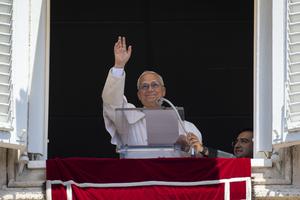
Pope Benedict XVI today addressed the question of religious education and the formation in the faith of the next generation of Catholics in the United States, underlining that authentic education is not simply about "passing on knowledge, essential as this is, but also [about] shaping hearts."
Students, he argued, "need to be encouraged to articulate a vision of the harmony of faith and reason capable of guiding a life-long pursuit of knowledge and virtue." Faith by its very nature, he said, "demands a constant and all-embracing conversion to the fullness of truth revealed in Christ."
The Holy Father also warned against dissent from the Church's Pastoral leadership among some Catholic representatives, noting "the confusion" it creates. "Such discord harms the Church’s witness and, as experience has shown, can easily be exploited to compromise her authority and her freedom," he said.
The Pope was addressing bishops from the 14th Region on their ad limina visit to the Vatican, headed by Archbishop Wilton Gregory of Atlanta.
From the Vatican Information Service
THE CATHOLIC IDENTITY OF EDUCATIONAL INSTITUTIONS
Vatican City, 5 May 2012 (VIS) - The question of religious education and the formation in the faith of the next generation of Catholics in the United States was the theme of the Holy Father's remarks to prelates from the United States Conference of Catholic Bishops (Regions X-XIII), who have just completed their five-yearly "ad limina" visit:
Speaking to the group in English, the Pope began by acknowledging "the great progress that has been made in recent years in improving catechesis, reviewing texts and bringing them into conformity with the Catechism of the Catholic Church". He also praised efforts underway "to preserve the great patrimony of America’s Catholic elementary and high schools, which have been deeply affected by changing demographics and increased costs, while at the same time ensuring that the education they provide remains within the reach of all families, whatever their financial status".
"On the level of higher education, many of you have pointed to a growing recognition on the part of Catholic colleges and universities of the need to reaffirm their distinctive identity in fidelity to their founding ideals and the Church’s mission in service of the Gospel. Yet much remains to be done, especially in such basic areas as compliance with the mandate laid down in Canon 812 for those who teach theological disciplines. The importance of this canonical norm as a tangible expression of ecclesial communion and solidarity in the Church’s educational apostolate becomes all the more evident when we consider the confusion created by instances of apparent dissidence between some representatives of Catholic institutions and the Church’s pastoral leadership: such discord harms the Church’s witness and, as experience has shown, can easily be exploited to compromise her authority and her freedom.
"It is no exaggeration", the Pope added, "to say that providing young people with a sound education in the faith represents the most urgent internal challenge facing the Catholic community in your country".
"First, as we know, the essential task of authentic education ... is not simply that of passing on knowledge, essential as this is, but also of shaping hearts. There is a constant need to balance intellectual rigour in communicating ... the richness of the Church’s faith with forming the young in the love of God, the praxis of the Christian moral and sacramental life and, not least, the cultivation of personal and liturgical prayer".
The Holy Father went on to explain that "the question of Catholic identity, not least at the university level, entails much more than the teaching of religion or the mere presence of a chaplaincy on campus. All too often, it seems, Catholic schools and colleges have failed to challenge students to reappropriate their faith as part of the exciting intellectual discoveries which mark the experience of higher education. The fact that so many new students find themselves dissociated from the family, school and community support systems that previously facilitated the transmission of the faith should continually spur Catholic institutions of learning to create new and effective networks of support.
"In every aspect of their education, students need to be encouraged to articulate a vision of the harmony of faith and reason capable of guiding a life-long pursuit of knowledge and virtue. ... In effect, faith by its very nature demands a constant and all-embracing conversion to the fullness of truth revealed in Christ. ... The Christian commitment to learning, which gave birth to the medieval universities, was based upon this conviction that the one God, as the source of all truth and goodness, is likewise the source of the intellect’s passionate desire to know and the will’s yearning for fulfilment in love.
"Only in this light can we appreciate the distinctive contribution of Catholic education, which engages in a “diakonia of truth” inspired by an intellectual charity which knows that leading others to the truth is ultimately an act of love. Faith’s recognition of the essential unity of all knowledge provides a bulwark against the alienation and fragmentation which occurs when the use of reason is detached from the pursuit of truth and virtue; in this sense, Catholic institutions have a specific role to play in helping to overcome the crisis of universities today".


Comments
Post a Comment
This Pope is a true intellectual giant. He understands that the West is in grave danger, that we are in dire need of authentic voices of truth, and that our institutions of higher learning - even most “Catholic” ones - have been coopted by the moral relativists.
There are some very good Catholic universities in the United States. We should send our kids to those schools instead of the “academically elite” name brands. It’s easy to identify the ones we should acknowledge and support - just figure out whether they are adherents of the Land O Lakes Statement or if, on the other hand, they are truly attempting to comply with Ex Corde Ecclesiae.
There are two very different concepts of what a Catholic university should be. Unfortunately, most Catholic high school students applying to college, and their parents, have no idea what dens of dissent and open rebellion against the Church many of our formerly great Catholic universities have become, all in the name of “academic freedom” and “independence.”
The Land O Lakes Statement was issued in 1967, signed by a group of Catholic educators led by University of Notre Dame president Fr. Theodore Hesburgh, CSC, had as its purpose defining the relationship between the modern American university and the Church, and between the Catholic university and American intellectual life. Characterized by historian Philip Gleason as a “declaration of independence from the hierarchy,” the statement provoked a decades-long debate over the character of American Catholic higher education. For supporters, “The Idea of the Catholic University” was a long overdue statement of Catholic educators’ agreement with the tenets of American academia, such as academic freedom, and their willingness to contribute fully to the nation’s intellectual life. For critics, the manifesto dangerously divorced the Catholic university from the life of faith and set in motion a deplorable decline in the Catholic identity of American institutions of higher education.
Ex Corde Ecclesiae was issued by Pope John Paul II in 1990. Its aim was to define and refine the Catholicism of Catholic institutions of higher education. The document cites canon 810 of the Code of Canon Law which instructs Catholic educational facilities to respect norms established by local bishops. Ex Corde underscores the authority of the bishops and mentions that canon law (canon 812)requires all teachers of theology in Catholic colleges and universities to have the mandate of the local ecclesiastical authority (normally the local bishop). Ex Corde Ecclesiae was viewed as a rebuttal to the Land O’Lakes Statement.
Many American Catholic universities have fought Ex Corde Ecclesiae tooth and nail, and very few of them are in compliance with it. Because of their power, wealth, influence, and stubborn insistance that they can in fact be “Catholic” with out truly being so, they have been able to give lip-service to Ex Corde Ecclesiae while remaining out of complianc now for over 20 years.
Elite American academia, including much of Catholic academia, is morally and intellectually bankrupt. Truly Catholic universities have a chance to play a vital role in battling the dictatorship of relativism and the culture of death, and to stand as bulwarks agains the radical secularization of society. I firmly believe that it is time to draw some clear lines. Unfortunately, I fear that is unlikely to happen.
Very good post by Don. I’m sure there are many “Catholic” universities that need to be examined but Notre Dame, being the most well known, has to be the main focus of attention. How much it could truly accomplish if it were truly Catholic. Just take a walk through the campus and it will be apparent soon that it is Catholic in name only.
i appreciate all the informartion. our Lord the King of the universe is in charge. Aleluya!!!
A MUST READ
You’d have to live on planet Mars all your life to be unaware that Georgetown University has been in schism for a very long time, while Ave Maria University is not. I think the parents that enroll their kids in schismatic universities know exactly what they’re doing, and they don’t care. It’s all about prestige; they don’t give a hoot about true Catholic faith. The parents left the church a long time ago.
Why doesn’t the Pope pick up the phone, call Georgetown and tell them to disinvite Sebellius? We are a library. That’s not working. That’s not normal. We celebrate good writing with no action. We need Popes to administrate 8 hours a day. Canon law doesn’t describe the Pope as a writer of warnings but as a ruler:
Canon 331. By virtue of his office he possesses supreme, full, immediate, and universal ordinary power in the Church, which he is always able to exercise freely
Can. 333 §1. By virtue of his office, the Roman Pontiff not only possesses power over the universal Church but also obtains the primacy of ordinary power over all particular churches and groups of them…
In addition, Jesuits take a special oath of loyalty to the Pope.
That Hat Lady- you need to understand that Georgetown is a top rate university with a reputation that means something. Ave Maria is a joke.
What makes you think she doesn’t understand the relative reputations of these schools? And really, even if she doesn’t understand, how does that change anything?
Good post S. The popes since Vat II have become sheep rather than the shepherd. Vat II was the ruination of the church. As you stated, according to canon law, the pope has the power. He doesn’t need the approval of the college of cardinals. Like the rest of society, the inmates run the asylum.
rick, yes, in the secular world, Georgetown is rated a top university. Georgetown IS the joke when it calls itself a Catholic university. Catholic in what sense? Ave Maria teaches the doctrines of the church as they were written.
Rick - Yes, Georgetown has a stellar “academic reputation” according to the pundits who rank schools. And no doubt they are able to attract top students both because of ther name-recognition and academic reputation. But there are plenty of supposedly “elite” schools with great academic reputations. That doesn’t necessarily make Georgetown a good option for people who want a truly Catholic education. In fact, perhaps that is precisely the problem with Georgetown - it has sacrificed its Catholic identity and purpose in order to gain favor among the academic academic elite who assign such “reputations” to universities. As I have said before, it is interesting that Georgetown is more widely known for its Islamic Studies program funded by Saudi shieks (in which they offer both a major and a Phd) than for its Catholic Studies program (in which they only offer a minor).
As Americans, we love that narrative of dissent and what we think it says about us and our love of liberty. Which is all the more reason why we should question that narrative: what makes any of us think that dissent is an infallible authority? And since when does “questioning authority” not involve questioning in turn those who dissent and those who hate the Church? The fact of the matter is that if the Church is indeed who she claims to be, not due to the efforts of her all-too-human members, but because of Christ Himself, then the Church loves questions and her authority welcomes them, because she can withstand that scrutiny. The demands of dissenters cannot, and they’re the usual, same old boring deal which conforms suspiciously to secular humanism and all of its narrow-minded sophistry (how’s that for conformity, eh? The more interesting question is not conformity or non-conformity, but to what or whom we conform). To be blunt, it is indeed to settle for less. All truth is God’s truth, and to be authentically Catholic is to think with the Church, trusting that the Church thinks with the Cross of Christ. It is therefore to think outside of the box. Furthermore, Catholicism sees no divide between faith and reason, and in fact doesn’t just see both as a merely “nice idea,” but insistently demands both. Am I saying that secular humanists are not welcome on a Catholic campus? No. But what I am saying is that secular humanism and its own cherished orthodoxies deserves to be challenged head on and without flinching. And authentic Catholicism is up to the task.
Post a Comment
By submitting this form, you give The National Catholic Register permission to publish this comment. Comments will be published at our discretion, and may be edited for clarity and length. For best formatting, please limit your response to one paragraph and don't hit "enter" to force line breaks.