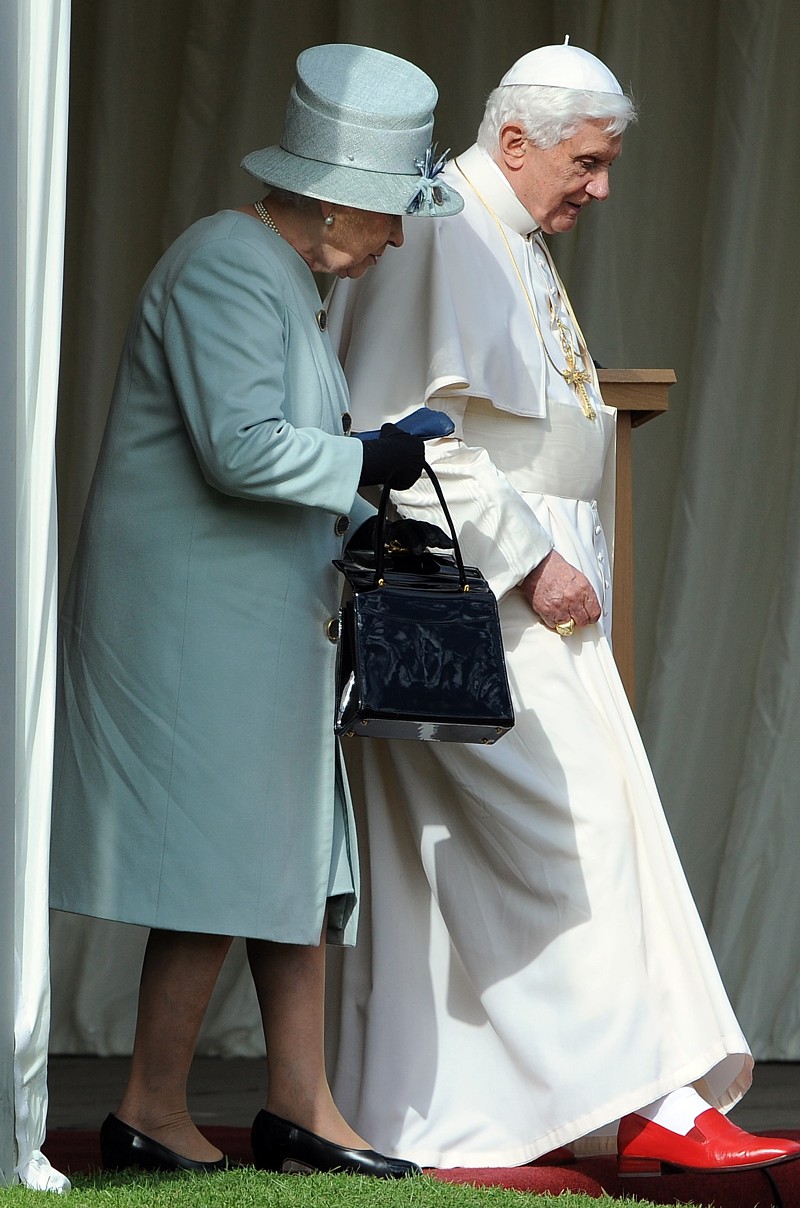
A week after Pope Benedict XVI’s visit to Scotland and England and its historical significance is still reverberating.
The first state visit by a Pope to Britain was remarkable in many different ways, not least because of the graciousness and generosity shown by Queen Elizabeth II.
Here was a Pope coming to the United Kingdom at the invitation of Her Majesty, the supreme governor of a church that violently split from Rome 500 years ago. Yet she gave him free rein to address her subjects as he saw fit – even beatify one who left her church to come over to Rome.
For the first time, a ruling English monarch allowed the Successor of Peter to address her Parliament, attend a liturgy in the church of her Coronation, and even to pray with her archbishop at the tomb of the Royal Family’s patron saint. Her government also hosted unprecedented formal bilateral talks with Holy See officials.
It was a kind of surrender, a giving up of the Reformation and all it had stood for in terms of rebellion against the papacy. But this shouldn’t be seen as a defeat for the Crown; rather the opposite. It was as if the Queen had finally come to the realization that Rome was right after all, that the Catholic Church offers something which her subjects need – even “thirst for” in the words of Benedict – and which her own church and state leaders have been failing to provide.
It was a remarkable turn of events and a highly significant moment in British history. Were they alive today, the Queen’s Tudor predecessors would have been flabbergasted and probably summoned her executioner. More, Fisher and Campion, on the other hand, would be rejoicing.
True, Catholic-Anglican relations have been amicable for 50 years since the two first opened an official dialogue. John Paul II also visited Elizabeth II in 1982, and the Queen has made two state visits to the Vatican.
But those were times when the Anglican Communion was stronger and looked as if it would last as a united body. The encounters were between two distinct Christian entities, united in common Baptism, and which in some ways complimented the other.
Today that’s no longer quite the case. Some say that Anglicanism has run its course. The advent of the new Ordinariates and their expected long term popularity is a consequence of its decline (though leaving behind a distinct patrimony that still has much to offer the universal Church). Benedict XVI called the new structure for receiving large numbers of Anglicans into the Church a “prophetic gesture” during the visit, one that will restore “full ecclesial communion.”
A corner has therefore surely been turned and a new chapter of Christianity in Britain, and possibly globally, may be beginning.
Elizabeth I was the English sovereign who gave momentum to the English Reformation (what Chesterton called the “shipwreck of Christendom”) that would last half a millennium.
Elizabeth II may well go down in history as the monarch who – with the help of a Pope passionate about Christian unity – didn’t quite end it but has courageously helped draw it to a close.


Comments
Post a Comment
Balderdash. Rubbish. The Queen’s son could marry a divorcee, HRH Camilla, Duchess of Rothsay, but could not have married a Catholic lass from Ireland. The Reformation is not over in England, nor is a reformation of the Roman Catholic Church totally ill-advised.
After over 400 years our family was anglican. Since 1913 we came back to Catholic Church.- We have again our Mother Mary, and all the Sacraments.-
The old arguments for the split have disappeared.- We have to be all toghether again.- We pray for that.- In God we trust…
The leaders of the Anglican Communion—scholars that they are—know that Christ willed that His Church be one. It is for them to choose between His will and 500 year old realpolitik.
You are way too optomistic. For the Pope to pray at an Anglican Vespers service with the Archbishop of Canturbury was not a victory for Catholicism, but rather a capitulation to Protestantism. Any true Roman Catholic ponyiff would never attend a Protestant service. Such a thing was anathema for every Pope up until 1960, when John XXIII recieved the then Archbishop Fisher of Canturbury to the Vatican as if he were a brother. An act which appalled all in the Vatican Curia. And rightly so.
No, most faithful Catholics can see no movement towards Rome and the True Catholic Faith. Rather, it was a capitulation to Protestantism by participating in their worship services.
I’m afraid this is - to put it mildly - wishful thinking. The Queen is a constitutional monarch and invites whomever the UK Government of the day tells her (we know that there were several invitations from, inter alia, Tony Blair and, latterly, Gordon Brown before the Vatican indicated it would accept an invitation). She entertained China’s Hu Jintao a few years ago, but she’s showed no signs of embracing communism yet.
Yes, there were historic moments, including the service in the Abbey with the Archbishop of Canterbury and the address to Parliament. I have a lot of time for Rowan Williams, and it was obvious there is genuine personal affection between the Holy Father and the Archbishop. I think theologically there are now relatively few differences between the Church and many Anglicans (although still some important ones); but there are widening gaps eg women priests and bishops and the result is that the likelihood of reconciliation between the Church and the Anglican communion is far less now than it was 10 years ago.
PS - Remember Bonnie Prince Charlie ....the Tudor kings and queens were not the ancestors of QE2.
No probably not - but it did have an impact on Mr. Allen’s reputation - in a negative sense. Maybe you should assign him the legionnaires case, he may be less biased.
Mr. Pentin, whatever the naysayers may say, I think you are very astute. Unprecedented graces were being poured out on English Christians during the Holy Father’s visit, and some of the leading non-Catholic figures seem to have been aware of this. HOWEVER, grace goes to waste unless one’s will cooperates with it, and that is the wild card here. Whatever the Queen or PM or Archbishop of Canterbury may do as a result is yet to be seen, but what really matters is whether the Catholic bishops of the United Kingdom will finally take up the prophet’s mantle and take up the task that the Holy Father has set before them.
There is cause for cautious optimism that the visit heralds, perhaps not the end of the Reformation, but the beginning of the end. There is much common ground between Her Majesty and the Holy Father: they are of an age, their formative years were significantly affected by their experience of war, and they have lived to see the place of religion in society change almost out of recognition; the latter is a fact that clearly concerns both of them deeply. In her address at Holyrood, the Queen acknowledged the important contribution of the Catholic Church to the life of the nation, before describing religion as “a crucial element in national identity and historical self-consciousness”; this provided a helpful context for the Holy Father’s reference to “the Christian message [which] has been an integral part of the language, thought and culture of the peoples of these islands for more than a thousand years”; this in turn contextualised his remarks about “atheist extremism” and the consequences of state-enforced godlessness which so enraged the secularists, but which the Queen’s and the Pope’s generation remember only too well. That this struck a chord with the majority of their hearers was evidenced by the warmth of the reception by Catholics and non-Catholics throughout the visit.
End of Reformation? Nay, it’s us joining them their Anglicans!
Where ever the Pope visits seeds of grace are planted. Amazing things happen, all in God’s time. Perhaps, what JPII accomplished with the communists, Benedict XVI will accomplish with the Anglicans. Rest easy, BXVI has no intention of leading in any direction but toward Christ’s true church.
“Strive to live content in the midst of those things that cause your discontent. Free your mind from all that troubles you, God will take care of things. You will be unable to make haste in this [choice] without, so to speak, grieving the heart of God, because he sees that you do not honor him sufficiently with holy trust. Trust in him; I beg you, and you will have the fulfillment of what your heart desires” (St. Vincent de Paul, Letters).
God bless the U.K. especially the bishops who must now carry the mantle of Pope Benedict to their flocks.
Seriously guys. Jesus came to save the lost, not the perfect. Do you expect his vicar not to go try get his lost sheep?
England is most truly England when she is Catholic.
This was a Big visit. Historically, and pastorally, speaking. One for the books for sure. For our venerable and saintly Pontiff, who thinks in centuries, this was nothing short of a Triumph. Not only did he close the book (or at least show the door) to the Reformation, he outlined a syllabus of errors for the new secular reformation. This visit, in the words of PM Cameron, will hopefully, make Britain, and the entire anglosphere, sit up and think.
Another commenter above stated, ” . . .the Tudor kings and queens were not the ancestors of QE2.”
Henry Tudor, earl of Richmond (1455 - 1509), who acceded to the throne of England as King Henry VII, became the father of Margaret Tudor (1489 - 1541), Queen of King James IV of Scotland. Her grandson, James Stuart, reigned as King of Scotland as King James VI and of England as King James I. All subsequent British monarchs have been descended from King Henry VII Tudor through King James I.
Mr Pentin, Your article appreciates the victories of the papal visit in Britain. This is not optimism, certainly, but gratitude. Catholics who cannot learn to appreciate some of the smaller victories (albeit monumental, in an age like to-day) speak like those young followers of Christ who would call fire down from heaven rather than embrace the spirit of John’s epistle, which calls all to love.
Pope Benedict’s visit to the UK was the work of the Holy Spirit, most of which we cannot see or fathom. Mr. Raymond DeSouza, author of the book, King Henry VII, Defender of the Faith, sent a copy of his book to Queen Elizabeth last year. She was grateful for the gift. In his book, he tells of the King’s defense of the Church and the seven Sacraments, before his corruption, of course. He was given the title, “Defender of the Faith” by the pope himself. Now Mr. DeSouza has embarked on a spiritual mission called “The Walsingham Project”, which involves work and prayer, especially to Our Lady of Walsingham, for the reconversion of England to the catholic faith. www.WalsinghamProject.com www.RaymondDeSouza.com
The fall of Jerusalem in 70AD saw the net result of Isreal’s obstinacy in sin. But before it fell, says Eusabius, all of those responding to the Good News, Providentially made it out of the city before the seige.
This is how I see the state of affairs in the UK. Those who respond to this good news from our Pope in the form of Ordinariate for Anglicans or simple amendment of life for Catholics, will somehow be offered hope of an escape from the impeding doom awaiting those intransigent in their sin, who will suffer the fate prophesied by Our Lady of Fatima: <em>nations will be anihilated, but finally My Immaculate Heart will triumph<em>
Joseph D’Hippolito said: “What good is it if England becomes Catholic when the Catholic Church itself is corrupt?”
The Catholic Church will always have scandal due to the sins of man. However, the Church’s teachings remains infallible due to the guidance of the Holy Spirit.
Whats wrong with catholics coming together with protestants, after all we all belive in the bible, we all wait for the messiah to come, we are not all the same. WHen you see crime christains always try to repent and ask for forgivness to God. The only gap remains is the right teaching and interpreting the word of God.
The report presents an optimistic view but did not address the real problem of the split within Anglicanism in the UK and its worldwide communion into “High” and “Low” churches. The Queen herself openly prefers the more Protestant “low” church while the current Archbishop of Canterbury has a quiet preference for “High” church Liturgy. The issue is whether the Low Church is growing well and draws further from its Catholic origins into a more Calvinist, Presbyterian or Evangelical form of Christianity.
Post a Comment
By submitting this form, you give The National Catholic Register permission to publish this comment. Comments will be published at our discretion, and may be edited for clarity and length. For best formatting, please limit your response to one paragraph and don't hit "enter" to force line breaks.