Trust in God in Times of Trial
Register Summary
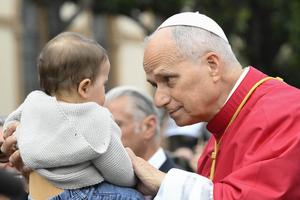
Pope John Paul II continued his teaching on Psalm 27 during his April 28 general audience with 15,000 people in St. Peter's Square. He had offered his reflections on the first part of the psalm, which he characterized as a “diptych,” during his general audience the week before.
The second part of Psalm 27, the Holy Father said, speaks of confidence in God in times of trial and tribulation. Psalm 27 depicts “a dramatic scene in which those who are closest to the psalmist and most dear to him forsake him, while his ‘enemies,’ ‘foes’ and ‘lying witnesses' close in upon him.” Despite the presence of evil in the world, the psalmist remains steadfast in hope: “Even if my father and my mother forsake me, the Lord will take me in.”
“Even in his loneliness and amid the loss of his loved ones, the psalmist is never totally alone because God, the merciful one, is watching over him,” the Pope noted. This confidence in the Lord, John Paul said, should inspire and console all who feel abandoned and alone because God has become visible to us in Christ.
“Christ has revealed God's face in a way that is accessible to us,” he said, “and he has promised that in that final encounter of eternity — as St. John reminds us — ‘we shall see him as he is.’” This encounter with the Lord, the Holy Father said, takes place especially in the liturgy and in personal prayer.
In the evening prayer of the Liturgy of the Hours, Psalm 27 is divided into two parts, which correspond to the diptych-like structure of the psalm. We have just heard the second part of this song of trust, which the psalmist raises up to the Lord on a gloomy day when he is under attack by evil. It consists of verses 7-14 of the psalm. These verses begin with a cry to the Lord: “Have mercy on me and answer me” (verse 7). Then they portray an intense search for the Lord amid an anguish and fear that the Lord has abandoned him (see verses 8-9). Finally, they depict before our very eyes a dramatic scene in which those who are closest to the psalmist and most dear to him forsake him (see verse 10), while his “enemies” (see verse 11), “foes” and “lying witnesses” (see verse 12) close in upon him.
Our Strength and Hope
But even now, as in the first part of the psalm, the decisive element is the psalmist's faith in the Lord, who saves him in the midst of trials and sustains him during storms. In this regard, the plea the psalmist addresses to himself in the final verse of the psalm is particularly beautiful: “Wait for the Lord, take courage; be stouthearted, wait for the Lord!” (verse 14; see Psalm 42:6, 12 and Psalm 43:5).
This certainty that the Lord is the source of strength and hope is also made very clear in other psalms: “The Lord protects the loyal but repays the arrogant in full. Be strong and take heart, all you who hope in the Lord” (Psalm 31:24-25). The prophet Hosea exhorted Israel in the same way: “You shall return by the help of your God, if you remain loyal and do right and always hope in your God” (Hosea 12:7).
For the moment, we will limit ourselves to highlighting three symbolic elements that have a deep spiritual intensity. The first element is a negative element — the nightmare of the psalmist's enemies (Psalm 27:12). They are characterized as wild beasts that roar at their prey and then, more directly, as “lying witnesses” who seem to breathe violence from their nostrils, just like wild beasts before their victims. There is, therefore, an aggressive evil in the world that Satan guides and inspires. As St. Peter reminds us, “Your opponent the devil is prowling around like a roaring lion looking for someone to devour” (1 Peter 5:8).
God's Compassion and Love
The second image clearly illustrates this faithful man's peaceful trust, even if his parents have abandoned him: “Even if my father and my mother forsake me, the Lord will take me in” (Psalm 27:10).
Even in his loneliness and amid the loss of his loved ones, the psalm-ist is never totally alone because God, the merciful one, is watching over him. This is reminiscent of that famous passage from the prophet Isaiah, who attributes to God feelings of compassion and tenderness that are more than maternal: “Can a woman forget her infant, be without tenderness for the child of her womb? Even should she forget, I will never forget you” (Isaiah 49:15).
Let us remind everybody — the elderly, the sick, those who feel like everybody has forgotten them and those to whom no one will ever show any tenderness — of the psalmist's and prophet's words, so they will feel the Lord's paternal and maternal hand silently and lovingly touch their suffering and perhaps tear-stained faces.
Seek God's Face
Thus we come to the third and final symbol, which the psalm reiterates several times: “‘Seek God's face’ your face, Lord, do I seek! Do not hide your face from me” (verses 8-9). The object of the psalmist's spiritual quest is God's face. In the end, an indisputable certainty emerges — the certainty of being able to “enjoy the Lord's goodness” (verse 13).
In the psalms, “seeking the Lord's face” is often synonymous with entering the Temple to celebrate and experience communion with the God of Zion. But this expression also encompasses the mystical need of intimacy with God through prayer. Both in the liturgy and in personal prayer we are given, therefore, the grace to perceive the face we will never be able to see directly during our life here on earth (see Exodus 33:20). However, Christ has revealed God's face in a way that is accessible to us, and he has promised that in that final encounter of eternity — as St. John reminds us — “we shall see him as he is” (1 John 3:2). As St. Paul adds, “Then we will see face to face” (1 Corinthians 13:12).
Commenting on this psalm, Origen, the great Christian writer of the third century, noted: “If a man seeks the Lord's face, he will see the glory of the Lord in an unveiled way and, having become equal to the angels, he will always see the face of the Father, who is in heaven” (PG 12, 1281). St. Augustine, in his commentary on the psalms, continues the psalmist's prayer in the following words: “I have not sought from you some reward that is outside of you but your face. ‘Your face, Lord, will I seek.’ I will pursue this search with perseverance. In fact, I will not seek anything of little worth; rather, I will seek only your face, O Lord, so I may love you freely since I find nothing more precious … ‘Do not turn angrily away from your servant’ so that, while seeking you, I will not stumble across something else. What sorrow would be greater than this for the one who loves and seeks the truth of your face?” (Esposizioni sui Salmi, 26, 1, 8-9, Rome, 1967, p. 355, 357).
(Register translation)
- Keywords:
- May 9-15, 2004