Media Watch
Vatican Revises Galileo Myth
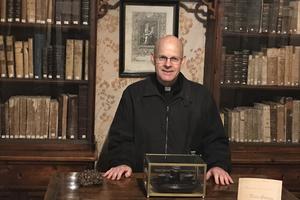
Archbishop Angelo Amato, secretary of the Congregation for the Doctrine of the Faith, has released the text of a letter recently discovered in Vatican archives that conveyed Pope Urban VIII's concern for Galileo's health and asked that his trial be speeded up for that reason.
Archbishop Amato noted other pieces of evidence that the Church treated Galileo with respect and courtesy — according him a servant and the best rooms, and even allowing him to stay with the Florentine ambassador before his trial.
While Churchmen were troubled by his theories and their apparent variance with Scripture, Archbishop Amato said, they were also intensely curious about his discoveries.
“He even had great success among the Roman cardinals,” he said. “They all wanted to see the sky through his famous telescope.”
Scouting Brings Youths to God
“Where everything speaks of the Creator and his wisdom, from the majestic mountains to the enchanting, flower-strewn valleys, may you learn to contemplate God's beauty and may your souls, as it were, ‘breathe,'” the Pope wrote.
John Paul urged the youth to deepen their faith and infuse it into their love of nature. He reminded them that as Christian scouts they were “motivated not by some vague ‘ecological feeling' but by the sense of responsibility that derives from faith. The protection of creation, in fact, is a distinctive feature of Christian commitment in the world.”
Pope Pius XII Savaged Hitler
The papers recount how, in April 1938, Kennedy met with Vatican Secretary of State Cardinal Eugenio Pacelli, the future Pius XII. The cardinal presented Kennedy with a report denouncing Nazism, in part because it attacked “the fundamental principle of the freedom of the practice of religion.” Cardinal Pacelli told the ambassador that any political compromise with the Nazis was “out of the question.”
The America article also cited a 1939 report by the U.S. consul general in Berlin, Alfred Klieforth — who said Cardinal Pacelli “regarded Hitler not only as an untrustworthy scoundrel but as a fundamentally wicked person.”
As a longtime diplomat, America suggested, Cardinal Pacelli apparently felt much more free to express his opinions in private than in public.
- Keywords:
- September 7-13, 2003