Up With Marriage
There’s more to St. Valentine’s than dimpled cupids aiming arrows. There’s the real deal on love — World Marriage Day, celebrated the second Sunday of February.
Romance is in the air at that time, says Sandra Waguespack of Baton Rouge, La. “People are thinking about love,” she adds, “and this celebrates a positive kind of love.”
She and husband Larry founded World Marriage Day in 1981, hoping to promote the positive aspects of marriage. The celebration is an effort to honor married couples, recognize the sanctity of marriage and bring hope to those not so optimistic about the institution of marriage.
“We’re talking about the sacrament of matrimony,” notes Sandra. “That sacrament calls us to be a sign to others. In a way, this celebration is making that sacrament visible. It’s giving witness.”
World Marriage Day was the Waguespacks’ answer to the barrage of negative images the media too often present of marriage. The first celebration in Baton Rouge included billboards, street banners and proclamations from the governor and the bishop.
“That year, every talk show on TV called for interviews,” recalls Larry. “They wanted positive love stories for Valentine’s Day. We got a tremendous amount of publicity. Because we were involved with World Marriage Encounter, we shared with the national leadership what we were doing.”
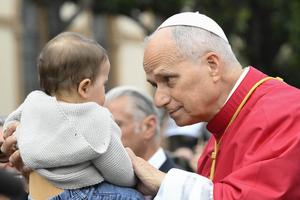
World Marriage Day ignited. The next year, 43 governors recognized the occasion with official proclamations. From there, it spread around the world, reaching 90 countries. In 1993, Pope John Paul II gave World Marriage Day his apostolic blessing.
“Back during the first Gulf War, we had chaplains emailing us for information; they wanted to have some sort of service, something positive for married soldiers who were missing their spouses,” Sandra recalls. “That really touched us. It made us cry.”
And the Waguepacks got a big surprise on a visit to the Holy Land when they spotted a World Marriage Day poster with their logo — “We Believe in Marriage”— in the church at Cana. Says Sandra: “We went, ‘Wow!’ We don’t know who put it there.”
With its theme of “Love One Another,” World Marriage Day has made a difference in the lives of Curtis and Lorraine Lauret — who’ve celebrated it in Louisiana, Maryland and now Simsbury, Conn.
Curtis considers the best part of the celebration the Mass at which parishes observe World Marriage Day. (Some churches may change the date this year because it falls on the first Sunday of Lent.) There’s usually a special homily, renewal of marriage vows and recognition for married couples. Some areas hold street parades; some parishes have dinner-dances.
“World Marriage Day is an affirmation of the sacrament of matrimony,” says Josephite Father Thomas Frank, “because, by tradition and natural law, the married couple is the foundation for family life.” This holds, he adds, despite the contemporary notion that there are many forms of families.
Rector of the order’s St. Joseph Seminary in Washington, D.C., Father Frank has been part of the national support staff for World Marriage Day and Worldwide Marriage Encounter.
“Because of our American culture, in which divorce is so rampant, young people need to know that there are couples who are living their sacramental life and can do it,” Father Frank says.
Curtis Lauret agrees. “The more you display the positive aspects of marriage, the more it’s got to have an impact,” he says.
Sandra Waguespack said a woman wrote last year to tell the couple about a teen-ager she observed during a World Marriage Day service. The girl was fussing; obviously, she wanted to be elsewhere — until the parish started recognizing the couples who’d been married 25 years and longer, and invited them to renew their wedding vows.
“The woman wrote about how this teen-ager’s demeanor changed as the girl witnessed what was going on,” says Sandra. “Then she wanted to be there. Tears were rolling down her cheeks. It affected this teen-ager and made a difference for her.”
It can do the same for others.
“World Marriage Day brings out hope,” Sandra says. “If a couple has a fight, the memories of seeing other couples married 40, 50, 60, 65 years — affirming marriage —gives them hope that a long, lasting marriage is possible. It gives them hope to say, ‘One day we’ll celebrate 50 years.’”
Dating for Life
Father Frank believes the World Marriage Day celebration is loaded with benefits. For one thing, he says, it lets couples witness to the joys of a healthy sexual relationship between a man and a woman. Such testimonies, he adds, contrast sharply with the superficial relationships celebrated by the popular culture.
Also, he notes, priests can encourage married couples to go out on “dates,” which can help them sustain and develop their relationship. “Couples find encouragement to move closer and closer together and to God,” he says.
And, Father Frank points out, World Marriage Day can give a couple the opportunity to address whatever toxic behaviors have been diminishing their “coupleness” — such as indulging in chronic criticism or ignoring the spousal relationship for “the sake of the children.”
Father Frank names one other benefit of which people might not be aware. “World Marriage Day is an affirmation for priests,” he says. “The commitment and dedication of married couples inspires us priests in our dedication to people.”
But the best part may be that, for many couples, recognizing World Marriage Day leads to fruitful participation in Marriage Encounter events and retreats aimed at married couples.
“World Marriage Day is not really one day,” agrees Sandra. “We should be celebrating our marriage and living it in a loving way 365 days a year.”
Joseph Pronechen writes
from
Trumbull, Connecticut.
INFORMATION
wmd.wwme.org
wwme.org
ematrimony.org