A Castle Befitting a Queen
If ever you're advised by a well-meaning Catholic traveler not to miss the cathedral in Baltimore, Md., make sure to ask: Which one?
For this mid-Atlantic melting pot boasts not one cathedral, but two.
Well, okay, let's be precise. Downtown, the first Catholic cathedral in the United States is now a basilica. It's undergoing major renovations. It successor as the bishop's seat is the Cathedral of Mary Our Queen, a mid-20th-century marvel on the city's outskirts.
When the missus and I were told about the latter's charms recently, we hurried to Maryland on pilgrimage. We discovered the splendid sanctuary honoring our queen on 25 serene, park-like acres in a neighborhood of large homes, quiet colleges and the St. Mary Seminary. We'll travel back in our hearts and minds come Aug. 22, feast of Mary's Queenship.
When we do, we'll recall the modern lines of the cathedral, which ought to stand as a grand model on how to design a contemporary Catholic church not for its time but for all times.
Approaching in our car, we spotted generous Gothic influences from the front to the back of the cathedral's 373-foot length. These noble elements appear in such places as softly pointed arches, the buttresses and a wealth of stained-glass windows. Drawing from the Middle Ages, the massive cathedral was built rock-solid. Not a sliver of structural steel mixes with the Indiana limestone walls and North Carolina granite foundation. The stones’ light pastel-grays practically glow in the sunlight.
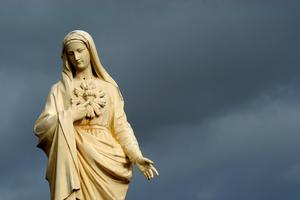
You could spend an hour meditating just on the outside, with all its liturgical art. For example, above the main doors, there's an eight-foot carving of Mary our Queen. Even bearing a scepter and globe, she's the model of humility. Above her, the Holy Spirit presides over angels crowning her.
Higher still, Christ the King stands in carved relief in front of a massive window and giant arch. Life-sized statues of the apostles form an honor guard around this arch.
Below Mary, carved panels reminded us of the Nativity and the Assumption, replete with joyous angels. The huge bronze center doors under them have detailed reliefs of 12 saints who were fervently dedicated to Mary, among them Joseph, Louis de Montfort and Catherine Laboure.
Stepping inside, we quickly grasped that the cathedral had taken a page from the Gothic masterpieces of old. Bas-relief carvings and stained-glass windows fill the interior like a compendium of the Bible, the liturgical calendar and the Catechism. It occurred to us that, yes, literacy is widespread in our day — but that doesn't mean we shouldn't study the faith in works of art like our forebears in antiquity.
In the narthex, the Latin and Greek doctors of the Church greeted us in carved reliefs. One of them, St. Athanasius, said, “If the son is a king, the mother who begot him is rightly and truly considered a queen and a sovereign.”
That was in the fourth century, long before this cathedral was consecrated on Oct. 13, 1959. It was in 1954, the year the groundbreaking took place, that Pius XII officially instituted the Aug. 22 feast of the Queenship.
Royal Resplendence
The nave is enormous and awe-inspiring. High in the choir gallery, a familiar statue of Christ the King reappears. On either side are the windows considered by many to comprise the finest collection of stained glass in the country. Nine firms — seven in the United States and two in France, including Chartres — crafted most with two basic themes: liturgy and saints.
As the 348 panels making up the windows progress up toward the sanctuary — all things lead to Christ, of course — they follow the main events of the Church's year from first Sunday of Advent to the end of November, and they follow the Bible from Genesis to the Acts of the Apostles. The colorful windows picture main events and biblical topics of each season, and include saints commemorated during those times. All the scenes and portraits on sparkling backgrounds of regal red and royal blue evoke a 20th-century sensibility.
We could have spent days meditating and marveling over each detail, then stayed another doing the same with the 46 carved-stone panels in the arches along these windows. They present briefly the story of Jesus and amplify the events of the Church year in the order they're celebrated.
These carved panels also commemorate area church milestones. In one transept, the panels of the Good Friday window form a modern masterpiece. Jesus is crucified in agony. Around and below Christ are images of the consecration at Mass, the Pieta, St. Joseph of Arimathea, the Good Thief. The opposite transept shows us Jesus scourged.
There are 13 Italian marble altars around the cathedral. We lingered at the one dedicated to St. Michael, and in the largest three chapels radiating off the aisles and gallery around the enormous sanctuary.
The Lady Chapel extends out like a small church itself. Because it's dedicated to the Assumption, the reredos centers on Mary's rising into heaven and adds key scenes in her life.
We were awestruck by the wondrous shades of blue — Mary's color — from light sapphire to deep ultra-marine in the stained-glass windows. The themes are the Immaculate Conception and the Assumption, with all kinds of Marian references appearing, like Jacob's Ladder, the Ark of the Covenant and the Baltimore council naming Mary patroness of the United States.
The Stations of the Cross are unique in this chapel. They're carved along like a frieze under the windows on both sides.
The Pope Prayed Here
The beautiful St. Joseph Chapel honors the modest saint in the altar and 40 stained-glass panels honor him as protector of the Holy Family and the patron and model of workers. It was easy to figure out how the tools surrounding St. Joseph in one scene represented Baltimore's workers and their jobs.
Off the gallery, we stopped at the quiet corner Shrine of the Immaculate Conception. Cardinal Karol Wojtyla prayed in it in September 1969. He revisited in October 1995 as Pope John Paul II and prayed in the stunning Blessed Sacrament Chapel with its many windows honoring the Sacred Heart, the Blessed Sacrament and Christ the Priest.
Although we didn't hear the great Moller pipe organ built down the road in Hagerstown — it's the largest in the state, with 7,231 pipes — we could well imagine its eloquent power playing the great Marian hymns to accompany the cathedral's hymn in stone and glass honoring Mary our Queen.
Joseph Pronechen writes from Trumbull, Connecticut.
- Keywords:
- August 22-28, 2004