Archbishop Offers Window Into the Visitation of Women Religious

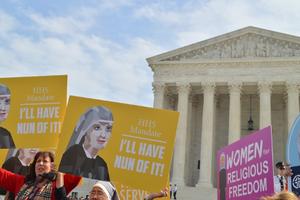
The apostolic visitation of U.S. women’s religious communities is close to completion. To obtain an early assessment of the study, Rome correspondent Edward Pentin spoke in mid-November with Archbishop Joseph Tobin, secretary of the Congregation for Institutes of Consecrated Life and Societies of Apostolic Life — the Vatican department charged with overseeing the process.
Archbishop Tobin, a former superior general of the Redemptorists and a native of Detroit, discussed the challenges of conducting such a major visitation, some of the controversies surrounding the study, and what he hopes it will achieve.
Your Excellency, could you tell us more about the apostolic visitation and what stage it has reached?
I think it’s important for your own reference that the new prefect [Archbishop João Bráz de Aviz] and I are newcomers to the visitation process. In other words, we got on a train that had already left the station.
It has been conceived in four stages, and it’s in the fourth and final stage; and that’s really the submission of the reports by the visitor, Mother Mary Clare Millea. Now, what she has done is prepare a sort of overarching report, as well as at the same time making a heroic effort to submit reports on around 420 religious congregations.
This dicastery will examine 420 single reports as well as the overarching report.
Do you have a date when it’ll be finished?
I know Mother hopes to have her reports written by the end of this calendar year. She’s also a superior general, wearing two hats, and doing a marvelous job of carrying forth a pretty difficult task: trying to meaningfully listen to 59,000 women. We don’t yet have a date when we’re going to make a statement.
Could you recap the visitation’s aims and objectives and how close they are to being achieved?
As I understand it, the overall objective was to examine the quality of life of American women religious in apostolic congregations, so the orders of contemplative life were excluded. Mother Mary Clare has made every effort to do this and has done it in a number of different ways.
In the first phase, she did it through personal contact with the superiors general; in the second phase, there was a questionnaire; and in the third phase, there was an actual on-site visitation by teams of almost all women religious.
Now, is it accurate from a sociological perspective? I would doubt that, just because the task was so gargantuan.
Has it given some indication of religious life in the United States? Yes, I’d say that’s true, including the quality of life, which was the stated objective of the visitation.
You said in a recent interview with Catholic News Service that mistakes had been made during the early stages. Could you tell us more about what you meant by that?
The question, in my mind, has been the size of the task. Now we — this dicastery — do visitations all the time, and they can be a very helpful instrument in discernment of the future of a religious group. To attempt to do this for 59,000 women was, at least in my mind, questionable. And it was assigned to one poor superior general like Mother Mary Claire, notwithstanding her gifts and skill at organization, which are really to be admired.
Then there’s the question how this was communicated. I think the initial communication of the visitation seemed to lend itself to a lot of misinterpretation.
Was part of the plan to help make these religious more faithful to the magisterium, more orthodox?
I don’t know. The instructions that I discovered, and when I talked with Mother Mary Claire, were that her task was to look at the quality of life.
What does that mean exactly?
It’s a very good question! It’s very broad. But I think it would be a mistake to see it simply as a question of orthodoxy. I would say in any ecclesial vocation we’re called to be faithful. When an ad limina visit takes place, there are potentially questions of orthodoxy. We’re talking about faithfulness to Our Lord and to the Church.
There are other issues beyond orthodoxy. One is the aging question and care for religious — the fact that women religious in the U.S. worked long hours in the vineyard, not always with equitable compensation, and so now they’re not able to care for their elderly sisters.
Some steps have been made concerning a special collection — I believe it’s the biggest in the United States — for religious orders and caring for the elderly. So these are some of the issues that can be seen under the rubric of quality of life.
Some have said the aims have been watered down on account of some religious superiors saying they’ve been unfairly accused. What is your response to that?
As far as I can tell, from the documents here, no one has accused anyone of anything. There was a concern for the recognition of the importance of religious life in the history of the United States and a desire that this particular vocation in the Church has a future.
As far as accusations of women superiors are concerned, I wouldn’t know how to address that. It may be part of the ambiguity of the visitation and its stated objectives.
One accusation I read is that some orders have dissented too greatly from the Church to be re-constituted. Have some religious orders or individuals gone too far?
Those are two different questions — some individuals or some orders. Again, I’ll be in a better place to answer that after I’ve read the report. I can refer to what I’ve read until now and also listening to the American bishops who’ve just begun their ad limina visits. ... So far, I’ve only read three or four regions’ [reports] that have arrived here.
I’ve not seen any indication of that: that religious life has gone too far. I think there is a genuine concern on the part of everyone about scarcity of vocations in religious life and whether it can continue. I don’t think it has led to individual or corporate dissent, at least from what I’ve read.
How confident are you that these institutes will attract vocations in the future?
I’m confident of this and refer also to what the Holy Father has said repeatedly and most recently. If you look at his statement to Brazilian bishops Nov. 5 last year, he talked about consecrated life as being a chosen course for the future, a chosen course given to God and a lifestyle that must be present in the Church because it was the lifestyle of Jesus, who was chaste, poor and obedient.
In that sense, I think religious life will continue, and hopefully continue in the U.S., as a gift to the Church. Now, if any religious order can confidently say, ‘We always will be here’ — no; that’s the will of God. It wasn’t an idea of ours, but a gift from God, a charism of the Holy Spirit. What our job is is to live faithfully that gift that’s been given.
I think it’s important, too, to look at what religious have no control over. One would be part of the ethos of a society. For example, the same things that threaten marriage as a vocation threaten religious life: the possibility of living a faithful response for the rest of your life.
Another thing common in the West is the diminishing number of young people. We live in a country here [in Italy] that has the lowest birth rate — some would say in human history — right now. So, in larger families, it’s possible for a young person probably to enter religious life with less grief from their parents. That’s not to excuse any mistakes we might make as religious; it’s simply to put it into a wider context.
Do you think some of the novelties of the last 50 years — for example sisters living not in a convent but in the world, sometimes even on their own, and not wearing the habit — are problems that have helped foster this crisis in some women’s religious communities?
On the question of some living in the world, in the 17th century that became a positive influence for religious life, when women’s apostolic congregations really began, with the inspiration from people like St. Vincent de Paul, St. Jane Frances de Chantal. Women began to not wear the monastic habit, but live in the world as a sort of leaven.
I think we need to look at the path we’ve taken after the [Second Vatican] Council and to recognize where we were wrong. I can speak most eloquently about my own order, the Redemptorists. We look at the things that we’ve done very well for the last 50 years and some things that we’re rethinking now, too.
Despite these problems, and in spite of the broad nature of this visitation, do you still think some very positive developments will come from it?
I think some good things have happened already. Firstly, the American Church as a Church — because there’s been so much publicity around this visitation — has asked itself: What has women’s religious life meant to the Church? What has it meant, and what does it mean today?
That’s a good thing, because women religious are a vocation in the Church. We’re not some sort of exotic lifestyle that lives somewhere else. No, we’re part of the Church, part of the community of the baptized. And part of the responsibility for promoting vocations is the Church’s responsibility, because it recognizes that this is a good expression of the Christian vocation.
Some of the ambiguous stuff in the early stages of the visitation got religious orders talking to each other. That has had some good points. And there’s been a fair amount of dialogue between this dicastery and religious houses in the United States.
It isn’t always easy, but it’s good because we’re searching for God’s call. I’m hoping that there will be even greater fruits of this: a renewed sense of the ecclesial nature of religious life — that [religious life] is a part of the Church and something about which the Church cares. I love my own vocation as a religious and thank God every day for it, and so people who want to live this way I really want to support and help.
Will there be similar apostolic visitations in Europe?
I don’t know if the dicastery would be keen to take on a whole country unless we’re talking about Gibraltar or something! We have, at any given time, a number of visitations going on, not because of problems, but to help fledgling institutes to grow strong wings, to take off, but nothing on this scale. As far as I can tell about the history of this congregation, there’s been nothing on this scale.
I think it’s worth noting religious are accustomed to visitations because that’s one instrument that the government of religious orders use. I was 18 years in our general government, and I’d say out of those 18 years nine of them — half of the time — was spent on the road, going to different provinces, having a look, a talk, discussing what we say we’re about with regards (to) our constitutions and how we live, which is sometimes a very humbling exercise.
So I’m hopeful — because one cannot be Christian without being hopeful. That doesn’t mean one doesn’t see problems. But if there are problems, we’ll address them. I’ll be able to tell your readers more in the months to come.
Edward Pentin is the Register’s Rome correspondent.

Edward Pentin Edward Pentin is the Register’s Senior Contributor and EWTN News Vatican Analyst. He began reporting on the Pope and the Vatican with Vatican Radio before moving on to become the Rome correspondent for EWTN's National Catholic Register. He has also reported on the Holy See and the Catholic Church for a number of other publications including Newsweek, Newsmax, Zenit, The Catholic Herald, and The Holy Land Review, a Franciscan publication specializing in the Church and the Middle East. Edward is the author of The Next Pope: The Leading Cardinal Candidates (Sophia Institute Press, 2020) and The Rigging of a Vatican Synod? An Investigation into Alleged Manipulation at the Extraordinary Synod on the Family (Ignatius Press, 2015). Follow him on Twitter at @edwardpentin.