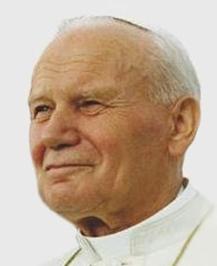
So various circles have been atwitter about news reports that Pope John Paul II practiced certain forms of self-mortification or, in the immortal words of the Associated Press, “John Paul II used belt to whip himself.”
It is not surprising that our pleasure-obsessed culture would find this unusual, nor is it surprising that latent anti-Catholic tendencies in the culture would cause people to read it in a negative light—as something shocking or repulsive.
So what can we say to those who have this kind of reaction?
Let’s start with what we can say to fellow Christians (Catholic or not) who find themselves thinking this way: While not every person is called to the kind of self-mortification that John Paul II practiced, self-mortification is part of the Judeo-Christian tradition with roots going all the way back to the Bible, both Old and New Testaments.
We read in the Old Testament, for example, of people fasting, wearing sackcloth (which abrades the skin; the Old Testament equivalent of a hairshirt), putting ashes on their heads, and lying tied-up in uncomfortable positions for long periods of time (Ezekiel 4:4-8).
In the New Testament we also read of such practices, and of particular note are Jesus’ own remarks about (and personal practice of) fasting. If Our Lord himself practiced fasting, then self-mortification could scarcely fail to find a place in Christian spirituality. Note also that in the Sermon on the Mount he doesn’t say “if” you fast but “when” you fast—implying an expectation of his followers.
Once we have recognized this, the issue of self-mortification becomes one of degree and occasion, for the fundamental principle has been established. If a particular Christian’s faith tradition (or personal view) hasn’t made room for self-mortification then he needs to conduct an open-minded re-examination of the issue.
He might be helped in that re-examination by what we can say to a non-believer, which goes beyond establishing that self-mortification is biblical and deals with the underlying principles.
The first thing to point out is that this isn’t masochism. It’s not the case of wanting the pain out of some sick craving. While there are masochists, anything they do along these lines is not a genuine spiritual exercise. The whole point of self-mortification is that you don’t find the pain attractive but are willing to submit to it anyway for a higher goal.
And the non-believer, unless he is a unthinking hedonist, should be able to acknowledge that it can be legitimate to endure pain for a higher goal (i.e., that there can be higher goals in life than just avoiding pain). For example, the pain that soldiers undergo to defend their country, the pain that parents undergo to help their children, and the pain that absolutely all of us must shoulder in order to achieve important goals.
So what goal was John Paul II, and other practitioners of self-mortification, striving for?
Holiness.
Specifically, virtues like humility, compassion, self-control, the ability to say no to your body in the pursuit of a spiritual goal.
A close analogy is the athletic saying, “No pain, no gain.” In order to get your body in shape, you must be willing to endure some hardship, and the same is true of your soul (or your personality if the person doesn’t believe in souls).
Self-mortification teaches humility by making us recognize that there are things more important than our own pleasure. It teaches compassion by giving us a window into the sufferings of others—who don’t have a choice in whether they’re suffering. And it strengthens self-control.
As well as (here’s the big one I’ve saved for last) encouraging us to follow the example of Our Lord, who made the central act of the Christian religion one of self-denial and (in his case) literal mortification to bring salvation to all mankind.
Even if a non-believer doesn’t buy the religious premises involved, he should be able to see the nobility of the principle of shouldering hardship for the sake of others and for the sake of learning virtues like humility and compassion rather than focusing exclusively on one’s own pleasure.
Hopefully he can see why a pope, as the vicar of Christ and as the leader of the Christian world, would be called to personal mortification in a way that goes beyond what most people are.
NOTE: Any form of significant self-mortification must be done under the guidance of a competent spiritual director. Do not try this at home on your own.

Comments
Post a Comment
Jimmy this phenomenon of the modern mind equating masochism with mortification through a kind of philosophical binary decimation is one I’d like to see you examine more closely! As always, thanks for an intellectual—and impeccably Catholic - treat of a read.
Jimmy:
You didn’t mention the traditional very Catholic practice of “offering it up.”
I’m reminded of the “pain” with which most goals in secular life are realized. We are not repulsed by a mom becoming totally exhausted while taking care of a sick child, or a businessperson missing two meals in a row while traveling to an important meeting, a person accepting the physical back pain that accompanies a weekend camp-out with the scouts or hours of shivering cold spent on a frigid January day, marching for LIFE in DC. Are not spiritual goals more compelling?
Insight into this topic can be found in the book Faith for Today, a collection of John Paul II’s catechetical teachings. His comments on ‘Priest, Prophet and King’ were a new awareness for me. My default understanding of ‘king’ was power over others. On pg. 101, he identifies the kingly office as that of self control; the source of the Lord’s bodily self-discipline.
So what you are saying, is that a mother or father, who works hard for her family and gets exhausted, that is self mortification. Fasting does not starve your body or harm it. Unless you stop eating altogether and you get sick or die, which is suicide & a sin. Sounds like you are saying the Pope leads a life of luxury, everyone ‘doing for him’, so in order not to feel above his ‘people’ he has to whip himself into mortification?—-in order to have compassion for the people? Does not make sense to me. I always thought it was a sin to harm the mind and body that the Lord has given us. When you are old, the skin becomes stretched and thin, so any whip that hurts, would break the skin open, thus infections. With all his illnesses and responsibilities, I think Pope John Paul had enough mortification that he could “offer-up” for his holiness. I am 83 yrs old and I shall tell you, we go through mortification with old age problems. I had a niece who at age 5 had diabetes and died suffering from it at age 35 (mortification). Also children born with deformities.(mortification) Jesus showed us on the Cross, that death is a form of mortification for everyone. I have seen death and it is not easy. If Pope John Paul felt he needed to do this, then that was his business and it should not have been publicized.
I do not think that this should have been published. If JP2 wanted us to know about it, he would have told us himself. This is a very private matter between him and Jesus. Some people are called or feel that they have to do extraordinary things and in my oppinion, this was something he felt he wanted or needed to do. Do not Judge….
I, too think this should not have been publicized - especially not without some catechesis. But since it has been, we really need some way to understand it and to explain it to others who are genuinely bewildered.
I teach Theology of the Body to teenagers, and I am having a hard time getting my head around it and figuring out how to present it to my students.
I understand “offering it up” and the need for physical discipline. But it is one thing to accept and embrace the suffering we cannot avoid, and quite another to impose pain deliberately on our bodies. I have no problem understanding fasting and penance. But I am just having a hard time being okay with a person who it would seem from outward appearance had enough and more to suffer already putting themselves under this kind of practice.
I think the first commenter was right - this was a private matter that maybe should have stayed private.
I am reminded that St. Teresa of Avila practiced self-mortification, and no one thinks of her as a masochist, or insane. I have heard writers in certain traditions say that when tempted it is good to practice small self-mortifications in order to overcome the temptations. It can also be a way to join Christ in His passion. So it leads one from the Garden, to the Pillar, down the Via Dolorosa, to the Cross, in a very special, and intimate way. As Christ said, our moritifications are not meant to be for the public eye - wash your face, put on your finest clothing, and comb your hair - because if you parade your fasting, or other acts of self-giving, then the “praise” of the people will be your reward - but keep it in your heart, and the Lord will see it, and that will be your reward, that and the growing closer to Him that you will achieve. I agree, this should not have been made public, it is a very private thing, and should NOT be attempted without spritual direction.
I for one am glad his mortifications were publicized. First, obviously, it wasn’t the Pope who publicized them himself, in fact he tried to hide them. Second, he has gone to his heavenly reward so publicizing them obviously cannot affect him now. Third, should we also keep secret the penances most Saints have practiced over the centuries? I mean, aren’t their penances examples (and in some cases) admonishments to us?
For instance, if I am an athelete and want to perform better, I would want to know how other athletes who perform better than I achieved so much.
While self-flagellation is certainly unusual (especially today), vast numbers of us undergo such voluntary physical suffering in order to become stronger or simply more attractive.
When we go to the gym and work out, what is it but physical suffering? You see people grimacing in pain, running to the point of exhaustion, lifting weights to the point of muscle failure. Why? Because they understand that in order to become stronger, they must first drive their bodies to the point of weakness. The body responds over time by becoming stronger. Interestingly, as we experience the benefits of this voluntary suffering, many of us actually find enjoyment or “joy” even in the very midst of that suffering - through the release of endorphins and adrenalin and also in the knowledge of what we are ultimately accomplishing.
People in the military may voluntarily endure “torture” (including water-boarding, I might add) in their training so as to become mentally and physically tougher, too, should they be captured. What is so different about self-flagellation? How many of us (especially in the self-indulgent West) are slaves to the needs (or mere “wants”) of our bodies? Is it really so hard to understand how voluntarily undergoing such sufferings can help to strengthen a person?
our first parents were made in such glory that it is said that their hairs were beams of light and they were going to be given power to bring forth holy children through the spoken word!
Instead , the spoken word they listened to , is of the serpent , thus making it their partner and giving it dominion !
Our Lord, The Word , through His Passion, in loving union with The Father, in The Spirit , has given us means of giving dominion over to The Spirit again and corporal mortifications of uniting physical sufferings too, with The Passion of our Lord could be a way to invite in The Spirit,more powerfully , into more lives !
Pope John Paul 11 had much to deal with , what with the abuse scandals and such !
It might have been prayer and penitential practices by this holy Pope , that is helping The Church now , to be rid of these !
Publication of this news , if at all, hopefully would encourage more persons, even couples struggling with Natural Family planning etc : , to look into this as a real aid, to help them to grow in love and holiness in all areas !
This is not the case of a modern Pope who practiced this kind of ascetic behavior. The late Servant of God Pope Paul VI (who John Paul II really looked up to and admired) also did something along these lines by wearing a hair-shirt (which might be the reason he always looked sad or in pain) This was not known about him until years after his own death in 1978. So it is not the first for a modern pope, although Paul was very unpopular at the time of his death, he is now being looked at as a prophet (which he himself foretold to someone) after the release of Humanae Vitae in July 1968. Paul was like John Paul also a mystic himself and he was the first pope travel and have ecumenical encounters.
Post a Comment
By submitting this form, you give The National Catholic Register permission to publish this comment. Comments will be published at our discretion, and may be edited for clarity and length. For best formatting, please limit your response to one paragraph and don't hit "enter" to force line breaks.