Generally not.
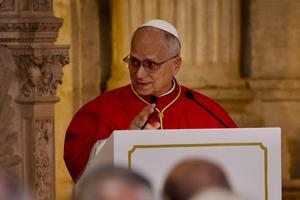
Or at least that’s the answer of Bishop Gianfranco Girotti (pictured) of the Apostolic Penitentiary.
According to Catholic News Service:
A priest who confesses sexual abuse in the sacrament of penance should be absolved and should generally not be encouraged by the confessor to disclose his acts publicly or to his superiors, a Vatican official said.
Likewise, the confessor should not make the contents of such a confession public, said Bishop Gianfranco Girotti, regent of the Apostolic Penitentiary, a Vatican court that handles issues related to the sacrament of penance. . . .
When a priest confesses such acts, “the confession can only have absolution as a consequence,” he said.
This may be an eye-opening response, but there are some qualifiers. The first is this:
Bishop Girotti spoke strictly about the response of a confessor, and not about the wider responsibility to acknowledge and investigate priestly sexual abuse outside the confessional.
So he’s not saying that everything possible shouldn’t be done outside the confessional to investigate abuse. He’s dealing with what goes on under the seal of confession, which—among other things—prohibits the confessor from himself revealing the penitent’s sin.
Then there is this:
“It is not up to the confessor to make them public or to ask the penitent to incriminate himself in front of superiors. This is true because, on one hand, the sacramental seal remains inviolable and, on the other hand, one cannot provoke mistrust in the penitent,” he said.
“From the confessor, (the penitent) can only expect absolution, certainly not a sentence nor the order to confess his crime in public,” he said.
In the first quotation Bishop Girotti seems to be saying that (a) the confessor cannot make the sins public because of the seal and (b) he should not ask the penitent to incriminate himself because to do so would provoke mistrust in the penitent.
(a) is very certainly true. (b) would seem to be questionable.
In the second quotation Bishop Girotti refers to “a sentence” and “the order” to confess publicly. There may be a translation issue here, but he may be alluding to one of a number of things.
Perhaps by “a sentence” he means (c) sentencing the penitent to self-incriminate as part of the act of penance required for absolution.
Perhaps by “the order” he refers to (d) demanding that the penitent self-incriminate but not as a condition of absolution.
If he is saying that a confessor must not require the penitent to self-incriminate as a condition of absolution then he is absolutely correct. If that were possible then any priest in the world would be able to circumvent the seal of confession by simply requiring penitents to publicly self-incriminate. It would defeat the whole purpose of the seal.
“You committed a sexual sin? I think it would be spiritually advantageous in motivating you not to do it again by admitting it publicly. Your penance is to admit it on YouTube.”
“You stole something? It would serve you well in motivating you not to do it again by self-incriminating. Your penance is to go turn yourself in to the cops.”
While public self-accusation was sometimes practiced in the early years of the Christian faith, the pastoral experience of the Church has been that it is much more pastorally advisable to assure penitents that they will not be publicly exposed, which is why the seal was created in the first place. To require penitents to publicly reveal their sins would defeat its whole purpose.
Rome is very serious about the integrity of the seal, and to keep anybody from even thinking about ways to circumvent it, the Code of Canon Law bluntly states:
Can. 983 §1. The sacramental seal is inviolable; therefore it is absolutely forbidden for a confessor to betray in any way a penitent in words or in any manner and for any reason.
§2. The interpreter, if there is one, and all others who in any way have knowledge of sins from confession are also obliged to observe secrecy.
Can. 984 §1. A confessor is prohibited completely from using knowledge acquired from confession to the detriment of the penitent even when any danger of revelation is excluded.
§2. A person who has been placed in authority cannot use in any manner for external governance the knowledge about sins which he has received in confession at any time.
So the priest could not sentence a penitent to self-incrimination as a requirement of absolution.
Could he order him to self-incriminate?
Apart from the elements required for the sacrament, such as the assignment of a penance, the confessor does not have authority over the penitent. A confessor could not say, “For your penance say three Hail Marys. Oh, and apart from your penance, I also order you to take up a career in journalism (or fill in the blank with some other act that isn’t part of the penance).”
For lack of ability to order the penitent to do something, the most the confessor would be able to do would be to implore, encourage, urge, etc., the penitent to self-incriminate, either before Church or civil authorities.
To what extent should he do that?
Here there is room for debate.
From the news story, Bishop Girotti appears to think that this should not generally be done out of concern that it could alienate the penitent—to discourage him from seeking God’s mercy in the way that is ordinarily required for the forgiveness of mortal sin.
To answer the question one would need to take into account both the goods to be achieved by encouraging the penitent to turn himself in and the harms that could result.
So I’m wondering what the readers think.
How strongly and in what circumstances should a confessor urge a penitent to turn himself in? Does it matter whether the penitent is a priest or a layman? If it is you? Does it matter whether the sin is sexual abuse or something else? What sins should be ones that a confessor encourages self-incrimination for? What ones shouldn’t he? How can we distinguish the two? And what would happen to your willingness to go to confession if you knew you would meet with a strong encouragement to self-incriminate?



Comments
Post a Comment
Excellent and much needed article! As Fr. Stanley Yaki once told me: “Truth never changes and so the media always seeks to distort the truth in order to make a story more exciting—the more you deal with the media, the more you will find this”
I think it may be beneficial to recall that contrition on the part of the penitent is a requirement for absolution, and a priest who has reason to believe that the penitent is not really contrite cannot offer absolution.
One would think that in the case of sexually abusing a child, if there were real contrition—whether perfect or imperfect—then the penitent would recognize the need to turn himself in and seek help, particularly in the case of sexual abuse, where the available evidence suggests that the chance of his re-offending is high.
And frankly, I don’t see how the chance of his feeling alienated from confession could possibly be any higher than the chance of his re-offending if he is not strongly encouraged to turn himself in and seek help.
It seems to me that there are various sins that required different acts of penance. There is a difference between mental sins and actual action sins which can be further divided into material based sins (theft, etc) and “physical harm to people” type sins.
For example, if someone stole a large quantity of money, I thought one of the acts of penance would be returning the money. You couldn’t just take it, then go to confession and then keep the money. It wouldn’t have to be a public act of return the money, but could be an anonymous return. Obviously you can’t make an anonymous act of admitting to murder, rape and other sexual sins against others, etc. How does the penitent demonstrate their resolve to “sin no more”? Or does he need to do so? If it’s not the first time, how many times does it need to happen before the priest can determine that there is no resolve to avoid this sin?
How strongly and in what circumstances should a confessor urge a penitent to turn himself in?
I think it is essential for the confessor to give recommendations for how the penitent can avoid these sins in the future. For example, if you’re having an affair then end the relationship with that woman (even as a friend). If it’s a sin with a minor, then the penitent needs to be advised to get transferred into a position where that is no longer the temptation. I think the penitent should also be advised to make amends for his sins.
I would expect this to take the form of letting the penitent know what he AUGHT to do as well as what he NEEDS to do. For example [given that I don’t have the gift of the Holy Spirit to give spiritual council which we all should be praying the priest receives], “You have made a good confession, part of the act of contrition you’re about to say involves making amends for your sins and resolving to never commit them again. For the sins you confessed I’d advise you to do X to make amends and Y to remove from yourself the temptation to sin. I will pray for you that you may be given the grace to know the proper course of action to take and the courage to take it. For your penance you will be required to pray for those you have harmed.”
My gut reaction is that the Priest should beat the pedophile to death. I know that would be wrong, but I find no mercy in my heart for those who harm children.
I remember my uncle, who was a NYC police detective, was asked on a school exam, “What punishment would you recommend for a child abuser?” He wrote, “I would have a millstone put around their neck and cast them into the sea.”
His professor’s response was: “very funny…”
All the more reason to accept the fact that “confession” is a phony sacrament. The confessor who doesn’t immediately report a crime against an innocent child is as complicit in the sin as someone who donates money to planned parenthood. Both are allowing the crime to continue. In fact, in the case of the confessing pedophile, I would bet that the “good feeling” of confession allows him to comit this terrible deed with increasing frequency. Getting absolved makes everything OK in his sick mind. Fondle another boy? Just go to confession. Actual sicknesses of the mind will not be healed through confession, any more than a broken bone will be healed by saying an Act of Contrition.
What Shaun G said. The fact that someone is in the confessional indicates they’re willing to deal with the (much more serious) eternal consequences of their sin. But if that person isn’t willing to face the temporal consequences of their sin, then how can true contrition exist? The confessor should offer every support to the penitent to strengthen his resolve, but if I were the confessor I’d make turning himself in a condition of absolution. I’d do the same for any other crime, such as embezzling or murder.
Don’t forget the extra layer here: someone who sins and keeps returning to confession seeking absolution is in danger of committing the sin of presumption, which is worse yet.
You contribute nothing to the discussion with replies like that, David P. You use non-absolutes like “I bet” and your own supposition to come to an absolute conclusion like “Confession is a phony sacrament.” If you add nothing to the topic, you should refrain from posting. The same church fathers who established and worked out the canonical books in the bible are the same ones who established the ancient Church’s sacrament of Confession. I guess they were only part right. Or maybe they were correct about the canonical books but wrong about the presence of Christ in the Eucharist as well as the sacrament of confession. So 1 for 3? Oh, but they were wrong about everything else that eventually formed what we call the Catholic Church, so that’s one correct thing out of a myriad thousands of others. How sure are you that they were speaking with God’s authority on that one topic, the Scriptures, and then mangled and twisted everything else?
Anyhow, as for the topic of discussion - during my own confessions I have often received ‘actionable’ advice from the priest. Before the Absolution, they usually give some frank opinions on what I’ve confessed and some specific suggestions on how to remove myself from temptation and/or minimize the chance that it can happen again. I really don’t see how the same couldn’t be done in the case of sexual abuses of any kind and in general I think it’s a very helpful thing. To my remembrance, it has never been part of the Penance proper, but it is still during the intimate time in the confessional when the priest is acting in persona Christi. During that time, if a priest told me that what I had confessed was directly destructive not only to the victim but also serves (along the same lines of Saul’s actions) to persecute the Church and Christ Himself, that would certainly put things in their proper perspective. I would hope that any mushy general advice or feel-good reconciliation talk would be avoided and the seriousness of the offense be made clear to the penitent.
Shaun G makes a good point vis-a-vis the intent and contrition of a person being mirrored in their actions. I’m not sure on what grounds a priest can refuse to offer sacramental absolution, but it does seem plausible that the Grace that comes from being absolved of sin could be withheld with the purpose and intention of ensuring sufficient contrition on the part of the confessing.
Putting my last two paragraphs together, wouldn’t it be possible for a priest to 1.) hear a confession whereby a priest admits sexual abuse 2.) offer the priest the sternest and best attempt to appeal to his sense of justice that he should ensure no more abuse happens by turning himself in or taking another course of action for the sake of Christ and His Church, 3.) if additional instances arise of the same penitent seeking Confession subsequently, the priest can inquire as to what steps the penitent priest has taken to address the problem, 4.) refuse to hear the confession if it is obvious that the priest hasn’t taken any steps to address the problem and is freely miring himself in sin.
I think one problem would be that a sexually abusive priest may ‘wander’ for his confessions over the years so that no particular priest or set of priests gets the impression that there is a sustained problem.
The whole scenario is a nightmare, and one of the more horrifying examples of the way sin corrupts and suffocates the souls and impacts others. I can only imagine the burden of sole knowledge of such grave sins.
According to the traditional principles governing the inviolability of the sacramental seal, Bp. Girotti is correct. The purpose of all these rules is to insure that the sacrament is not rendered “odious” to penitents (as the theology manuals say), which it surely would be if confessing a sin meant that a penitent would be pressured to engage in some sort of extra-sacramental self-incrimination. If that doesn’t play well with the media, well, tough.
The confessor can require a commitment to heal the damage done before granting absolution. Traditionally this has not involved turning oneself in to the authorities or admitting fault even to the person(s) that have been wronged (in addition to God). The confessor can also require the commitment to remove certain occasions of sin.
However, psychology is able to show that the harm a person does (including to themselves), in things such as pedophilia that provoke such extreme measures to hide one’s sin, requires entry into therapy (in addition to sacramental confession) for healing to proceed. The damage done to the perpetrators psyche amounts to an occasion of sin if not treated.
Therefore I think a priest might make the judgment that certain sins, where secrecy only exacerbates the addiction or where group or other therapy is known to be essential to healing the damage done and showing a serious purpose of amendment , could require a commitment to seek certain types of group therapy before granting absolution. In fact the Apostolic Penitentiary could require such a commitment as a condition of granting absolution in the case of sins reserved to its judgment.
The present crisis may be enough for the Church to review her practices to better reflect our understanding of the healing process today. The history of the sacrament shows that previous reviews have born much fruit, such as those that:
allowed for repeated reception of the sacrament,
reduced the requirement for public confession or penances;
required that a confessor could not absolve a accomplice;
insisted on individual and private confession;
reserved certain serious sins for judgment to a higher authority and even to the Holy See.
One example of a reserved sin where canon law requires that the penitent “turn himself in” formally (ie publically) is Can. 982 “A person who confesses to having falsely denounced to ecclesiastical authority a confessor innocent of the crime of solicitation to a sin against the sixth commandment of the Decalogue, is not to be absolved unless that person has first formally withdrawn the false denunciation and is prepared to make good whatever harm may have been done.“ I cannot help but recall the story where Daniel denounces the Israelite judges who entrap Susanna when she refuses to commit adultery with them.
So a priest must seek judgment from higher authorities in the case of certain sins before granting absolution, and sometimes confession of certain crimes outside the sacrament is required before absolution is to be granted. There is every reason why these measures should be extended to crimes such as pedophilia. The fact that Bishop Gianfranco Girotti is not reported as mentioning this raises questions in my mind about either the accuracy of the reporting or his judgment.
If you’re confessing to a priest, for absolution you don’t need perfect contrition. You only need attrition - the fear of damnation to Hell by offending God and the resolve not to commit the sin again.
The priest should not be practicing anything that is likely to alienate the penitent from the sacrament, even if that means encouraging them to turn themselves in. In certain cases perhaps, this could be done, but only in the context of exploring options for reparations after being invited to do so by the penitent, and only if the priest reiterates the likely consequences (i.e., the penitent shouldn’t be tricked into it).
If we truly believe that all works out for the best for those who love God, not reporting truly won’t matter. We want to protect innocent children from physical danger, yes, but an even higher calling is saving guilty souls. When we bully/cajole/threaten a soul, we betray that calling.
Some of us may want to condemn the child abuser, but who are we to cast stones, when we might have easily done something similar afforded similar circumstances in life. Leave the judgment to God, help the children where we licitly can, and offer God’s abject mercy to the wretched penitent in confession.
“Leave the judgment to God”.
This is not the Catholic understanding of the sacrament. Canon. 978: “In hearing confessions the priest is to remember that he is at once both judge and healer, and that he is constituted by God as a minister of both divine justice and divine mercy, so that he may contribute to the honor of God and the salvation of souls.
Christ commanded his hierarchy to judge. “Those sins you forgive…those sins you do not forgive…”
“this could be done, but only in the context of exploring options for reparations after being invited to do so by the penitent,” Again this is not the Catholic understanding of the relationship between confessor and penitent. As judge,the priest decides the penance, although he may invite the penitent to contribute to the decision. Canon. 981: “The confessor is to impose salutary and appropriate penances, in proportion to the kind and number of sins confessed, taking into account, however, the condition of the penitent. The penitent is bound personally to fulfill these penances.”
“Reserved cases is a term of Catholic doctrine, used for sins whose absolution is not within the power of every confessor, but is reserved to himself by the superior of the confessor, or only specially granted to some other confessor by that superior.
To reserve a case is then to refuse jurisdiction for the absolution of a certain sin. The reservation of sins presupposes jurisdiction, and therefore the pope alone can make reservation for the whole Church; bishops can do the same for their diocese only, and certain regular prelates for their religious subjects. That a sin be reserved it must be mortal, external, and consummated.” (Catholic Encyclopaedia)
Below is an accurate discussion of the matter:
In a criminal matter, a priest may encourage the penitent to surrender to authorities- in some cases, this can be made a condition of absolution as part of one’s penance. However, this is the extent of the leverage he wields; he may not directly or indirectly disclose the matter to civil authorities himself.
There are limited cases where portions of a confession may be revealed to others, but always with the penitent’s permission and always without actually revealing the penitent’s identity. This is the case, for example, with unusually serious offenses, as some excommunicable offenses are reserved to the bishop or even to the Holy See, and their permission to grant absolution would first have to be obtained. There are certain procedures that have been formally set by the Church and civil governments that apply, without violating the seal of confession, if the penitent is a priest or other church official and is guilty of a civil crime involving the sexual exploitation or abuse of minors. These were instituted out of necessity during the sex abuse crises in the American church and in other countries.
Getting absolved makes everything OK in his sick mind. Fondle another boy? Just go to confession.
Respectfully you are laboring under an error. It is a very common one often repeated (here is a 19th century anti-Catholic cartoon on it: http://www.bettnet.com/gallery/anticatholic/source/confession.html). One of the conditions of confession is a genuine resolution not to sin again. Without it, the confession is invalid.
Now, a molestor might be under the error that it does make it ok, but an error it remains and an invalid sacrament it would remain, but as the saying goes, abuse does not nullify proper use.
God bless,
Scott W.
Again excuses for the Bishops and this time one within the Vatican Court. These molestations by our Catholic priests are disgusting and as Christ said “whatever you do my little one, you do unto me”. So they keep going to confession and they keep abusing Christ Himself. If they are that weak-minded, they should not become priests, or stay in the priesthood. I notice lately within the Catholic Church that we “the little people” or the “mass” have strict rules to live by, but when it comes to anyone with authority or in higher places like the government, much is overlooked. I would love to see the Catholic Church excommunicate people like Ted Kennedy or Palossi for their Pro-choice movement. I know it will never happen because they give more money to the church and the church needs the money. Didn’t Jesus throw the money-makers out of the Temple? Also what has happened to the Nuns, I would not trust any of them with my children in today’s world. Priests and Nuns are subject to obedience, yet they do “their own thing”, and get away with it. Our Vice-President wore his ashes on his head in public and was shown going to Holy Communion, yet he upheld the health bill that included abortion. No wonder Protestants say “Catholics can sin all they want, all they have to do is go to Confession and they are forgiven to do it over and over again”.
Will, I have a strong suspicion these people you mention haven’t been to confession in ages. I would like to see a stronger stance taken as well in some areas, but I think it is a folly to ascribe the sins of a few to the whole bunch. Everyone sins, but not every priest is a pedophile, not every nun is a heretic and not every politician is evil…well, I’m not so sure about the last one ;)
The sacrament of confession, like all things, can be abused, but that doesn’t mean the Church must change it. It would be like someone taking the Eucharist unworthily and then the Church deciding that Christ is too vulnerable in this form so they’ll no longer distribute it to the faithful or perhaps stop saying mass at all.
It would seem mandatory that the Confessor not break the seal of confession. That part is forbidden to the Confessor and he cannot control/change the “rules of the game” so to speak. However I was always taught that part of absolution depends upon the penitent’s remorse including firm purpose of ammendment. Just as in the case of a penitent confessing to stealing, restitution must be made in order to be absolved so it would seem in the case of the priest who has violated his vows that he must make some sort of restitution by going to his Bishop and revealing what he has done so that a similar restoration may occur.
My understanding of the crime of the abuse of a minor sexually is that it is a reserved sin that only the Holy Father can absolve.
And, according to the present canon law, this priest is suspended automatically from the priesthood. A confessor cannot absolve him in a normal way; he must seek the proper authority from the Holy See.
This is something recent. I don’t understand the comments by this Archbishop.
Maybe someone with canonical expertise can comment.
I am a little surprised that no one has mentioned the central issue of true repentance. Whether or not we agree with the interpretation of this canon law, it is clear the confessor is under holy obligation to dispence absolution to the true peninent. Here lies the crux of the matter. We are calle to repentance and not mere remorse, which is more a feeling than an act of the will to turn away from sin. It is a well documented fact that paedaphiles will from time to time feel some degree of remorse, while having no real intention of stopping. Is it not to a Holy and loving God we are confessing? Is it not God’s loving forgiveness we are seeking? The confessor must, as a first duty, ensure this penitent is sincere. A priest who confesses is more likely to struggle with the nature of his sin.
Abolution can be refused if there is no true repentance. I would rather hotly debate this issue than the red herring of the sanctity of the confessional.
I am a little surprised that no one has mentioned the central issue of true repentance.
I thought I did and so did adele.
Sorry, Didn’t see their posts.
No biggie. It doesn’t hurt to restate it because the “Catholics can sin all they want and then go to confession and do it all again” saw is an old lie that doesn’t seem to die. :)
Child molesters go to prison, unless they are Catholic priests, in which case they are reassigned to a new position. A man who has ‘virtual sex’ online with a police officer posing as a minor goes to prison, but priests who have actual sex with children are reassigned. How is rape of children not a crime in the eyes of the Church of Rome? Did Jesus forgive a child rapist in any writings in the Bible? The Vatican sees rape as a character defect, a sin of desire ... certainly nothing to involve police. Are priests immune from the laws of world courts? As an EX-Catholic, I can not imagine why millions of people would support an institution that protects pedophiles instead of sending them to prison.
David, read this extract from the letter of Benedict XVI for the Catholics from Ireland (http://www.zenit.org/article-28701?l=english)
7. To priests and religious who have abused children
You betrayed the trust that was placed in you by innocent young people and their parents, and you must answer for it before Almighty God and before properly constituted tribunals. You have forfeited the esteem of the people of Ireland and brought shame and dishonour upon your confreres. Those of you who are priests violated the sanctity of the sacrament of Holy Orders in which Christ makes himself present in us and in our actions. Together with the immense harm done to victims, great damage has been done to the Church and to the public perception of the priesthood and religious life.
I urge you to examine your conscience, take responsibility for the sins you have committed, and humbly express your sorrow. Sincere repentance opens the door to God’s forgiveness and the grace of true amendment. By offering prayers and penances for those you have wronged, you should seek to atone personally for your actions. Christ’s redeeming sacrifice has the power to forgive even the gravest of sins, and to bring forth good from even the most terrible evil. At the same time, God’s justice summons us to give an account of our actions and to conceal nothing. Openly acknowledge your guilt, submit yourselves to the demands of justice, but do not despair of God’s mercy.
Child molesters go to prison, unless they are Catholic priests, in which case they are reassigned to a new position.
Interesting that you mention that. We were just talking about the fact that 60% of the total of 3000 abuse cases over the last fifty years (side note: compare that record to other institutions for enlightenment) involved teens and a number of teen boys. Yet, if one reads the typical “coming of age” story by a homosexual celebrating gay sex, they say that their first encounter was with an older man. In other words, when it is with anyone other than a priest, it’s ok.
I also find it interesting is the International Planned Parenthood Federation’s sexual rights statements is against “coerced” child pornography, but nothing in it that says they are against the concept itself. In other words, it seems the outrage here is flavor of the month. If one looks at the actual church teaching, it is easy to see that any sex outside of a valid marriage is gravely evil. This teachable is unchanged and unchange able. So the choice is to remain loyal to an institution with stable doctrines and do the admittedly difficult work of rooting out corrupt ministers and their abettors, or joining up with the secular pluralists who are working on an ever-downward sliding scale of evil. Easy choice in my view.
Jimmy,
I read that extract before you asked me to read it. I agree that abusers should trust in God’s mercy, etc,
My point is that the institution Christ empowered to forgive sins in his name denies absolution for some sins unless the penitent formally (ie not within confession) makes good the damage done (canon 982). So there is scope for the Church to extend this practice to situations where priests confess abuse. In my opinion this would not damage attitudes to the confessional, anymore than canon 982 does.
Can. 982 “A person who confesses to having falsely denounced to ecclesiastical authority a confessor innocent of the crime of solicitation to a sin against the sixth commandment of the Decalogue, is not to be absolved unless that person has first formally withdrawn the false denunciation and is prepared to make good whatever harm may have been done.
What is your point?
P.David’s conclusion that the “good feeling” after confession encourages one to commit the offence again. I request You sir, to learn more about the Church and confession. Please understand what is confession and how one should approach it. Those who do not have faith in Jesus and his Church can do anything and justify all sins in their way
Of course, the seal applies to each individual, and to specific sins confessed by each one of us, and it must be this way for the sacrament to be protected, but a discerning priest will surely become more aware from listening to confessions of the general “moral climate” among specific groups of individuals. If a priest becomes aware of a major problem among a large group of his parishioners, let’s say, I think the seal should not prevent him from touching on the issue during a Sunday sermon - of course in a generalized, non-specific way. It might help those people to work on changing whatever it is they’re doing wrong. And contrition is a condition of receiving absolution - a contrite penitent should at least want to make up for the harm he has caused and take responsible steps to avoid the same sins in the future!
I sometimes imagine what I would do if I was a priest and I heard a confession that was extremely severe (such as sex-abuse). Granted I haven’t studied sacramental theology and do not have the God-given grace to dispence penance, but I had thought that the obvious course of action was to give a conditional absolution. The condition would be for the person to turn themselves in, seek counselling and/or make amends for the damage done. In the case of a priest confessing sexual abuse I probably would require them to talk with the bishop of the diocese.
I am very grateful for discussion of this issue in this blog and elsewhere. I am beginning to see that conditional absolution in this case is not appropriate. I like some of the comments here, especially the one by Shaun G. Here is something I found helpful from “This Rock” magazine:
“Q: Can absolution be withheld from a murderer until he agrees to give himself up to authorities?
A: Absolutely not. A priest may withhold absolution from a murderer if he has reason to believe that the penitent is insincere. He also may assign the penitent to atone for his sin by helping those he has harmed, anonymously if necessary. For example, if the victim was a husband and father, the priest may direct the penitent to contribute to the support of the widow and children. In order to avoid revealing the murderer’s identity, the support may be given through the mediation of the parish’s charitable funds. The priest also may encourage the penitent to turn himself in to authorities. But he may not condition absolution upon the murderer’s confession to civil authorities. No one—not even the priest—can require an action that would reveal to outsiders the contents of his sacramental confession and thus violate the seal of the confessional (http://www.catholic.com/thisrock/2004/0405qq.asp). “
I just re-skimmed the comments, and it looks as if no commenter so far has answered Jimmy’s final question—“What would happen to your willingness to go to confession if you knew you would meet with a strong encouragement to self-incriminate?”
He asks this because if one’s willingness to go to confession is not affected by such encouragement, then it suggests that Bishop Girotti’s contention that that kind of encouragement would provoke mistrust in the penitent is flimsy, and that his advice that priests not encourage penitents (while in the confessional) to turn themselves in is also flimsy.
So, let me try to answer the question.
No, I don’t think that encouragement would alienate me from confession. It might make me less inclined to seek confession from that particular priest, but here’s how I look at it. If the priest is encouraging me to do something that I know in my heart is the right thing to do—then even if I don’t actually have the courage to do it, I’m not going to hold any will toward the priest or the sacrament of confession for his encouraging it.
And certainly, in the case of a priest sexually abusing a child, being encouraged to take steps to prevent future abuse—which, in the case of pedophilia, the best available evidence suggests requires, at a MINIMUM, being removed from ordinary priestly ministry—should indeed be recognized as the right thing to do.
(In other cases, that may not be as clear-cut. For instance, Jimmy’s example of being encouraged to admit a sexual sin on YouTube would probably indeed make a person less likely to commit that sin again—but is it the MINIMUM reasonable step one can take to express an intention to avoid that sin? I would say not: There are plenty of other steps one can attempt to take that might also plausibly help one to avoid the sin, but not involve putting oneself up to public ridicule.)
I think that if I knew I was going to have to encriminate myself it would make me even more sincere in my confession. Each time I go to confession I try to be as contrite as possible and completely sorry for my sins. If I knew that the priest was going to ask me to take further actions, I would probably pause to think about it, but in the end I would still go because in that moment when I am deciding to go to confession I feel the sorrow for my sins and the desire to make amends. I think it would avoid what Roget T and David P. were talking about with the sin of presumption and repeating the same confession over and over. It would make me really sorry for my sins and willing to do something substantial to overcome them. The penitent might wander for his confessions but when he is finally ready to face his wrongdoings and make changes to his life he knows that there are people who are there to support him in that change and want him to overcome the sin. I don’t think that it should be a condition of absolution but should always be encouraged in serious circumstances and especially if a pattern of the sin has developed.
Jimmy, “tocayo”,
I am always excited to read your new posts and surely this is because of the top-quality journalism you exhibit. A true journalist, you pose questions to your readers that should be asked. This article is a prime example of what a Catholic Blog should not only include, but also the way it should be written and presented.
Specifically in this article, you’ve sparked an interesting slew of ideas that I hope someone “up there” in the hierarchy may read and apply. Thank you for your blog, and thank God for journalists like you.
-JACV
YES! A priest that abuses a child and admits it in the confessional SHOULD BE REQUIRED TO ADMIT THEIR CRIME, at least to hisr superiors, as a condition of true absolution, and then be required to either live a monastic or cloistered life or be removed from the priesthood - NO EXCEPTIONS!!!!! Not requiring the priest tell his superiors (since the confessor cannot tell) puts the burden of telling about the abuse on the VICTIM, which is completely wrong! What if the child is too young to tell? What if the child has been coerced by the abuser not to tell, which is often the case? As we can see from past history, the victims often don’t tell or wait years to tell. And sadly, many are not believed. In addition to the child sufferring with the mental stress of abuse, they may have been infected with sexually transmitted diseases. No only is the child’s mental health in danger, their physical health is too!
While the sacrament of reconciliation is indeed an important one, we cannot put the secrecy associated with this sacrament above the health and well being of our children. If there is nothing in Cannon law prohibiting a confessor from requiring an abusing priest to admit his crimes to his superiors, then confessors should be encourage or better yet required to include disclosure as part of the absolution process. Personally I doubt that a pedophile priest has true contrition and regularly goes to confession to admit his sins, but has only done so when he has been found out. And by not requiring the confessor to insist the abuser disclose his sins and prohibiting the confessor from telling himself has only enabled the abusers to hide their crimes. As a result we have hundreds of people now speaking up about abuse that happened to them years ago and the church’s failure to properly identify and deal with the abuser priests. While the church’s silence about abuser priests was unintentional, it was the result of ignorance about pedophilia and has been very damaging to the victims and to the image of Christ and the church.
We need more education about pedophilia for the clergy, lay ministers, parents, everyone! Most people (and this bishop included) are ignorant about pedophilia. Pedophilia is a psychological disorder! And confession, while it may absolve the sin committed by a priest when he abused a child, it doesn’t cure the illness any more than it would cure schizophrenia. Pedophiles typically begin abusing children when they themselves are between the ages of 10 and 12—yes when they themselves are children. So a priest that abuses children did so before he became a priest, and when he took his vows as a priest, he was lying to the church about himself! A priest that abuses a child has done it before and will do it again if given the chance! A priest that abuses children is NOT a disciple of Christ but a Judas that betrays Christ and must be delt with swiftly and effectively.
Your all sick You hide behind your man made rules and man made secrets to avoid doing what is right. God is ashamed of all of you.
If a person confesses that he has abused a child, and the child has not received the appropriate care, isn’t the abuser obligated to “make good whatever harm may have been done”?
If I confess that I have locked my dog in the cellar and haven’t fed him for a week, is absolution for the sin of cruelty dependent on my feeding the dog?
If I confess that I have sexually abused a child and have not ensured that the child is receiving care to recover from this trauma, is absolution dependent of my ensuring that the child is cared for? Isn’t the child still suffering?
Geri
How are you going to help the kid you molested? You help him by being out of his life. That is achieved by jail time. Don’t kid yourself that you can un do the harm you did. Turn yourself in to the police as soon as possible.
Response to Greg:
I was giving an example. I will restate my question. If a child abuser confesses the abuse to a priest, and the abuser has not assured that the child is receiving the appropriate care, can the abuser receive absolution?
It is probable that the abuser has to turn himself in in order to ensure that the victim receives care, but my point is that the victim needs to be cared for.
I think that if a child sexual abuser has not (1) ensured that the victim is receiving care and (2)has not put himself into treatment, then the abuser does not admit he has committed a sin against the victim. I think it would be dishonest for the confessor to grant absolution in this case.
Agreed but it is impossible for the abuser to fix the child. Children are not lightbulbs. You cannot unscrew them.
Only God can absolve the abuser. Priests are not God. If priests want to do the right thing and give their “absolution” it is easy. Tell the abuser to turn themselves into the police and then they will grant them absolution. Anything short of that is just looking for a loophole to cover up a man made crime. But you could say that abusing children only harms them when they grow up. So priests could abuse terminally ill children. They won’t live long enough to grow up and be harmed by the abuse of the priest. That is another loophole for ya.
Post a Comment
By submitting this form, you give The National Catholic Register permission to publish this comment. Comments will be published at our discretion, and may be edited for clarity and length. For best formatting, please limit your response to one paragraph and don't hit "enter" to force line breaks.