In his second major address since being elected Supreme Pastor of the Universal Church, Pope Francis has again reminded the faithful that Christ, not the Pope, is at the centre of the Church.
He also explained the reasons why he took the name Francis after St. Francis of Assisi, offering an insight into his priorities as pontiff.
Addressing the 6,000 journalists accredited to cover the conclave, Pope Francis spoke movingly and with humor on a number of major themes, including the important role of the media in covering the Church. He pointed out that the Church is a spiritual not political body - a "holy people of God who walk toward the encounter with Jesus Christ" - and that only by putting oneself in this perspective, "can one fully explain how the Catholic Church works.”
He stressed that "Christ is the centre" of the Church, "the fundamental reference, the heart of the Church! Without Him, neither Peter nor the Church would exist or have a reason for being."
He explained how, during the conclave, he decided to choose the name St. Francis. He was a man of poverty, peace and safeguarded creation, he said. "He is the man who gives us this spirit of peace, the poor man," Pope Francis said. "Oh, how I wish for a Church that is poor and for the poor!”
The Holy Father, to much laughter, also recalled how some had suggested he take the name Clement XV to get even with Clement XIV who suppressed the Jesuits.
At the end, he gave a silent blessing, also remembering the many journalists present who were not Catholic.
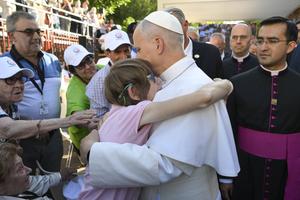
Many journalists were moved to tears by the meeting, and noted how he warmly embraced some of those who were selected to greet him at the end. He received a standing ovation and many cheers from the audience.
Speaking to the Register at the end of the meeting, Archbishop Claudio Maria Celli, who welcomed the Pope in his first audience in the Paul VI Hall, said Pope Francis "has a good relationship with the media, for sure. I don't think he's an expert in communication but he's a simple person, open to keeping a dialogical attitude with people and he has an open heart."
Referring to the warmth of the individual greetings at the end, the president of the Pontifical Council for Social Communications said: "You can't imagine his reaction to Argentinian people whom he knows - he received them and embraced them, and people were addressing him with the familiar "tu" rather than [the formal] "lei", and they call him "padre" which is nice."
On the Pope's choice of name, Archbishop Celli recommended seeing the frescos of Giotto in Assisi. "There you will see Francis is helping the Church not to fall down, after the dialogue with the crucifix, and that is beautiful," he said.
Asked if the new Pope will use Twitter, he replied: "We will see."
***
Full Text:
Address of the Holy Father
To Representatives of the Communications Media
Saturday, 16 March 2013
Dear Friends,
At the beginning of my ministry in the See of Peter, I am pleased to meet all of you who have worked here in Rome throughout this intense period which began with the unexpected announcement made by my venerable Predecessor Benedict XVI on 11 February last. To each of you I offer a cordial greeting.
The role of the mass media has expanded immensely in these years, so much so that they are an essential means of informing the world about the events of contemporary history. I would like, then, to thank you in a special way for the professional coverage which you provided during these days – you really worked, didn’t you? – when the eyes of the whole world, and not just those of Catholics, were turned to the Eternal City and particularly to this place which has as its heart the tomb of Saint Peter. Over the past few weeks, you have had to provide information about the Holy See and about the Church, her rituals and traditions, her faith and above all the role of the Pope and his ministry.
I am particularly grateful to those who viewed and presented these events of the Church’s history in a way which was sensitive to the right context in which they need to be read, namely that of faith. Historical events almost always demand a nuanced interpretation which at times can also take into account the dimension of faith. Ecclesial events are certainly no more intricate than political or economic events! But they do have one particular underlying feature: they follow a pattern which does not readily correspond to the “worldly” categories which we are accustomed to use, and so it is not easy to interpret and communicate them to a wider and more varied public. The Church is certainly a human and historical institution with all that that entails, yet her nature is not essentially political but spiritual: the Church is the People of God, the Holy People of God making its way to encounter Jesus Christ. Only from this perspective can a satisfactory account be given of the Church’s life and activity.
Christ is the Church’s Pastor, but his presence in history passes through the freedom of human beings; from their midst one is chosen to serve as his Vicar, the Successor of the Apostle Peter. Yet Christ remains the centre, not the Sucessor of Peter: Christ, Christ is the centre. Christ is the fundamental point of reference, the heart of the Church. Without him, Peter and the Church would not exist or have reason to exist. As Benedict XVI frequently reminded us, Christ is present in Church and guides her. In everything that has occurred, the principal agent has been, in the final analysis, the Holy Spirit. He prompted the decision of Benedict XVI for the good of the Church; he guided the Cardinals in prayer and in the election.
It is important, dear friends, to take into due account this way of looking at things, this hermeneutic, in order to bring into proper focus what really happened in these days.
All of this leads me to thank you once more for your work in these particularly demanding days, but also to ask you to try to understand more fully the true nature of the Church, as well as her journey in this world, with her virtues and her sins, and to know the spiritual concerns which guide her and are the most genuine way to understand her. Be assured that the Church, for her part, highly esteems your important work. At your disposal you have the means to hear and to give voice to people’s expectations and demands, and to provide for an analysis and interpretation of current events. Your work calls for careful preparation, sensitivity and experience, like so many other professions, but it also demands a particular concern for what is true, good and beautiful. This is something which we have in common, since the Church exists to communicate precisely this: Truth, Goodness and Beauty “in person”. It should be apparent that all of us are called not to communicate ourselves, but this existential triad made up of truth, beauty and goodness.
Some people wanted to know why the Bishop of Rome wished to be called Francis. Some thought of Francis Xavier, Francis De Sales, and also Francis of Assisi. I will tell you the story. During the election, I was seated next to the Archbishop Emeritus of São Paolo and Prefect Emeritus of the Congregation for the Clergy, Cardinal Claudio Hummes: a good friend, a good friend! When things were looking dangerous, he encouraged me. And when the votes reached two thirds, there was the usual applause, because the Pope had been elected. And he gave me a hug and a kiss, and said: “Don't forget the poor!” And those words came to me: the poor, the poor. Then, right away, thinking of the poor, I thought of Francis of Assisi. Then I thought of all the wars, as the votes were still being counted, till the end. Francis is also the man of peace. That is how the name came into my heart: Francis of Assisi. For me, he is the man of poverty, the man of peace, the man who loves and protects creation; these days we do not have a very good relationship with creation, do we? He is the man who gives us this spirit of peace, the poor man … How I would like a Church which is poor and for the poor! Afterwards, people were joking with me. “But you should call yourself Hadrian, because Hadrian VI was the reformer, we need a reform…” And someone else said to me: “No, no: your name should be Clement”. “But why?” “Clement XV: thus you pay back Clement XIV who suppressed the Society of Jesus!” These were jokes. I love all of you very much, I thank you for everything you have done. I pray that your work will always be serene and fruitful, and that you will come to know ever better the Gospel of Jesus Christ and the rich reality of the Church’s life. I commend you to the intercession of the Blessed Virgin Mary, Star of Evangelization, and with cordial good wishes for you and your families, each of your families. I cordially impart to all of you my blessing. Thank you.
(In Spanish)
I told you I was cordially imparting my blessing. Since many of you are not members of the Catholic Church, and others are not believers, I cordially give this blessing silently, to each of you, respecting the conscience of each, but in the knowledge that each of you is a child of God. May God bless you!


View Comments
Comments
Join the Discussion
As we approach Holy Week – It is important to remember That Holy Thursday is when Jesus Instituted the Priesthood and the Holy Eucharist – His presence among us until the end of time.
Our Lord Jesus Christ, during His public ministry: taught in the temple and chose 12 apostles who leaving everything followed Jesus. He went to feasts and weddings changing water into wine. He is accused of being a glutton; of eating with sinners and publicans. He visited His friends for dinners and sat talking to them. He took the little children close to him and blessed them and their parents. Jesus got angry and chased the money changes from the temple, cursed the fig tree and cursed those who scandalize and hurt especially little children.
He preached His Gospel and fed the multitudes. He drove out devils from those possessed by evil spirits. He cured the sick, gave sight to the blind and made the crippled walk. He raised the dead to life. He forgave sinners, including the woman taken in adultery telling her “sin no more.” He went to the mountain to pray in solitude. He allowed Himself to be tempted by satan and vanquished him showing us how to overcome temptations of pride, false humility-to be seen by men; quest for power and the worship of the world, the flesh and the devil and everything thing the world stands for.
Jesus gives us His example and direction on how to live: For I was hungry, and you gave me to eat; I was thirsty, and you gave me to drink; I was a stranger, and you took me in; naked, and you covered me: sick and you visited me: I WAS IN PRISON, AND YOU CAME TO ME. … The King answering will say to them: Amen I say to you, as long as you did it to one of these my least brethren, you did it to me.
On Palm Sunday, knowing full well what was to come, Jesus did not refuse to ride on a donkey through the streets of Jerusalem where many spread their garments and boughs from the trees in the way to their adulation and went before and followed Him, saying: Hosanna, blessed is he that cometh in the name of the Lord. Jesus shows us how to be humble even when we are praised by others, yet soon to prove how short-lived such praise can be.
Yet, on Holy Thursday Jesus is not on the road, in the soup kitchen, in the hospital or the prison or with His friends eating by the wayside or by the sea shore or in a fishing boat as He frequently did.
On the eve of His Death for the Salvation of the mankind, on this Solemn Holy Thursday Jesus is with His Twelve. Not even His Mother is there. Jesus asks His disciples to “go and prepare the Upper Room which was large furnished dining room,” “Where I may eat the Pasch with my TWELVE disciples.” The Greatest Miracle and Gift to the world was about to be given.
Jesus did not wash the feet of His mother or the feet of Mary Magdalene or any other woman. Jesus washed the dirty feet of these twelve men who followed him, including the feet of Judas who was to betray Him.
He then goes on to make them His Priests by instituting the Holy Priesthood and The Most Holy Eucharist – His True Presence. His Body, Blood, Soul and Divinity to be in our midst until the consummation of the world.
According to our station in life and calling, the greatest act of humility, is in giving up ones own will to follow God’s plan and will for each of us; in silence, obscurity and love. This applies also to the Pope who is not just the Bishop of Rome but the Supreme Pontiff of the Universal Church that is over two thousand years and made up of over a billion souls.
Especially when in position, knowing that cameras follow us and the eyes of the world are constantly upon us, TRUE CHRIST LIKE humility is not deliberately showing off and standing out with outward actions contradicting and sweeping aside what was done for hundreds of years if not more.
Humility is Truth. I also noticed that Pope Francis has been downplaying his main title-Supreme Pontiff. He is not the first among equals. I love the Pope who is the SUPREME PONTIFF OF THE UNIVERSAL CHURCH and happens to be the Bishop of Rome. In our excitement, we seem to be oblivious to this important fact.
Jesus said: Woe to you when men shall bless you…Blessed shall you be when men shall hate you, and when they shall separate you, and shall reproach you, and cast out your name as evil, for the Son of man’s sake.
The following article speaks about major issues that are destroying the family which is the basic unit of society. Read how the absence of ‘chivalry’, of women wearing pants and boxing up bridle gowns, and how birth controlling are destroying the ability to be our brothers’ keeper.
http://www.newoxfordreview.org/article.jsp?did=0313-jackson
Uncatechized families cannot take care of the poor as they ought. The Sacrament of Matrimony has been diminished and slashed resulting in many divorces that has added to the numbers who are poor.
The preferential option is to serve God. In obedience we will serve where and how God calls. This humanistic connotation of preferential option for the poor is a socialized, feel-good-about self posture and is not a Catholic principle. The horizontal focus will not endure if we did not begin from our knees worshiping God and asking for the assistance of Our Blessed Mother to guide us. Jumping ahead in doing good works and not giving priority to God is burn out. One can do a lot of good works and still lose their soul in disobedience to God’s will.
Isibel, Matthew’s Gospel says “poor in sprit”. Luke’s Gospel (based on Matthew’s) purposely leaves off “in spirit”. Luke was making a specific point. So “poor” is scriptural. Check it out in Luke.
.
On a semi-related note, the most spiritually alive and beautiful churches I have belonged to are the poorer parishes. God guide the affluent suburban parishes that I grew up in. These parishes spend money on building new buildings, entertainment and fellowship (not all bad). The parish I belong now too, is one of the smallest and probably poorest and continually outgive for all the diocesean mission and charitable drives, not per capita but in actual monies. I am not trying to be snotty or “better than thou” by any means. I just am really sad for all the mission and charity opportunities I never had growing up because serving was not a focus. Chairty or mission was something done once a year during Lent or so. That should be the heart. These poorer parishes seem to get that.
.
I think the Pope is doing a good job reminding us about the poor. There is nothing wrong with that. In fact, it is the very scriptural. God’s “poor little people”, the anawhim (sp?) are the ones called his beloved. We are called to serve those.
I think many have missed the entire topic!!!!! Poor- economic….no. But, also remember that great wealth used unwisely leads to destruction, and is sin. If the people of the church are faithful, and Christian, then let the wealthy faithful help his fellow man. This is the preemminent msg and meaning in the Holy Bible, and the Holy Apostolic Church. Is this Catholic Church ruled by such materialistic views? I am appalled that no one can grasp what a clear picture this should be…..pray for true understanding, as I always will, for Gods divine glory!!
Works without faith is dead works and will never result in a good end. They who love God will practice charity for they know they serve Him.
The truth is that there are those who are called to the state of perfection (religious who willingly take vows of poverty) for the purpose of fostering detachment but the Church teaches against this for the laity who can use the things of the world for the greater good. Our Lord, Jesus Christ did not condemn the possession of worldly goods, or even of attaining great wealth. He himself had rich friends. He did warn us that the things of the world could become obstacles to our spiritual well being. Poverty is simply not a virtue and even if it is part of a path to holiness for those who take it as a vow, it is not a guarantee that anyone who embraces it will be or become holy. It is considered an aid for those who’s state in life is lived within certain religious orders.
Br. Justin,
If poverty is a path to holiness, why would the Church work so hard against it? We should want everyone on the path to holiness and therefore should be working very hard to make everyone as poor as possible.
Br. Justin,
If poverty is a path to holiness, why would the Church work so hard against it? We should want everyone on the path to holiness and therefore should be working very hard to make everyone as poor as possible.
The truth is that there are those who are called to the state of perfection (religious who willingly take vows of poverty) for the purpose of fostering detachment but the Church teaches against this for the laity who can use the things of the world for the greater good. Our Lord, Jesus Christ did not condemn the possession of worldly goods, or even of attaining great wealth. He himself had rich friends. He did warn us that the things of the world could become obstacles to our spiritual well being. Poverty is simply not a virtue and even if it is part of a path to holiness for those who take it as a vow, it is not a guarantee that anyone who embraces it will be or become holy. It is considered an aid for those who’s state in life is lived within certain religious orders.
I understand your explanation regarding Tradition vs traditions. However it seems that many beautiful traditions that are useful in teaching the faith may be discarded, impoverishing the Church and the Faithful. This is what I am waiting and watching for. I do not think it prudent for the Holy Father to walk out into the crowds to shake hands because he actually is endangering others who could be injured. There is a reason for all the protocol and the etiquette. I think it might be wise for the Holy Father to take the counsel of Vatican Security experts before he goes out into the crowds again. And I think he should wear the red shoes because it teaches the faithful symbolically that that he is the Pope of the Martyrs. Black shoes are far too worldly.
I think some missed my point. I didn’t even bother to argue that poverty was a virtue, I am too busy to bother. All I know is that off the top of my head is that Sacred Scripture and Apostolic Tradition commend poverty as a path to holiness, poverty not restricted to its material dimension of course. Nor has Pope Francis explicated that the poverty he is calling us to is merely a material poverty, but rather inclusive of and more importantly I imagine the poverty of spirit rooted in the virtue of humility you mention Isabel. Also I never said that human traditions were necessarily invalid or unimportant, just that not to confuse Divinely instituted with the human exalting the latter as if it had the value of the former.
Sherie,
I assume that everyone posting here is a brother or sister in Christ. I do not believe anyone here is a materialist but a sincere Catholic educated in the Faith and with the absolute best of intentions for our Church and our Holy Father. Kindly give those of us who are responding to the attitude of our Holy Father regarding poverty a chance to explore his words in light of the Gospel.
I simply do not believe that poverty in and of itself is virtuous. I do not believe the intention of Jesus in the Sermon on the Mount was to teach us that those who are materially poor are more holy than those who are materially blessed. I believe the Sermon on the Mount was saying that those who are poor in spirit, (humble) are blessed.
I am not a Latino Catholic but I am a faithful Catholic and I do hope you will extend your generosity to those of us who simply do not believe poverty is equal to spiritual humility.
Wow!! I don’t see many examples of humble humans here!!! Where is your faith that Pope Francis has the Church’s best intentions in mind? Just because he chooses not to wear the very costly red leather shoes? He is a Jesuit Pope from South America! Did u think that he isn’t good enough to lead this church.? Give him time!!!! He is a devout Christian, & I must say he follows his faith for the sake of Jesus first, Church second! It is difficult for a materialist to understand his humble thoughts, & also his great love of Christ and the Catholic Church. The Hispanic & Latino population of CATHLOICS are the highest percentages in the World!!! He is a breath of fresh air, & I am personally thrilled that he is who GOD ordained to see the Catholics through as long as God wills, no matter what he wears. I do not think he wants a financially poor church either, let us all pray for understanding in this matter. Many have already misread this GREAT successor to St.Peter. Let him have a minute to breathe. I love him :)
Br. Justin,
Even though human traditions are not equal to Sacred Tradition they are extremely important. The Blessed Mother was so concerned for the tradition of having wine at the wedding of Cana that she persuaded her Son to perform His first miracle so as to not embarrass the family. Sometimes traditions are essential even to God.
Br. Justin,
If poverty is a virtue then why aren’t the poor all virtuous? As you know, there is a great deal of crime, violence and even savagery to be found among the economically poor throughout the world. Economic poverty simply is not equal to “poor in spirit” which is the virtue of Humility. Our disagreement is that there are those who are equating material poverty with the divine virtue of humility.
Poor in spirit means being subject to truth. Although our Lord did empty himself he did not grow up in abject poverty. God through St. Joseph and the Blessed Virgin did materially provide for him. Was our Lord not as holy because he had a home and food growing up as he was later in his life when he emptied himself?
A comment on the second post. It’s important to distinguish between tradition (human customs which although possibly venerable not essential and thus able to be adapted or set aside) and Tradition (i.e. Apostolic Tradition or the deposit of faith), you seem to be equivocating the two.
John’s post on the 18th says that poverty is not virtue. While I haven’t researched that claim I’ll give that comment the benefit of the doubt. I would comment though that Jesus categorizes ‘poverty’ and ‘poverty of spirit’ depending on the Gospel your reading as beatitudes. We should be a people of the beatitudes, not only avoiding breaking the Ten Commandments, but desirous to pursue Christian perfection by God’s grace. The Church also recognizes the vow of poverty as one of the Evangelical Counsels as a means to entering more deeply into our baptismal consecration in the religious state. This freely chosen poverty is not a commandment but an invitation to be more perfectly conformed as disciples to our Lord who emptied Himself, fulfilling the prophecy of the Suffering Servant.
Bill, please post them.
Awfully harsh comments regarding and toward the Vicar of Christ here.
@John, Isabel
Sorry you had trouble posting - not sure why it happened but the webmaster’s looking into it.
TG,
You said, Many of the drug cartel started out as poor.” Perhaps, but so did many saints . You say the lure of money is too much of a temptation if you are not grounded in the faith. But the lure of pleasure can be just as difficult to overcome for those who have money. God does not forget to give the poor his grace to overcome their temptations. If their temptations are great, God’s grace is given in more abundance! There is no excuse to join a Drug gang or Cartel because you are economically poor.
You say that you know some people who left the Catholic Faith and Church and became protestants because that church gave them aid while the Catholic Church did not. I say they never had any faith and were more concerned with their stomachs than their souls. For this, God, let them go. They remind me of the israelites wanting to go back to slavery because at least pharaoh gave them bread . They are not worthy of entrance into the Church if they prefer a full stomach to Jesus Christ, The Bread of Life! I am glad they are gone.
Christian Charity involves a personal sacrifice of wanting the good of another at a great cost to oneself for the love of God. Compassion means to suffer with or in another’s place as Jesus did for us. Just giving people bread is a false Charity and even satanic if it leads people away from Jesus and His Church.
A lot of us, like my family, who aren’t poor have nonetheless sacrificed much to support the Church—its schools, missions, clergy and the very buildings in which we worship. Right now at our parish we are trying to afford a new roof before the current roof collapses entirely.
If all of us, tomorrow, decided to liquidate everything and hand it to the first needy person we encounter, I guess Pope Francis would approve.
But then who will take care of all the needs of the Church? Apparently Francis is under the impression that those needs will be met by divine intervention.
The responsibility of the Christian is to take care of the needy, not to aspire to become needy as well. The poor aren’t morally better than those who have money. And in fact, if you asked “the poor,” they would ALL say they aspire NOT to be poor.
I wonder what would happen if wealthy Catholic philanthropic groups, like the Knights of Malta, suddenly decided to donate to the Salvation Army instead. Sure, missions would close. Sure, schools would have to cut back on financial aid for a lot of kids.
But hey, wouldn’t that feel great?
John, I agree with you. Our true test of love is in keeping God’s Commandments. Those who do so are the poor in spirit.
I do not mean to sound harsh either but our Lord teaches us that “man does not live by bread alone.” Jesus is not a bread king or the ultimate social worker. Jesus is the Savior of the World. The mission of His Church is to save souls and not to fill stomachs. The poor in spirit are the humble, not the economically disadvantaged. There are many poor people who reject God and who have turned to government as God, others to drugs and who commit grave violence against God and neighbor in shooting their children in the streets. These are not the blessed who are poor in spirit but enemies of God and humanity. The poor in spirit can be from any economic circumstance. They are merely those who strive to always be subject to truth in faith, hope and in love. These persons can have many material blessings and use them for the good of others at great sacrifice equal to Christian charity.
You have said that we are to help the poor or not be allowed into heaven. But if I recall correctly there was a time when Jesus refused to give the people any more bread for their physical hunger and called them to to Faith in HIm as the Bread of Life. When they refused to believe this truth, he didn’t give them bread again. Was our Lord sinning against the poor by refusing to give them any more bread? Is He not in heaven for not helping the poor? No, he was giving them the opportunity to become poor in spirit or spiritually humble believing in HIm, hoping in HIm, and sacrificing everything to follow Him. ” Poor” does not equal poor in spirit. The poor man might be tempted to steal while the rich man might be tempted to hoard. If both are poor in spirit neither will give in but overcome temptation with faith hope and Charity for God and neighbor.
The greatest service anyone can give to a spiritually impoverished person (no matter their economic circumstance) is prayer and personal sacrifice to lead them to the grace of God which is infinite in the Church. We have to lead them to the Bread of Life (Jesus present in the Eucharist). This way, even if they are physically hungry as our Lord was after forty days of fasting, they will be happy because they will have found the true Bread and living water that helps us never to go hungry or thirsty again.
There is nothing wrong with giving of our material goods but we can’t believe our mission is accomplished merely by giving a poor person a coat or even a house. If we give them the whole world and they lose their souls what good have we done?
My comments have also been flagged as Spam. I do not understand why since I am only repeating the teaching of Bishop Sheen regarding material poverty and spiritual poverty. I suspect there is something very wrong here.Kindly post my comments as they are thoughtful reflections on the Gospel according to Church teaching and not spam Thank you.
For sure, there are many levels of meaning for “the poor”. To be poor means to be lacking in something that is essential to human dignity. States of poverty evidence that the scales of justice are off kilter. We have the individual and collective responsibility to right those injustices by whatever is in our means. Sometimes that’s money, sometimes it’s not.
There are those poor in education, ignorant in many ways that leave them crippled throughout life. There are those lonely and poor without friendships, often times due to early on dysfunctional relationships endured during formative years. Some of the poor live in shame and are incapable of intimacy with others. They have been taught through the words and actions of others that they are worthless.
Some of the poorest of our neighbors in Christ are those considered to be rich materially. Yet, they are not happy. Their priorities in values make their lives miserable because temporary things of the world do not promise or give lasting happiness. Their idea of happiness is a lie. They will never be satisfied. They displace the true meaning of life with money and material stuff. They clamor for more and more seeking happiness and never really achieve it.
Yet, many of the saints were rich with material abundance while giving and living lives in which worldly goods were secondary to treasures amassed in heaven.
And how many people are close by or far away whom we refer to as poor, but who are the richest among us?
You might say that some of the poor described above bring it upon themselves. And you might be somewhat right. In that case, I would call that an injustice to one’s self as well as injustice to God’s plan for us in this life.
No matter what describes the poor, we must do what we can in our own spheres to right the injustices of many types of poverty.
One way or another, are not all the poor suffering? As Catholics, Christians, and children of the God, are we not called to assuage the sufferings of others? This is what Jesus Christ did in so many ways during His lifetime, and teaches us to do now through His Vicar Pope Francis. God bless Pope Francis. May we all listen to him and live the Gospel. This is, I believe, is at the core of evangelization.
TG,
You said, Many of the drug cartel started out as poor.” Perhaps, but so did many saints . You say the lure of money is too much of a temptation if you are not grounded in the faith. But the lure of pleasure can be just as difficult to overcome for those who have money. God does not forget to give the poor his grace to overcome their temptations. If their temptations are great, God’s grace is given in more abundance! There is no excuse to join a Drug gang or Cartel because you are economically poor.
You say that you know some people who left the Catholic Faith and Church and became protestants because that church gave them aid while the Catholic Church did not. I say they never had any faith and were more concerned with their stomachs than their souls. For this, God, let them go. They remind me of the israelites wanting to go back to slavery because at least pharaoh gave them bread . They are not worthy of entrance into the Church if they prefer a full stomach to Jesus Christ, The Bread of Life! I am glad they are gone.
Christian Charity involves a personal sacrifice of wanting the good of another at a great cost to oneself. Compassion means to suffer with or in another’s place as Jesus did for us. Just giving people bread is a false Charity and even satanic if it leads people away from Jesus and His Church.
Finally got my comments posted ! Miracle !
Not the priority that this Pope and so many economically mistaken liberal priests place on the condition of material lacking persons. All the while begging for $$ and living in the kingdom of the Vatican a far cry to poverty ! The hypocricy does nothing but ridicule our Church, perhaps that is their goal.
God uses the wealthy to maintain the material aspects of the church. The wealthy and the poor are the same in the eyes of God, the difference is not in material goods but in the spirit. And as stated earlier, both need to be ministered to. Maybe if the church goes bankrupt, this Pope will get his wish and then the church will focus on the true message of Jesus Christ, the reconciliation of man to God. And not so much on soup kitchens and fundraising for the materially poor. The latter is very important but, not the most important.
Many Jesuits have hurt the church and it’s followers with their communist propaganda. Poverty is not a virtue. Yes, our Lord told the rich young man “to sell everything and give it to the poor, and follow him” if he wanted perfection. All who do this to follow Jesus are admirable for their commitment but, that is their choice. Jesus does not demand that we be poor in material goods, he demands that we keep His commandments. Can a poor man without money or food feed anyone? Most likely NOT.
I tried to post comments 3 times, twice they were deleted and it was stated that I did not write the exact words as per the image,which was a lie. The third time it was flagged as “spam” another lie. I called in to file a complaint. I did not use profanity in my comment. You are purposely blocking points of view that you do not agree with. This is not the pursue of truth but rather the oppresion of it. Perhaps you will now post my comment to mislead others that you are not blocking them. Very dissapointed and doubtful of your true beliefs.
Being poor does bring me challenges and temptations. Many of the drug cartel started out as poor. The lure of money is too much a temptation if you are not grounded in your faith. I thank God that my Mexican grandparents (who were very poor) taught their children the faith as my parents did me. I know people from Mexico and they may be Catholics but they don’t know their faith and are grounded in American culture. They don’t have the humility that my parents and grandparents did. I know some who left the church and became Protestant because that church gave them aid while the Catholic church didn’t. I agree that we should help the poor with our own money or goods. That what our Lord expects of us.
I apologize. I didn’t mean to sound so harsh. Of course we must strive to be poor in spirit too, as explained by the poster above. I guess I’ve just read too many comments critical of the new pope, but that’s no excuse for me to lash out.
We are called to serve the poor-flat out. The Church has always understood this to be true. Give food to the hungry, clothes to the naked, and so on. That doesn’t mean through government programs, necessarily, but through charity. We are to help the poor or not be allowed into heaven. Jesus said so in the bible, and the Church has always taught that. Any other take on what is meant by “the poor” is nonsense.
Yes! I embrace your understanding and recognize this as true. Still, I think there is a great need for the Church to serve the materially rich as well. The rich can become terribly impoverished and lose their souls to hell because of the lures of the world. I think we should have special missionaries to the rich, like Nancy Pelosi the Kennedy’s the and the Cuomo’s who gained the whole world but lost their souls. To me, really loving these rich sinners is a great grace and spiritual challenge. They may seem to be rich but we know that it is they who are truly the poorest of the poor who are often envied or hated for what they have materially acquired. No one envies the poor man because of his poverty but the rich man is so often despised . I think we should love and serve all men equally for the love of God. And I think the Church should be for all men for all time in every circumstance of life. It bothers me that the Church favors one economic group over another. Jesus is not a bread king but the Savior of the world. I hope we don’t see the Church becoming a social worker for the economically depressed rather than a the the means of salvation for all men.
I think that the desire for the Church to be poor and be focused on the poor is a reference to Matthew 25, that whatever we do for “the least of these” we do for Christ. It’s the Church’s “preferential option for the poor” in that Christ is, in a particular way, manifested to us in the poor in an opportunity for us to not only give what we have been given, but to also recognize our own vulnerability and neediness before God.
So actually, it’s very much in conjunction with being “poor in spirit”- the two go hand in hand and call for us to share in solidarity of being totally and absolutely dependent on God, even for our very being and existence. The materially poor witness to that need and so should call forth the love and generosity we would show to Christ, could we see Him in them.
Wherever there is poverty though we ought to give, so if it’s poverty in sinfulness or mourning, etc., or poverty in material goods, we ought to see our call to mercy and generosity. A Church that isn’t looking at the poor is going to miss Christ and not live up to the fullness of her call to love and go out from the infinite wealth we are given in the Mass.
I didn’t understand this. Why does he want the Church to be poor? Are poor people holier people? It bothers me that many liberals often leave off “in spirit” when speaking about our Lord’s words in the Sermon on the Mt. Jesus said, blessed are the poor in spirit, not blessed are the poor. Being poor has it’s challenges. So does being very rich. The poor man may have to pray for the rent but the rich man may have to pray for the grace of modesty There is no difference. Many poor people are sinners and many rich people are saints but blessed are the poor in spirt no matter their economic circumstance.
What we see is what we get in Pope Francis. His predecessors were equal in these communication tasks, but his style can only communicate a sincerity which, in the long run, bids well for Christ’s Church.
I am so happy we have such a humble and beautiful Pope…!! St.Francis will be right up there with Pope John PAULUS II. I am also so happy that he is the 1st Jesuiten in the Catholic Church! God Bless you—-St.Francis….
Well, if the Vatican doesn’t start purging the priesthood (and the Episcopacy) of homosexuals fairly soon then the new Pope will indeed have a Church that is poor. The lawsuits will see to that.
The Holy Father Father Pope Francis l says that the Church is not about the Pope but about the people of Christ. I ask is the Pope downplaying his own role as the visible head of the Church? So far he has broken with some Traditions, not doctrinal ones but nevertheless Traditions. He speaks of Humility, discarding of the Papal red shoes, the red cape and has thus far departed from other traditional practices. In my opinion he is committing the same error of the past. In humility he is humbling not himself but the very Church itself. Thus far it sounds as if he is starting a new round of many unecessary changes. Also I fear that he will make the modernists feel justified in making the Church a Church of banality. The Holy Father is to be commended in humbling himself, but he should not humble the Bride of Christ, the Church. The exteriors are a twofold purpose, to Glorify God and to help us have a sense of the grandness of God, a sense of the sacred. This Tradition was begun by God himself starting in the Old Testament. It was said that the new Pope wore simple vestments showing his humility. He should humble himself as all of us should, but he should not humble God. The sacred vestments are for the purpose of Glorifying God and giving the faithful a sense of the sacred. He asks for a poor Church. What does this mean? Does it mean the Church divesting itself of all her Holy Treasures. “Let us not rent our garments, but let us rent our hearts”. I myself was devastated by all of the unecessary changes after V2. Will we now experience a new round of banality. The Holy Father seems to feel that he has no need for pomp and ceremony, but we the faithful do have a need for it. I promise my obedience to Pope Francis l on matters of Faith and morals but sadly I depart from his new ideas. I will keep my Catholic faith, faith, morals and traditional practices. I now feel like a modernist and it is the new Pope that has caused me to feel this way. I will not be watching his coronation as it perhaps will only deepen my despondency.
Pope Francis is indeed a media favourite since his messages are explicitly clear. He had been quoted many times for his love for life—for the poor, for the family, for brotherhood… even when he wasn’t the Pope yet.
Join the Discussion
We encourage a lively and honest discussion of our content. We ask that charity guide your words. By submitting this form, you are agreeing to our discussion guidelines. Comments are published at our discretion. We won’t publish comments that lack charity, are off topic, or are more than 400 words. Thank you for keeping this forum thoughtful and respectful.
Comments are no longer being accepted on this article.