Exiles' Hopeful Sigh: 'Next Year In Cuba'
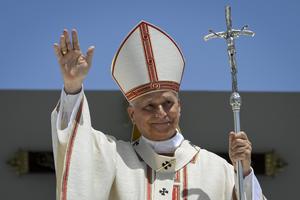
WHEN JOHN PAUL II agreed to meet with Fidel Castro a few months ago, the Cuban exile community was stunned. No one believed that Castro had suddenly converted or that the Pope was unaware of the thousands of political prisoners who have been tortured and executed in Cuba. But before predictions could be made about the results of the meeting, more surprises followed: the Pope accepted Castro's invitation to visit Cuba. In exchange, the Cuban government issued visas for 15 priests and 25 nuns. A small number of visas, perhaps, but nonetheless a dramatic concession for a government that in 1963 expelled 75 percent of the country's 800 priests and allowed only 300 of the 2,500 living there to remain. For 37 years only 250 priests have been allowed to serve a population of 4.5 million Catholic Cubans.
Was this warming of relations between Cuba and the Vatican a foreshadowing of impending change on the island or a mere smoke screen by Castro? Will the Pope's visit trigger a chain of events that will eventually end Castro's 37-year-old dictatorship? Like all things Cuban, these are heated questions.
In recent weeks these issues have been the topic of conversation among Cuban Americans. I must admit that I have great hopes for the papal visit. I started to hope a few years ago when a Polish friend told me that the first time she had participated in a non-Communist demonstration in Poland was for John Paul's visit in the early '80s. She is sure, she told me many times, that the power of that gathering changed things in her country and in Eastern Europe forever. Ever since the papal visit was announced, I've telephoned fellow Cuban Americans and shared the feeling that the future may be a little brighter for Cuba. We all acted a little giddy. “Who knows?” we speculated, “perhaps next year in Cuba.”
Then I vividly remembered that when I was in fourth grade, my father came back from work, uncorked a bottle of champagne and said: “Fidel is dead! We are going back home to Cuba!” My mother spent all evening talking about the state of the house they had left in 1960. But a few hours later it was confirmed that the rumor was simply a mix of hopeful misunderstandings among fellow Cuban exiles.
But year after year, Castro has held fast and left the exile community waiting for their dream to be realized. While Marxism and Leninism have crumbled around the prison island, Castro seems to have become almost untouchable as the last bastion of communism. Amaster at public relations and politics, Castro and his regime have survived the Bay of Pigs, numerous United Nations denunciations, repeated reports by Human Rights Watch and Amnesty International, several devastating hurricanes, top level defections, two massive boat lifts, innumerable assassination attempts, and a three-decade-old U.S. embargo. Even while most of Latin America has turned its back on his regime, and while the European Parliament has expressed its disgust at the lack of freedom in Cuba, Castro remains in power. Not even U.S. embargo-fighting legislation, the Helms-Burton Act, has toppled the 70-year-old dictator.
Castro's power and resilience is derived from the society he engineered 30 years ago when he dismantled conventional Cuban society block by block. After expelling most Religious from a basically Catholic country, he made all religious holidays illegal, paganized all holidays and prohibited employment for any believing Cuban. The Revolution thrived on the separation of families sending children to “voluntary” sugar cane-cutting summers and Sunday political rallies. Children were indoctrinated in schools with the legendary question: “Who takes care of you?” The right answer, of course, being “the Revolution.” Atheist families did well and were praised while any child that professed faith in God was marked for life.
Many priests were persecuted, tortured and beaten, But in spite of Castro's cruelty and skill, and the institutional Church's alleged silence—former political prisoners like Armando Valladares have accused some Church leaders of silence in the face of regime abuses—one thing is undeniable. The Church has remained in Cuba as the only vestige of civil society. While families have crumbled and all other societal structures were simply erased, people could still count on the Church. In a moving editorial about her experiences growing up in Cuba and believing in God,
New York Times reporter Mirta Ojito wrote: “Cubans are going to Church as never before because it is one of the few places they feel a measure of freedom and because, in the face of the misery of their lives, the Church, as it always has provides peace and sometimes a meal.”
As a result, there has been a tremendous resurgence of Church attendance in the recent past. Jaime Ordonez, an exiled member of the Catholic Association of Professionals agreed: “There is a renewal in Cuba. We keep in touch with Catholics there who have witnessed a dramatic increase in daily Mass attendance. Blacks and whites, young and old alike are returning to the Church.”
But in spite of the optimism it is obvious that many barriers remain in Cuba. In late February, Cubans around the world attended Mass said for the four pilots that were shot down by the Castro government a year ago. Peaceful demonstrations and prayer vigils were held worldwide in a spirit of unity and mourning.
One of the Masses was held in the Church of Carmen in Havana. During the Mass, Cuban state security broke in and threatened parishioners while arresting a 27-year-old Jewish dissident, Miguel Angel Aldana Ruiz. The police threatened that if the Mass was not stopped, they would make Aldana Ruiz “disappear.” Aldana Ruiz encouraged the parishioners to keep on praying while the police arrested him. As of today, Aldana Ruiz's whereabouts are unknown.
It is unlikely that a papal visit, scheduled to take place Jan. 21-25, 1998, alone will change Cuba. But Church attendance might. The spiritual build up of the Cuban people may be the first step toward rebuilding the society that Castro destroyed. It is always the small changes that trigger the big revolutions. In the meantime, I have chilled the champagne and this New Year's Eve I will toast with my husband and my parents and pray “next year in Cuba.”
Kristina Arriaga de Bucholz is based in Alexandria, Va.
- Keywords:
- April 13-19,1997