Print Article | Email Article | Write To Us

Daily News

God's Plan for Marriage (2149)

User's Guide to Sunday, Oct. 7

10/07/2012 Comments (7)


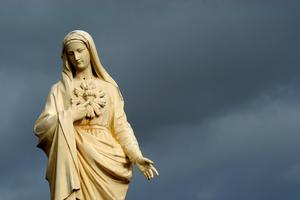
Sunday, Oct. 7, is the 27th Sunday in Ordinary Time. It’s also the feast of Our Lady of the Rosary.


Saints

In America, clever secular politicians feel they are showing great foresight by opposing the teachings of the Church. Of course, they are only the most recent in a long line of clever secular politicians who have had the same thought, from Nero’s Rome to North Korea.


On Oct. 8, the Church celebrates 11 martyrs of the Spanish Civil War who died at the hands of politicians in the 1930s. In three years, 12 bishops, 4,184 priests, 2,365 monks and 300 nuns died for the faith in Spain.


Readings

Genesis 2:18-24, Psalms 128:1-6, Hebrews 2:9-11 Mark 10:2-16 or 10:2-12


Our Take

Marriage isn’t a smooth and untroubled life. It is difficult. It entails suffering.

There are three ingredients to a fulfilling marriage, according to the Church: being faithful to your spouse, being open to children and staying together through thick and thin.

First, faithfulness. There is no greater fidelity than what Jesus describes in the Gospel.

“For this reason a man shall leave his father and mother and be joined to his wife,” says Jesus in today’s Gospel, “and the two shall become one flesh.”

Two don’t just become faithful; they become one. If that sounds like a painless, untroubled existence, think again. Think of the pain one flesh experiences, and then multiply that by two. Now, think how much harsher the pain is when “two become one.” Suddenly, there are two wills trying to be one will, two sets of preferences trying to compromise on one set of choices.

Marriage is often compared in the Bible to Christ’s relationship with his Church. The pain we feel in becoming one is like the pain Jesus felt when being faithful to the Father’s will. The second reading teaches us that Christ was “made perfect through suffering.” Likewise, the only way our love becomes perfected is through the suffering that comes with, for and even because of our spouse.

Second, Catholic marriage requires openness to children. In fact, children are mentioned in each reading.

The first reading from Genesis describes our movement from childhood to maturity: “A man leaves his father and mother and clings to his wife.”

The Psalm describes our movement from maturity to parenthood: May “your children [be] like olive plants around your table. … May you see your children’s children.”

The Gospel describes yet another movement: back to childhood — “whoever does not accept the Kingdom of God like a child will not enter it.”

This is the progression of a Christian life. Children start out helpless and rely on others for everything. Adults rely in the same way on their spouses (or their vocations). Then parenthood (spiritual or physical) comes, and through it all we find we need to rely on God for everything.

Third, God designed marriage to be permanent. “Whoever divorces his wife and marries another commits adultery against her; and if she divorces her husband and marries another, she commits adultery,” Jesus says.

Of course, there are cases where abuse is present or there are other serious issues that can impede this permanence. But in God’s plan, overall, if you are married, you are supposed to stay that way, through all the ups and downs.

A remarkable study surveyed couples before they married, during their first year of marriage, and then checked up on them every five years for decades. What the study found was that most people experience periods of “great dissatisfaction” with their spouses. Those who divorce and remarry are soon enough “greatly dissatisfied” with someone new. But those who stick it out and stay with their spouse will report “satisfaction” again.

Marriage is a sacrament. Sacraments work, guaranteed. We just have to give them a chance, with God’s grace.


Tom and April Hoopes write from Atchison, Kansas,

where Tom is writer in residence at Benedictine College.

 

Filed under catholic marriage, children, god's will, husbands, sacrament of matrimony, wives

Comments

Post a Comment

This is all well and good, but the collapse of marriage among devout Catholics and the lack of opportunity for faithful, practicing single Catholics to marry must remain a concern.  If the institutional Church did more to affirmatively promote marriage for its single members, we might not be fighting a rear-guard action today against same-sex unions.

LTS I don’t know where you are seeing a collapse of marriage among devout Catholics.  The Catholic Church is the one place where the teaching on marriage is very clear.  Perhaps you’ve seen a lot of marriages that shouldn’t have exsisted in the first place, which is unfortunate.  Invalid marriages occur due to various reasons, but even an invalid marriage can be saved unless one or both spouses are abusive to each other.

I understand the pain of being single but the Church does promote vocations (marriage & religious) to her members.  And while there is not a plethora of explict dating opportunities, there are many outlets inside as well as outside the Church to meet other single Catholics.  Some of the opportunities inside the Church include volunteering (at Fish Fries, a shrine or parish school bookfairs, the parish school picnic or field day, PSR, RCIA, FOCUS, 4:12, EDGE, parish’s pulling weeds day, cleaning out the rectory basement day, etc.), going on retreats, checking your diocesan newspaper for dances or other events that are meant to attract singles, having a booth at the Christmas craft fair at your parish or Girls Day Out…

The holy family decided to have only one child.  Why can’t other catholic families decide the same is right for them?

Bishops who allow Priests and politicians who allow the license of Moral Relativism: it is the ‘false gospel’ St. Paul warned us about on 8 Oct 2012 in his the First reading to the Galatians 1:6-12. Here is one stark, recent example: when the self-described “Cafeteria Catholic” nicknamed the “Lion of the Senate” roared his last, the Redemptorists and Diocese of Boston shamefully treated him as a “Dignitary who must not be judged.” Actually, as a self-professed “Cafeteria Catholic” who would pick and choose the pro-abort option at every turn, he should have previously been given a “Latae Sententiae” with a caveat from any number of Bishops: “Minus anything less than a profound and public apology to his Pro-Life Catholic Church, consitituents and all to whom he has scandalized via the advance of the pro-human-slaughter in the womb, the following will occur: a burial somewhere deep under the floor of a local Catholic Cafeteria.” Sound too harsh? Poor baby. But more: poor little innocent ones to whom we deal the ultimate child abuse—slaughter in the womb. Sibelius should have the same warning now; no—3 years ago! clearly, and unequivocally. Instead, our Catholic “leadership” leads from behind, with trepidation for the almighty 501(C) Tax Exempt Status. Kyrie Eleison. LoveInitsFullestExpression=LIFE         http://www.catholicfatherbill.com

I am a testament to all what was written above. Troubles in my marriage let me finally to fall on my knees and completely giving myself to God’s plans. And all my life changed. I thank God for my wife every day now. I pray for my wife every day. I am in love with my wife, and not because she is like Mary but because I opened my heart to God and now I share in His love for Her.

Dear Judy: The Holy Family did not decide to have one child only. They decided to do what God created them for. They had a very unique role. One single role that will never be expected from anyone else. Our role is to be open to Life. God gave us a tool - we know when we can get pregnant. Only a few days a year. As a man I can use my wife whenever I want to use her for my pleasure or I can respect her and learn to say no to myself whenever we think we are not ready to have children. We are expected to think about each other instead of loosing ourselves for bodies. Now, God can make a choice and give us a child to take care of. BTW - sex without God is sex without Love. Shutting door on God means shutting door on the one that is the source of Love between spouses. That means that there is only bodily sex and there is no Love. It is a dry old moldy bread instead of an amazin meal. Sex without heart is dead, so sex without opennes for live is dead. That means that my wife would be just a ‘sophisticated’ body for my pleasure void of any value. So if the pleasure dissapears I can dump her for someone that gives me what I want - my own pleasure. And that is an ultimate death.

With all due respect, if you know a thing about Mary and/or Joseph, they didn’t ‘decide’, but rather placed their entire faith in God, who decides. That is what Tom and April are suggesting here—surrender to God’s will rather than assuming God’s divine place and definitively saying ‘No’, when we should be saying (not just in marriage, but in all we do)‘Your will be done, not mine, Lord’.

If one child is God’s gift to a marriage, so be it. But always being receptive to the prospect of more is what a blessed marriage is about, which is why deliberate use of artificial birth control for the express purpose of avoiding children is entirely contrary to God’s plan. Not my words, but Mother Church’s words.

During the time of Jesus, marriage among Jews was a male-dominated institution. A wife was regarded as the property of the husband and had few legal rights. Adultery, for instance, was prohibited not as a breach of trust but as a violation of the husband’s property rights. Divorce, however, remained an acceptable option and could be legally demanded only by the husband, although the wife could obtain it if the husband consented.

In the Roman Catholic, Orthodox, Anglican and Episcopal tradition marriage eventually became regarded as a sacrament. It was not until the twelfth century however, that the Roman Catholic Church taught that marriage is indissoluble, making divorce impossible. The only possibility of separation and remarriage was through annulment. The bishops at the Second Vatican Council (1962-5) acknowledged that the purpose of marriage in the modern world was not only the procreation of children but also companionship and even intimacy between spouses. Canon lawyers interpreted this shift as an expansion of the grounds for annulment to include psychological factors, and consequently the number of annulments granted in the church rose significantly. Was this necessarily a bad thing? Must an abused woman remain married to a physically and mentally abusing spouse or even a unfaithful spouse?


Post a Comment

By submitting this form, you give The National Catholic Register permission to publish this comment. Comments will be published at our discretion, and may be edited for clarity and length. For best formatting, please limit your response to one paragraph and don't hit "enter" to force line breaks.

The time period for commenting on this article has expired.