Cardinal Burke Talks About Rome, the Mass, Canon Law and U.S. Culture
Midwestern cleric speaks candidly as he celebrates his first anniversary of elevation to the College of Cardinals.
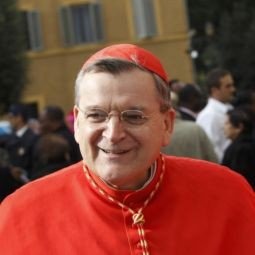
ROME (EWTN News/CNA) — Cardinal Raymond Burke, one of the Catholic Church’s top U.S.-born clerics, is marking the first anniversary of his November 2010 elevation to the College of Cardinals.
“Well, it’s been a very fast-moving year,” Cardinal Burke told EWTN News in his Roman apartment just yards from the Vatican, where he serves as head of the Church’s highest court.
“But it’s been a very good year, I’d have to say, and I’ve certainly come to understand more fully what it is to give this service to the Holy Father and hope that I am doing it better.”
The College of Cardinals consists of the men considered the Pope’s closest aides, giving counsel and assistance to the Holy Father when needed. It currently has under 200 members, with only 115, those under age 80, eligible to elect a future Pope.
Cardinal Burke, 63, has had a remarkable journey from America’s rural Midwest, where he grew up as the youngest of six children, to his current post as prefect of the Supreme Tribunal of the Apostolic Signatura.
“I never dreamed of it, to be honest with you,” he said, reflecting on God’s guidance of his path to the Vatican.
“I grew up, thanks be to God, in a very good Catholic home,” he recalled. “We were small dairy farmers in Wisconsin, which was a very common situation in that part of the world. But I see how God has been at work all along, and I marvel at it.”
While much has changed since those days, his life as a cardinal is “not unrelated to what my parents were trying to teach me from the time I was little.”
“And the truth of the matter is that the older I get, the more I appreciate those first lessons that were taught to me, that early formation in the faith.”
After 14 years leading dioceses in Wisconsin and Missouri, Cardinal Burke was chosen in 2008 to head the so-called the Supreme Court of the Catholic Church.
“Whenever I’ve done whatever’s been asked of me,” he said, “I’ve always found a happiness in my work as a priest, and I continue to find that today.”
A patriot with an obvious love for the United States, the Rome-based cardinal remains invested in the struggle for his country’s culture.
“It is a war,” he stated, describing the battle lines between “a culture of secularization, which is quite strong in our nation,” and “the Christian culture, which has marked the life of the United States strongly during the first 200 years of its history.”
He says it is “critical at this time that Christians stand up for the natural moral law,” especially in defense of life and the family.
“If Christians do not stand strong, give a strong witness and insist on what is right and good for us both as individuals and society,” he warned, “this secularization will in fact predominate, and it will destroy us.”
Cardinal Burke favors realism over pessimism and believes “things are getting better” in America, particularly among the young.
“I think that sometime the young people understand much better the bankruptcy of a totally secularized culture because they’ve grown up with it,” he observed.
Many youth “have seen their families broken” and “have been exposed to all the evils of pornography,” leading them to conclude that the secularization project “is going nowhere and that it will destroy them” if left unchecked.
But the cardinal also thinks persecution may be looming for the U.S. Church.
“Yes, I think we’re well on the way to it,” he said, pointing to areas of social outreach , such as adoption and foster care, where the Church has had to withdraw rather than compromise its principles.
This trend could reach a point where the Church, “even by announcing her own teaching,” is accused of “engaging in illegal activity, for instance, in its teaching on human sexuality.”
Asked if he could envision U.S. Catholics ever being arrested for preaching their faith, he replied: “I can see it happening, yes.”
The Vatican’s top judge takes a dim view of self-professed Catholic politicians who oppose the Church on key moral issues.
Among them is Health and Human Services Secretary Kathleen Sebelius, who is currently seeking to force most of the country’s employers, including Catholic institutions, to cover contraception and sterilization in employee health plans.
“To the degree to which (Sebelius) proclaims herself to be a practicing Catholic, she is very wrong,” said Cardinal Burke. He sees it as “simply incomprehensible” for a Catholic to “support the kind of measures that she is supporting.”
The cardinal says his native country’s 2012 election will be “very significant.”
Catholics, he said, “have a serious duty to vote and to try and find the best candidate to elect.” And some “good and solid, right-thinking individuals” may even be called to run for public office themselves.
Above all, the cardinal hopes for a New Evangelization” of the United States, starting with faithful families, strong religious education, and reverent liturgical worship.
The family, he noted, is where a child “first learns the truths of the faith: first prayers, first practices his or her life in Christ.” But the Mass itself is the “source of our solid teaching, of our solid witness” and also “the most beautiful and fullest expression we give to that teaching.”
The tribunal prefect also exercises care for the Church’s liturgy as a member of the Vatican’s Congregation for Divine Worship.
He is grateful to Blessed John Paul II and Pope Benedict XVI for giving the Church “a font of solid direction” regarding worship, based on the Second Vatican Council’s vision of a “God-centered liturgy and not a man-centered liturgy.”
That intention was not always realized, he said, since the Council’s call for liturgical reform coincided with a “cultural revolution.”
Many congregations lost their “fundamental sense that the liturgy is Jesus Christ himself acting, God himself acting in our midst to sanctify us.”
Cardinal Burke said greater access to the traditional Latin Mass, now known as the “extraordinary form” of the Roman rite, has helped to correct the problem.
“The celebration of the Mass in the extraordinary form is now less and less contested,” he noted, “and people are seeing the great beauty of the rite as it was celebrated practically since the time of Pope Gregory the Great” in the sixth century.
Many Catholics now see that the Church’s “ordinary form” of Mass, celebrated in modern languages, “could be enriched by elements of that long tradition.”
In time, Cardinal Burke expects the Western Church’s ancient and modern forms of Mass to be combined in one normative rite, a move he suggests the Pope also favors.
“It seems, to me, that what he has in mind is that this mutual enrichment would seem to naturally produce a new form of the Roman rite — the ‘reform of the reform,’ if we may — all of which I would welcome and look forward to its advent.”
Cardinal Burke’s main role, however, is to uphold the Church’s legal system. He describes canon law as “the fundamental discipline which makes possible our life in the Church,” since it is “not a society of angels” but a communion of men and women who require norms for living.
He acknowledges that canon law fell out of fashion beginning in the late 1960s, during a period where many Catholics bristled at the notion of such rules.
“The whole euphoria that set in within society, and in the Church itself, was that this was the age of freedom, the age of love, and so, in those years, nobody talked anymore about ‘sin.’ This was considered to be negative talk.”
But since “human nature didn’t actually change,” the “lack of attention to discipline and to law” produced a great deal of “bad fruit.”
One consequence, the cardinal believes, was the mishandling of clerical abuse accusations.
“Absolutely, there’s no question in my mind about that,” said Cardinal Burke. He pointed out that both the 1917 and 1983 Codes of Canon Law put “a discipline in place” to confront an “evil” the Church had faced before.
“All of that was in place,” the Vatican judge reflected, “but, first of all, it wasn’t known in the sense that people were not studying the law, were not paying attention to it, and so, if it wasn’t known or studied, then it wasn’t being applied.”
Historically, he believes, it was an “unfortunate coincidence” that a cultural upheaval accompanied Blessed Pope John XXIII’s call for a reform of canon law.
“This added to the notion that we didn’t really have a law anymore; then the attitude developed that we don’t need it.”
Blessed John Paul II resolved the situation after his election in 1978, implementing a new code of law by 1983. Cardinal Burke remains “deeply grateful” for the late Pope’s action.
Having been raised to the rank of cardinal, the head of the Apostolic Signatura could someday cast his vote for a future Pope.
But could divine Providence ever call the son of a Midwestern farming family to the papacy himself?
“Oh, I don’t believe so,” Cardinal Burke laughed.
“I hope that the present Holy Father lives a long time. He’s a tremendous gift to the Church, and that’s my great prayer: that the Lord gives him many more years.”