A Spiritual Father to a New Flock
Bishop Robert Vasa reflects on first year shepherding the Diocese of Santa Rosa.
Moving from the Diocese of Baker in rural eastern Oregon to the San Francisco Bay Area has been a major transition for Bishop Robert Vasa. He has traveled far from the Lincoln, Neb., farm where he grew up, the grandson of Czech immigrants, and now leads a large and diverse diocese. But he hasn’t let the transfer impede his drive to be a spiritual father to his flock.
Since becoming bishop of the Diocese of Santa Rosa, Calif., one year ago, he has become fully engaged as shepherd of 171,887 Catholics living within his 11,711-square-mile diocese, stretching from Petaluma to the Oregon border. Last August, he invited two sisters from the Spokane, Wash.-based Sisters of Mary, Mother of the Church to his diocese.
At the end of March, he was the keynote speaker of the “Make Straight the Pathway” conference on Catholic health care in San Francisco. At the end of April, he spoke at a men’s conference in the Napa Valley. This October, he will kick off an evangelization initiative that is still in the planning stages.
But there is more to his life as a bishop than these activities. His is a life filled with devotion, leading by example. In a recent interview, he discussed current issues as well as his own spiritual life.
You’ve now been in the Bay Area for a year. How do you feel the area can be evangelized?
We have a diverse set of priests and laity. They are the seedbeds of evangelization. We need formation of evangelized people who can carry it to the streets. The work of Christ is largely spiritual. There should be perpetual adoration in each parish.
How can cultural and cafeteria Catholics be evangelized?
All we can do is teach the truths of the faith consistently and charitably. People have a tendency to say “I believe” — and for many people it tends to be an opinion rather than an act of faith. It’s more of an “I accept it, therefore I believe it” rather than “I believe it, therefore I accept it.” Few people believe what the Church teaches. It requires faith and trust in the word of someone else. We have to submit ourselves in our faith; it takes humility. It’s not easy to set aside one’s own opinions to follow the Church, to believe and accept it.
What is the difference between conscience and opinion?
There is a huge difference. Conscience is a judgment: What does the Church teach? An individual looks at a particular action: Is it consistent with the body of teaching? An opinion is how I think or feel, regardless of teaching.
How should Catholics act politically?
Politics deal with people’s relations with each other. Love your neighbor as yourself is the ethics of politics. Catholics have a right to intervene when rights are violated. “Thou shalt not steal” is a commandment; it’s a law. The law does enforce morality. If society or government determined theft was no longer wrong, there would be chaos. We believe killing is wrong. Those who are innocent should never be killed. A baby in the womb is a person; the human entity exists prior to birth. There is a right, a true and a good.
Health care has become highly politicized. What do you think of Queen of the Valley Hospital’s (Napa) decision in March to provide tubal ligations only as indirect sterilization for health reasons rather than prevent pregnancy?
I commend Queen of the Valley for making the decision. The system is moving uniformly. It is probably a good thing, provided they stay true to Catholic morals and ethics.
What did you discuss at the “Make Straight the Pathway” conference?
I have a friend with the Christus Medicus Foundation who has brought it to the West Coast. I brought a moral component. Some health care is not health care at all. Contraception and sterilization cause healthy organs to malfunction. However, fertility treatments aren’t covered, and IVF (in vitro fertilization) replaces the marital relation. I want Catholics to be prudent buyers of health care. Health care is with the whole person: body, soul and spirit. I’m supporting and promoting respect for life from conception to natural death. The HHS mandate undermines respect for life.
How should Catholics reach out in a relativistic society?
All we can do is teach the truths of the faith consistently and charitably. Everything we say ought to be orthodox. There should be right teaching and right practice. The faithful lay Catholics need to make contact with them (non-Catholics/non-Christians). They need to find those opportunities. It’s a moment of encounter. In times of crisis, people will stop to say, “What’s really important?” They’re used to living moment to moment. The primary role of lay Catholics is to reach out to other Christians.
What are your plans for the evangelization initiative in October?
It’s a draft; it’s not ready for prime time. I have given a copy to priests. The faithful are in need of strengthening and need [guidance] to incorporate authentic beauty in the liturgy. Hopefully, through God’s grace, we can bring in solid teachers for the faith. We need a formation of evangelized people who can carry it to the streets. The evangelization initiative is: How do we engage our Catholics and lost brethren? We have to show the Church is good for society and good for mankind.
You recently spoke at the Napa Valley Men’s Conference. What did you discuss? What is men’s spirituality, and why do you focus on evangelizing them?
The spirituality of men is different from women. This conference gave men a chance to claim their own identity. Men are 50% of the population. There is a significant emphasis on women’s spirituality. We tend to focus a lot on Mary and not so much on Joseph. There were 300 to 400 men at the conference. My talk was “The Husband as Priest in the Domestic Church.” I gave a talk on fatherhood. The family is a domestic Church, according to the documents of the Second Vatican Council. There are prayers, rituals, a liturgy of meals. I talked about the importance of men stepping up and showing leadership, as well as the beauty and dignity of worship. I told men that the family is a parish entrusted to them.
How does men’s spirituality differ from women’s? How can Catholic men be strengthened?
Men and women are different physically; how they perceive and pray is different. We are afraid to use the term “leadership of men,” when it doesn’t demean women. I inspired men to be more active in their faith, to take up their crosses and follow Christ in a consistent way. The Sunday Mass is going to the well; I told men to see the sacraments as a source of strength. I support and encourage men by being there.
What devotions are important to you?
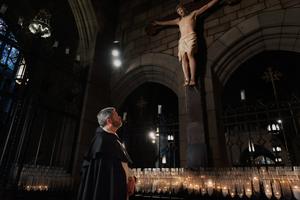
I say Mass every day and have an hour in chapel. I keep God at the center of my life. I read Catholic magazines and books. I deepen knowledge of the Lord and his way. I try to say the Rosary each day. Prayerful devotion is a source of tremendous spiritual power. Devotion to Our Lord in the Blessed Sacrament is the summit, the high point in life.
What books and publications are important to your spirituality?
I like books such as The Soul of the Apostolate (by Dom Jean-Baptiste Chautard), St. Francis de Sales’ Treatise on the Love of God and Introduction to the Devout Life. These are books that stand the test of time and have fundamental spiritual principles. Pop spirituality isn’t substantive.
How would you describe your spiritual life?
I recognize Jesus as my personal Lord and Savior. It’s not excessively familiar. I deepen my knowledge of the Lord and his way. Czech tradition is a father-oriented society, so the primary relationship is with the Father. Mary is there as a constant source of encouragement. It is about living every day with the Eucharist. I want to lead in a quiet, strong way like St. Joseph.
What do you consider success as a bishop?
What really matters is the salvation of others. Helping others to lead holier lives is a single-minded goal. There is the heresy of numbers. The genuine measure is people faithful to the Gospel. The strength of the Church is the number of religious vocations; it’s a telling measure. It’s more about the salvation of souls than jumping through hoops. My apostolate is showing up. People want to know that they matter and you listen to them. It’s about living every day with the Eucharist.
Register correspondent Anna Abbott writes from Napa, California.