Print Article | Email Article | Write To Us

Next Year In Jerusalem
Thursday, April 21, 2011 7:59 AM Comments (67)

image

Have you taught your children that, while Christmas is very important, it’s really Easter that’s the greatest feast of the year? Do they buy it?

When I was little, this point of doctrine was obvious: All during Holy Week, my father could be heard practicing the Exsultet to chant at the Easter vigil, as my mother fried and ground up liver and onions in preparation for the Passover seder. The fragrant schmaltzy steam of the chicken soup, the palm leaves, bags of jelly beans for Easter Sunday and the boxes of jellied fruit slices for the seder—these were all equally essential for Holy Week. We drooled over the growing heaps of luscious Passover food as we suffered the final pangs of Lenten sacrifices. My mother covered her head to bless the candles at the start of the seder, and then a few hours later, hovered over us in the pew to save us from singeing our hair on the Easter candles. I can’t imagine eating leftover gefilte fish without a chocolate bunny on the side; and I can’t imagine hearing “Christ our light!” without echoes of “Dayenu!” - “It would have been enough!” still lingering, both exultant prayers of thanksgiving to the God who always gives more than we deserve.

You might be pardoned for imagining some kind of schizophrenic clash of cultures in my house, but that’s not how it was. My parents did struggle to synthesize the incongruities between Catholicism and Judaism (and for a hilarious read, check out my mother’s account of interfaith communications). My parents were raised secular Jews, and went through a long and strange exodus through the desert together, and eventually converted to Christianity—and then, when I was about 4, to Catholicism.

But for us kids, there was no incongruity: Growing up Hebrew Catholics just meant having much more FUN on Easter than anyone else. My Christian friends wore straw hats, ate jelly beans, and maybe dyed eggs if their mothers could abide the mess. We, on the other hand, whooped it up for an entire weekend as we prepared for and celebrated the Passover seder, the ceremonial feast which Jesus ate with his disciples at the Last Supper. At our seder, which we held on Holy Saturday, there was chanting and clapping, giggling over the mysterious and grisly ceremonial roasted egg and horseradish root, glass after glass of terrible, irresistible sweet wine, special silver and china that only saw the light of day once a year, pillows for the chairs so we could “recline,” and the almost unbearable sweetness as the youngest child asked, “Why is this night different from all other nights?”

It was different because, every single year on that night, there were laughter and tears. The laughter was always more: I waited with bated breath for my father, after drinking his third or fourth ceremonial glass of wine, to trip over the Psalm and say, “What ails thee, o mountains, that you skip like rams? And o ye hills, like lung yams?” And then there are the tears, when we remember the slaying of the first born, and a drop of wine slips from our fingertips onto the plate.

Most Catholics are familiar with the idea that Moses prefigured Christ: Baby Moses was spared from Pharaoh’s infanticide, as baby Jesus was spared from Herod’s; Moses rescued his people from slavery, as Christ rescues us all from sin and death; the angel of death passed over the houses whose doors were marked with the blood of the sacrificial lamb, just as death passes over the souls of those marked with the sign of baptism. Moses brought the Jews on a generation-long journey through the desert, during which God showed constant mercy and forgiveness, and the people demonstrated constant faithlessness and ingratitude—a journey which is mirrored in the lives of everyone. And Moses eventually brought the people within sight of the promised land of Canaan, as Christ has promised He will lead us to the gates of Heaven.

I will always remember my father pausing in the middle of the ceremony, and holding up the broken afikomen matzoh to the light of the candles. When he had the attention of all the children he would ask, “Do you see the light, shining through the holes? Do you see it? It is pierced, just like Jesus’ hands, feet and sides were pierced. And do you see the stripes? Just like Jesus was striped by the whip of the Romans.” And then we would replace the matzoh in the middle compartment of a silken pouch. This special pouch held three sheets of matzoh (a Trinity?)—and the middle one would be hidden away (as if in a tomb?). Until it was taken out and consumed, we couldn’t have dessert. All the sweets that were waiting in the other room—the chocolate and honey sponge cake, the fruit slices, the nuts and blonde raisins, the halvah and the macaroons—all of these had to wait until that middle piece was found and found (resurrected?) again.

But what always stopped me in my tracks is something my father discovered one year. Imagine, he told us, the Hebrews in their homes, painting their doorpost and lintel with the blood of the lamb as the Lord commanded. They would raise their arm to brush the blood on the top of the door, and then down again to dip again into the blood; and then up to the left, to mark the post on one side, and then to the right ... does this sound familiar? Act it out: up, down, left, right.  It’s very possible that, thousands of years before Calvary, the children of God were already making the sign of the cross.

Make of it what you will. At our house, what we made of it was that God loves us, has always loved us, and always will love us. “I have been young, and I have grown old, and I have never seen the righteous man forsaken or his children wanting for bread” (Ps 37:25). We are all the chosen people, and God speaks to us each in our own language, through our own traditions.

And I believe that he laughs and weeps along with us when we say with a mixture of bitterness and hope at the end of the seder, “Next year in Jerusalem.”

 

Filed under easter, judaism, passover

Comments

Post a Comment

My family have participated in a Seder meal with friends who are Hebrew Catholics, and it is a very powerful expression of God’s continuing covenant with His people.  Amazing.  You capture the mystery beautifully here.

Thank you for this beautiful reflection. And (selfishly) what good timing! I am in the middle of making Haroseth as I stopped to read this. Enjoy a blessed Triduum!

And I am making a very un-kosher unleavened bread (butter! yum!) that was in an old book by Maria von Trapp for celebrating the liturgical year.
The menus is bitter herbs,Manishewitz concord grape,  unleavened bread, charoseth, and roast lamb. I always wondered about this, and maybe, if you see this comment, Simcha, you can help me out. The seder as described in the haggadah does not include lamb. Did lamb on Passover end with the destruction of the temple, which I suppose was the end of animal sacrifice?

in highschool (catholic)- we had a big seder meal in the gym with ‘families’ of about 10 at each table…I learned a lot (maybe if I were Jewish my house would be spic and span right now)

@Daria:  yes, as far as I understand it, that’s right:  Apparently at some point the sacrifice shifted from an individual, family meal to a huge gathering of thousands at the temple; and then they stopped eating lamb at Passover when the temple was destroyed.  For more about this, I highly recommend Brant Pitre’s book _Jesus and the Jewish Roots of the Eucharist_, which I and some others reviewed at Patheos, here:
http://www.patheos.com/community/takeandread/2011/02/18/behold-the-manna-the-bread-from-heaven-that-ever-was/

Has anyone ever held a Christian seder meal on Holy Thursday?  This link is to a beautiful adaptation for families to follow, complete with directions and a script. www.lightsmyway.com

I love the observations about the motion of putting blood on the doorway pre-figuring the sign of the cross, and the light shining through the matzoh holes and Christ’s wounds. They’re like signposts along humanity’s pilgrimage route.

I envy you your experience with the seder.  We had one every year at my grandparents’ house, but things quickly devolved into politics.  But I can still sing the Four Questions and I taught them to my kids and I remember drinking the Manischewitz and thinking that Jews had the best grape juice and the best hot dogs in the whole world.

This brought tears to my eyes. i was raised Catholic (mother), but celebrated most of the Jewish holidays with my Orthodox grandparents (father). This time of year is bittersweet since my grandparents have both passed away. I have tried to celebrate Passover with my family and they really enjoy it, but this year and the last few years it has become nearly impossible with schedules to do so. My heart is heavy with the loss of the celebration, but I can only do so much.

Thanks simcha for a great description of your Passover Seder. I celebrated a great Hebrew Catholic seder with my cousins (the fourth year we have done it together). The children absolutely love it and really look forward to it and they all have their favourite bits. I think the wider Catholic church needs to learn from the Jewish community how to catechise their children in the home setting. All the Easter lituries are in the church and at home is only a meal-with maybe grace at the beginning and a search for easter eggs. Pope benedict when he was a Cardinal called for passover to be celebrated as a family festival by all Catholics (especially european catholics).

The best of both worlds, is what I’d call it: two major feast days wrapped in a single weekend. And the excellent double reminder of the importance of Easter and the prefiguring in Moses’s time.

And thank you for linking to your mom’s article - now I know from where you get your fabulous writing ability!

I second that- just read Marilyn’s article it was so amusing and Jewish.

Happy, happy memories.  I remember that night as being holy and festive— a taste of heaven. We were so lucky!  It’s true, it was easy for us to see that Easter is the greater feast.  Christmas dinner was harder for us to do “right” because we didn’t have family Christmas traditions of our own from past generations—which was OK, since lasagna for Christmas is wonderful.  But this was fully our own and also fully Christian. Thank you for writing this.  (Uh . . . I do think people should know that the ceremonial wine glasses are tiny, and the younger kids had Welch’s grape juice, mostly.)

After reading most of Chaim Potoks novels, I had a sense that i was reading, in a way, about devout Catholics from Brooklyn. So from my perspective, learning about the customs and life of Jews filled a missing link in for me as a Catholic. Makes the Catholic life even more enriching. A Jewish convert I know of tells me that even today, if I would visit Synogogue, I would see where our liturgy comes from. Also, I think gefilte fish (not the sweetened kind) makes a great Friday fast snack.

I am wondering if your Jewish grandparents were accepting of the conversion of your parents and raising of the grandchildren as Catholic? My husband is Jewish and converted to the Catholic faith after 25 years of marriage. We were married in a Catholic ceremony and have raised our children in the Catholic faith. Sadly, this was unacceptable to my husband’s family. They were estranged from us and then after a time came around. However, the religious issue is still divisive and my husband has never disclosed his conversion. We maintain a cordial relationship but my husband’s family is to this day, sadly,  anti-Catholic .

Great post! Judaism brings so much meaning when you look at Christianity.

What a beautiful post, it nearly brought me to tears. We are Roman Catholic, but growing up we did a “Passover Meal” on Holy Thursdays, with lamb, unleavened bread, etc. and we asked “why is tonight different from all other nights?” It sounds like it pales in comparison to the “real thing”, but I am now kicking myself that I haven’t yet begun this beautiful tradition with my own family, and wishing that I had enough time to whip it out for tonight. Next year…
Thank you.

@Anne on Thursday, Apr 21, 2011 3:42 PM (EDT):  That’s a shame that there is so much tension in your family.  My grandparents were horrified at first, but were fairly resigned by the time I was old enough to be aware of the situation, and some of them even had end-of-life conversions to Catholicism!  So you never know what will happen.

Don’t want to rain on anybody’s seder here - honestly, I’m on the fence about this myself.  When I first heard of Christians doing a “seder,” I thought it sounded nice, but I’ve asked a number of Jewish friends about it, and all were very uncomfortable with it.  One said she found it “deeply offensive.”  I thought she might be over-reacting, but then I thought, if non-Catholics started play-acting Mass to learn about Catholicism, I’d be deeply offended too.  As both Jewish and Catholic, what do you think about this, Simcha?

I come from a Jewish family and I find your article deeply disturbing, a feeling I get when I watch TV Evangelicals talking about Palestine or Catholics. It is a hideous idea to combine Truth with Darkness, and the Jews are condemned to wander in Darkness until they decide to give up being Jewish. I do agree with ARM that play-acting can be offensive, and I would add that it can also be dangerous.

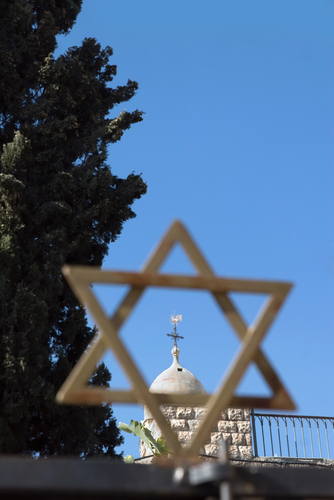
For example, you have headed your article with the Zionist Star, a masonic thing that has nothing to do with traditional Judaism and everything to do with the modern Apartheid state of Israel. The Menorah would be more appropriate, with a cross on top. Your picture is more approprate to an article about how Zionism has destroyed religious liberty in the Holy Land. In this article you show us your Zionism, not your Catholic Faith.

I have friends that told me about their experience going to a Christian non-denomational couple’s wedding. They were really exploring what it meant to have a Christian marriage, and did some biblical studying on the topic. My friends recounted that the wedding involved breaking bread over an altar and other symbols that pointed to some Catholic truths. Both my friends and my reaction to this was positive. Clearly by doing this they were searching for meaning, depth, truth. I think that if I heard of another non-Catholic “play-acting Mass” in a manner that was respectful and humbly searching for meaning, I would be enthusiastic. I have heard of Christian pastors slowly changing their services to something more similar to the Mass, only to then convert. But I would be curious what Jews would think of this too. Just offering my own thoughts.

Hey Paul, your response shows us your cuckoo pants, rather than your Catholic faith.

Reflecting more on this…we share the same roots of our faith.  What’s wrong with celebrating and sharing in that? Wouldn’t that only bring some sense of unity and peace?

@Paul, maybe we should also get rid of those dark and disturbing Old Testament readings at Mass. And the incense.  And the tabernacle.  And the altar.  And oh yes, the Eucharist, with its “hideous” and “dangerous” Jewish roots. Your ideas intrigue me, and I wish to subscribe to your newsletter!

Simcha: Definitly, as befits your name, a joyful post! And I still have to get Brant Pitre’s book!

I disagree with both ARM and Paul Bennett—neither your Mass attendance nor your seders are “play-acting”, but rather very serious actions towards reconciling Jewish cultural imperatives with your Catholic faith. And I also know that groups like the Hebrew Catholic Association work with the CDF and the USCCB to keep the lines from crossing. Next time you cover a topic like this, you might see if you can find appropriate cross-links to back up your position ... oh dear, that sounds too serious! :^)=) But maybe it’ll help fend off the sourpusses.

As a Jew who practices Judaism, with all its rich and full layers of meaning, I have to admit that I’m disturbed by any attempt to merge these very different traditions. 
It’s moving to read of the power or beauty of your own childhood memories, but I believe that Judaism has all of that on its own - the laughter, the tears, the love and salvation of a faithful God. 
I believe it is a complete faith that has stood on its own longer than any other religion.  If I wasn’t Jewish, I am sure I would be Catholic - it seems by far the closest thing to what I believe and feels very warm and familiar to me. 
But Judaism does all of that for me and more and I hope and pray Christians will come to see it as a complete and independent faith on its own merits - not merely as an empty or perfidious precursor to a full and vibrant Christian life.

Just to clarify: I am NOT on the same page as Paul Bennett, nor do I think Simcha’s family is “play-acting.”  They are Hebrew, after all - this is their own tradition.  What I’m wondering about is whether it’s entirely appropriate for the rest of us Catholics who are not descendents of Abraham to mimic ceremonies that belong inside the family, as it were.

Several years ago, the Catholic and Protestant chapels on our military base held a Holy Thursday Potluck/Seder before Mass (for the Catholics).  Many of us truly enjoyed the insight to our Jewish heritage.  Of all the efforts that have been made between the two chapels for ‘fellowship’ this was one of the most successful and meaningful.

And our Bishop told us on no uncertain terms that it was not to happen again.

Several of us tried to find out just why, and no satisfactory answer was ever given.  You can be sure our Protestant brethren don’t quite understand.

I now have a son who has ‘converted’ (is that the right word?) to Judaism and I would love to be able to participate, to a point, with him, and to help him understand just what he has embraced, and hopefully what he has turned away from.  As I, and by extension my daughters, also have Jewish family roots, I don’t think this is wildly inappropriate.  After all, Jesus and Mary would have done the same, no?

What is play acting Mass?  What about other denominations are they play acting Mass?  I’m not Catholic, but I attended a Mass and it was the same as any other denomination.  I think you need be concerned about where you have fallen and confess and not worry about whose pretending to be this or that.  After much prayer people are led into different directions and it’s not up to you to discern.  It’s between them and God.

Okay, I guess there are two questions here:

/

1 - Should Catholics celebrate some kind of “baptized” Passover seder if it offends the Jews?

/

2 - Is it somehow sinful for Catholics to celebrate the seder, since it is the ritual of a different religion?

/

To the first question, I think that Jews may very well be offended by the entire christian faith, and not merely one holiday.  After all, christians claim the entire Old Testament as our spiritual heritage.  We claim all the prophesies about the Messiah as our own.  If a Jew would be offended about something, then there is much more there then just a seder.  So if we are going to eradicate everything in our Catholic culture which derives from Jewish culture, then a huge and essential chunk of our faith will be gone.  So I don’t really know what else to say about that.  I think it would be fairly obnoxious to try to evangelize a practicing Jew by inviting him to your christianized seder, but I can’t see skipping it yourself just because it might offend a Jewish friend.

/

That being said, there is a certain movement, mostly among Evangelicals, to adopt certain purely cultural Jewish practices (not only at this time of year, but all year long), and I can see how that would be deeply irritating.  I once ran across a blog by a young protestant woman, who, with no Jewish ancestry whatsoever, claimed that she was a Christian Jew—as far as I could tell, just because she LIKED the Jews so much.  So she dressed like an Eastern European from the turn of the century, memorized some Hebrew prayers, etc. That’s just weird, and annoying. You can’t just go adopting an entire people as your ancestors. 

/

I don’t know if it’s possible for someone without Jewish ancestry to celebrate a seder in a way that doesn’t seem forced.  I wouldn’t be *offended*, myself, but I don’t quite understand what the motivation would be, if you have your own Catholic traditions to follow.  (I realize I made a crack about how much more fun we had than other Christians, but they were mostly CINOs anyway, and concentrated on the spiral ham and the egg hunts.  I now know that serious Catholics make a rich and beautiful celebration out of Easter, without any help from the Jews!)

/

I might also add that if you are going to live your life in a way that will offend no Jews, you are doomed to failure, no matter who you are.  Being a member of a race that has been persecuted without ceasing for millennia tends to make people a little prickly.  There are some Jews who think everything is offensive; and there are some Jews who think everything is funny. 

/

The second question, whether it might be *sinful* for Catholics (with Jewish heritage or otherwise) to celebrate a seder is addressed pretty fully in this guy’s blog.
/
http://aronbengilad.blogspot.com/2008/11/passover-seders-are-sinful.html
/
He says, “It is impossible for a Catholic Jew to celebrate Passover as if the Messiah had not come, as everything in the celebration speaks of his Presence and brings one to a deeper understanding and appreciation of the transformed Passover Seder that is the Eucharist.”  There is nothing to fear here. 

/

It is hard to believe that, when someone reacts with a visceral distaste for the idea, he is reacting purely out of concern for the purity of the Church:  it is hard to imagine that there is no anti-semitism in this reaction.  I am not accusing anyone here of anti-semitism; but the wholesale rejection of anything Jewish is NOT a Catholic idea.

/

I guess what I want to say is that we are ALL of mixed heritage.  Have you ever attended a Catholic service in a really different culture?  There are ALWAYS traditions adopted from whatever culture existed before the Church arrived —but it is particularly rich when the Church includes Jewish elements, as it does in abundance already.  After all, Christianity is the shoot that was grafted onto the tree of Jesse.

@Simcha I totally agree with everything except.  “You can’t just go adopting an entire people as your ancestors”.  As children of God, we all have the same ancestors.  The enemy is the one trying to divide us not God.

@Capitalcee:  Okay, agreed - but the way this particular girl was doing it was kind of like when some white suburban hippie decides to start braiding her hair and dressing like an American Indian, because the spirituality is so intense, man.

Thank you for your thought-provoking article, Simcha.  My family has always done a Catholic seder in our home for Holy Thursday, followed by going to Mass.  We are not Jewish by descent but I always loved seeing the common roots and the connections between Judaism and Catholicism that you mentioned.  This year, however, I came across a document: God’s Mercy Endures Forever: Guidelines on the Presentation of Jews and Judaism in Catholic Preaching(Bishop’s Committee on the Liturgy, United States Conference of Catholic Bishops, September, 1988) I was particularly troubled by Paragraph 28. Which seems to support doing a correct Jewish seder but to condemn changing it to be more “Catholic”.  What is your understanding of this?

Maria, I’m not familiar with this document.  Could you quote the paragraph in question?  Although sometimes taking a single paragraph out of context can be misleading.

@Simcha

http://www.usccb.org/liturgy/godsmercy.shtml

Thanks for your answer, Simcha.  It makes sense to me.  Obviously, a baptized seder isn’t a sin, and also obviously some Jews will be offended by any and all Christian practices, but I do tend to think researching Jewish cultural practices and striving to re-enact them in ever greater detail is, as you put it, forced and also . . . tactless - is that the right word?  (Not to mention that it’s a bit ironic for us to be carefully imitating modern Ashkenazi foods like gefilte fish and matzo that bear little resemblance to anything Jesus and the apostles ate; it would make more sense to me to have lamb and pita if you want to tell your kids “We’re having a meal a bit like Jesus’ last supper”.)  I like your point that we can’t go adopting an entire people as our ancestors just because we’re Christians.  I know Catholics whose view is that the New Covenant negates and wholly replaces any special relationship God had with the Jews as a chosen people, so that we are now essentially the “real chosen people,” and I don’t think that’s right.  We’re children by adoption, but that doesn’t make us children by blood; I don’t think we should insist on stripping the Jews of that distinction.

@Maria and JP:  Hm, I see what you mean.  I don’t know what to say.  I don’t mean to be flippant, but the bishops are sometimes wrong. 

/

Paragraph 28 says:
“It is wrong, however, to “baptize” the Seder by ending it with New Testament readings about the Last Supper or, worse, turn it into a prologue to the Eucharist. Such mergings distort both traditions.”

/

I promise you, there is no distortion involved in our seder!  The mingling of traditions is seamless and profound.  I think this may be a case of bishops bending over backwards to avoid offense—goodness only knows what goes on in some well-meaning christian seders.  I’m sure that many are, as Maria says, “tasteless.”  (And Maria, that’s a good point about the specific food:  unless you have Eastern European ancestry, gefilte fish, etc., are just silly!)

/

I don’t mean to be arrogant, but I suspect this document was written by someone who has limited understanding of the parallels between the Old Covenant and the New Covenant.  It’s not as if God did everything He did in the desert for forty years, and then said, “Okay, THAT’S done.  NOW what should we do?” and then just started fresh with the Christians.  It’s all part of one big story, so—I don’t know, I just don’t get it.

From the USCCB doc”

. It is becoming familiar in many parishes and Catholic homes to participate in a Passover Seder during Holy Week. This practice can have educational and spiritual value. It is wrong, however, to “baptize” the Seder by ending it with New Testament readings about the Last Supper or, worse, turn it into a prologue to the Eucharist. Such mergings distort both traditions. The following advice should prove useful:

When Christians celebrate this sacred feast among themselves, the rites of the haggadah for the seder should be respected in all their integrity. The seder . . . should be celebrated in a dignified manner and with sensitivity to those to whom the seder truly belongs. The primary reason why Christians may celebrate the festival of Passover should be to acknowledge common roots in the history of salvation. Any sense of “restaging” the Last Supper of the Lord Jesus should be avoided .... The rites of the Triduum are the [Church’s] annual memorial of the events of Jesus’ dying and rising (Bishops’ Committee on the Liturgy Newsletter, March 1980, p. 12).

Seders arranged at or in cooperation with local synagogues are encouraged.


It seems to me that they are fairly specific in how not to ‘baptize’ the seder, that still allows for its incorporation into HOly Week observances.

This year, we were kicked out of our multi-service room in our chapel as a Jewish group (we have those here?) was holding a seder.  This is a first for us.  We’re a small and fairly homogenous community.  All this multi-culturalism is dizzying!

@ simcha

Sorry for double-posting your excerpt.  I suspect it is as you say.  Our Canadian bishops have not, as far as I know, published any official doc on the issues, except to tell us that we are not to use the term yahweh in any sense.

Our own bishop has forbidden the seder as a parish practice.  Period.  Perhaps he was suspicious of the doings?  Don’t know.  I think it’s too bad.

As you say, the bishops are not always right.  Our bishop seems often not to be correct.

Could never understand the attraction of gefilte fish myself…but ARM’s comment is well taken!

You probably have to grow up eating it.  I can see how gross it is, but I still can’t get enough!  Especially the kind that comes packed in that translucent gray jelly—mmmmmmmmm.

@Simcha…yes that’s probably it.  I’ve only had it once…not at a Seder with the beet=coloured horseradish that could take the skin off your mouth…I preferred the horseradish! LOL

Now, haroset…THAT was tasty.

My sense from that document is that its #1 concern is to avoid giving offense to Jews by playing fast and loose with their sacred rites.  I don’t think the bishops are denying the Jewish roots of the Eucharist, and I doubt they have in mind Catholics of honest-to-goodness Jewish heritage like Simcha’s family.

To be fair to the Bishops- I don’t think they are referring to Seders kept by Hebrew Catholics but those of a semi -official kind by the parish or a group within the parish. the problem with a baptised Seder is that for the Gentiles present they will not know clearly what is from the actual Jewish Seder and what are Gentile Christian additions. The Traditional Seder itself is a much more powerful witness to Jesus and the Eucharist than a Christianised Seder. One can keep the traditional Seder and explain any Christian parallels in the commentary on it during the Seder rather than including them in the ritual itself. My Hebrew Catholic Seder sticks to the traditional Seder with certain parts shortened so that we don’t keep the children up too late ( every family has its own particular minhagim (customs)}. Sometimes we make Christian comments at certain stages along with Jewish comments about the meaning of the different parts of the Seder. The problem with some Christian Seders is that they try to make it all solemn and serious losing alot of the joyous spontaneity of the Jewish Seder. What one does in their homes with their family is not really anyone else’s business anyway.

@ARM:  yes, that’s probably a lot of it, although the phrase “Such mergings distort both traditions” really sits oddly with me. I can’t understand anyone wanting to be bishop - what an impossible job!

Cardinal Ratzinger (now Pope Benedict XVI) in his book “Behold the Pierced One” states “...it seems to me, this Passover celebration which has come down to us from the nomads, via Israel and through Christ, also has (in the deepest sense) an eminently political significance. We as a nation, we in Europe, need to go back to our spiritual roots, lest we become lost in self-destruction. This feast needs to become a family celebration once again, for it is the family that is the real bastion of creation and humanity. Passover is a summons, urgently reminding us that the family is the living home in which humanity is nurtured, which banishes chaos and futility, and which must be protected as such. But we must add that the family can only be this sphere of humanity, this bastion of creation, if it is under the banner of the Lamb, if it is protected by the power of faith which comes from the love of Jesus Christ…”

Oh, Athol, I just noticed that you are the author of that blog I linked to!  I guess that officially makes me an unobservant Jew, ha ha.

dear Simcha, I agree with you- I think many of the Bishop are just trying to not disturb the Catholic -Jewish dialogue and often they go overboard in my opinion. If Passover is introduced as a family festival for all Catholics then I imagine it would be appropriate for them to adapt it to suit the customs of the particular Gentile nations they belong to.

Well Simcha it is a bit tricky with my name change from Athol to Brother Gilbert of the Divine Presence- no wonder you didn’t realise. The Cardinal Burke interview with David Moss was great in this regard and he enjoyed his time at the Hebrew Catholic Seder in St Louis immensely. He encourages Hebrew Catholics to keep their traditions and Seders “in the light of Christ”.

And I wanted to add that I agree with Simcha’s Husband about the cuckoo pants- I hope I will get to meet you both one day as I think it would be hilarious- could be a sin though-as we might have to much fun and laugh ourselves silly.

The Traditional Seder itself is a much more powerful witness to Jesus and the Eucharist than a Christianised Seder. One can keep the traditional Seder and explain any Christian parallels in the commentary on it during the Seder rather than including them in the ritual itself.
/
Yes, this is how we do it (although we begin and end with the sign of the cross). I love the comment that the traditional seder is a more powerful witness to the Eucharist than a Christianized seder.  I have never actually been to one of these gentile seders, but I can easily imagine that they are, as you say, overly solemn and formal, which is a shame - there’s always so much joking and laughing throughout the ceremony at our house.

In Behold the Lamb Ratzinger writes about the Holy Laugh in the Easter liturgy and how in the past the priest had to tell a funny joke so every one would laugh- that was in the times of the Latin Mass-If you did that today in some of those Tridentine Masses the peoples faces would crack and they would lecture the priest on the sins of levity and behaviour unfitting of the glorious Latin Mass which Jesus himself celebrated according to the 1962 Missal.

One of the best parish Seders I attended was a High Church Anglican parish Seder (on the Wednesday of Holy Week some years ago) where my mother and I were the only Jews present and everyone had a ball. They also had wonderful stations of the Cross and Holy Thursday and Good Friday ceremonies. They asked me as a Hebrew Catholic to lead the singing and dancing with my small team of Catholics (we were part of a Catholic community that worked with street kids etc). I was particularly astounded when the Anglicans took up a huge collection for us towards our work with the street kids at the end of the Seder. They kept each year ceremonies that were Catholic and Jewish but they were certainly not play acting- it was a deep and fulfilling spiritual experience for them and for us.

“the sins of levity and behaviour unfitting of the glorious Latin Mass which Jesus himself celebrated according to the 1962 Missal”

HA!!!!!

Simcha, I tend to agree with your analysis of the document from the USCCB.  Personally, I also think they have got things wrong, however, I want to be respectful of the bishops and not dismiss what they say, simply because they don’t agree with me!  I see a couple of different issues here:

1. Hebrew Catholics vs. non-Hebrew Catholics.
2. authentic seder vs. Catholic seder
3. location: synogogue/Jewish home, Catholic Church or Catholic home.

First, there doesn’t seem to be much, if any, disagreement about Hebrew Catholics celebrating a seder “in the light of Christ” (as Bishop Burke put it).  My particular question is about non-Hebrew Catholics.  For whom the Bishop also finds the seder edifying. 

Secondly, the USCCB does not seem to have a problem with any Catholics participating in an authentic Jewish seder as GUESTS or holding one themselves, as long as it is done “correctly”.  But they indicate that “baptizing” the seder is wrong.  I’m not sure what that means in particular.  Would a commentary which showed the connection to the New Testament be “baptizing” it?  Certainly, a true Jewish seder wouldn’t do that. Bishop Burke’s comment of doing it “in the light of Christ” could be seen as a contradiction to the USCCB position.  Or perhaps, it means one would not change anything, other than an internal knowledge of the Gospel.

To the third issue of location, the USCCB allows and even encourages participation at a seder held at a synagogue or Jewish home, if one is a guest.  I can understand that there COULD be problems and confusion if a seder were held at a Catholic church…even more so, if it were done in any way as a part of our own liturgy. 

But what about non-Hebrew Catholics holding a Catholic version of a seder in their own homes as a private devotion?  Is this permissible?

I think with some Christians a danger of including the Eucharist as part of the Seder Meal which the Bishops want to avoid. While the Eucharist has its roots in the Passover and the Sabbath- it does not replace them nor is the Eucharist a form of a baptised Seder. The Catholic mystics (such as Blessed Anne Emmerich and Luisa Piccaretta)state that Jesus celebrated the legal or ritual Pesach- then he rose from this table and washed the feet and then on a separate table where the Messianic cup of wine and the Afikoman (matztah bread) had been placed- he inaugurated the Eucharist. taking the Messianic aspects of the Seder he proclaim himself as the Messiah and introduced the Sacrifice of Bread and Wine as the memorial of his coming Sacrifice on Golgotha. I do not believe he included the Eucharist in the middle of the ritual Seder. I also do not believe this occurred on the first night of Pesach but on the second when many groups of men gathered as Havurahs to celebrate a less strict Passover Seder with their male friends. see http://aronbengilad.blogspot.com/2011/03/is-16-nisan-date-of-crucifixion.html

Wow, that’s really interesting, Athol. I had always thought it peculiar that artists show Christ with such a simple meal of bread and wine at the Last Supper - but it makes perfect sense, if that was separate from the seder meal.

This reminds me so much of how I grew up! I’m a cradle Catholic, but, through a variety of circumstances and bad catechesis, my parents left the Church when I was almost five. We ended up, funnily enough, in a Messianic Jewish church-not JforJ. We had a seder every year, and followed it Easter. The smells, in particular, are what I remember-that, the fact that I was the only ten year old I knew who liked gefilte fish and the chocolate covered orange peels. I also remember running out to check to see if Elijah had toddled on by. Good memories! The best part, too, is that we all went back into the Church when I was a teenager. So, now we have all the good stuff in our repertoire. Thanks for writing about this.

Many of the artists were familiar with mystical accounts and based their paintings on them.

Simcha, after reading this article I thought the comments would be too boring. After all, how could anybody have a problem with what you just described. Hm.

I have read a lot of your posts and I have to say I think you just have some people that sit and wait for your posts to be published to disagree with you no matter where you stand.  Although it’s slightly funny this matter of faith didn’t get nearly as much attention as (do I dare say it?) PANTS!

Gorgeous, Simcha. Just gorgeous. I thought of you so much when I was in Jerusalem for that conference a while back. And I said a prayer that you’d make it there some day. You’d love it. I want to go back and spend much more time there.

Happy Easter, Fishers and Prevers!

Simcha and Athol, I know this is after the fact, but I, like Maria, have a hard time figuring out where the lines are drawn for what is acceptable or not.  My family looks as much forward to our Passover dinner as to Easter morning. My kids and I always feel a deepening understanding and love for our faith during the meal. We particularly enjoy the rituals, such as the dipping of herbs and looking to see if Jesus has come again (the seder we use, being from a Christian perspective, replaces Elijah with Jesus.) The script we use is very similar to the one found here http://lightsmyway.com/inspiration/christian-family-seder-meal/

If you have the chance, would you mind, either of you, looking at this and commenting specifically on the merits or pitfalls of such a Christian seder as this?  BTW, the blogger is incorrect in her commentary that this seder contains readings from the New Testament.  It merely has a running commentary to go with the traditional seder passages.

Dear Simcha,
  Loved your article.  So interesting the part about the piercings and the stripes in the Matzo prefiguring Christ’s sufferings.  Speaking of pre-figuring:  I picked up a child’s guide to Passover in a bookstore a few years ago and almost dropped it when I read the scripture that goes with the third cup of wine at the Passover-the last our Lord drank at the Last Supper: “He will save you with an outstretched arm”.  Which a few hours later He did.

    Getting to church on Holy Thursday has always been too much for us to accomplish a Seder so our little nod to Christianity’s Old Testament roots and Christ the Lamb of God is a roast leg of lamb on Wednesday and the leftovers as lamb curry on Holy Thursday with Matzos and wine-a fast fix-ahead meal.

Simcha,

What a wonderful article about your experiences. I am a Hebrew Catholic like you and so many others who commented.  We have a small group called a Havurah that meets in people’s homes and is made up of both Hebrew and non-Hebrew Catholics.  We celebrated our first Hebrew Catholic Seder and it was a joyous event.  One of our Havurah families hosted the event and for many people it was their first Seder.  We used the Haggadah that is published by the Association of Hebrew Catholics.  We heard so many positive comments. From the Seder it is quite clear how Jewish our Catholic Church is.  The Church has always been and always will be made up of both Jew and Gentile.  We are not treading on anyone else’s religious tradition.  We are appropriating our own tradition.  This tradition belongs to the ancestors of Peter, Paul, John, etc of which all who practice Catholicism whether from Hebrew or Gentile descent come from.  We who are Hebrew Catholic have a calling from God to live out our faith according to the tradition of our ancestors and by extension we can share this with our non Hebrew brothers and sisters.

Shalom Simcha, this is a beautiful article.  I too am a Hebrew Catholic and we have small group called a Havurah that meets monthly to study and pray together.  We study the Jewish roots of our faith with other Hebrew Catholics and non Hebrew Catholics in the Indianapolis area.  We had our first Hebrew Catholic Seder and use the Haggadah published by the AHC.  What a joy it was to hear the 4 questions chanted in Hebrew by a 7 year old Irish Catholic boy!  All the non Hebrew Catholics were blown away by the connections between the Seder and our Holy Mass.  It is still hard for me to believe that there are people out there who just flat out deny the Jewishness of our faith.  It is fair to say that we are not appropriating anyone’s religious tradition because it is every Catholic’s tradition to celebrate Passover.  Of course there will be some non Catholic Jewish friends who would like to us to stop celebrating the Seder but this is our faith and our heritage.  We do not do this to be deceiving in anyway but we sincerely believe in the Jewish Messiah and post messianic Judaism which we call the Catholic Church.  I submit that any attempt to separate the two is not the work of the God of Abraham, Isaac, and Jacob.

Hey Paul,

You say, Zionism is ruining religious liberty in the Holy Land??  Are you kidding me?  The only country where Christianity is actually growing is in Israel.  Do you honestly think that if the Jews turned the West Bank over to the Palestinians that Catholics and Christians would stand a chance?  Just look at the rest of the Moslem world…that should give you the answer.  And you are from a Jewish family?  Oy vey?  Cuckoo pants…

Gershon

You make some very good points!

After my son converted to Judaism, I decided to use that as an opportunity to learn more about what is my heritage both as a Christian and as a person whose great grandmother was Jewish.

I began having the Parshas and Torah lessons sent to me online.  I have learned some fascinating things about Catholicism!

Post a Comment

By submitting this form, you give The National Catholic Register permission to publish this comment. Comments will be published at our discretion, and may be edited for clarity and length. For best formatting, please limit your response to one paragraph and don't hit "enter" to force line breaks.

Name:

Email:

Write your comment:

Please enter the word you see in the image below:


Notify me of follow-up comments.

About Simcha Fisher

Simcha Fisher
  • Get the RSS feed
Simcha Fisher writes for several publications. She lives in New Hampshire with her husband and nine children. Without supernatural aid, she would hardly be a human being.