I may have committed some . . . light heresy on my post about the Finding in the Temple last week. That wasn't my intention, of course. Show me that the Church teaches something else besides what I say, and I'm really not going to put up a fight! I wasn't trying to teach doctrine, but to share a moderately helpful insight about my personal spiritual life that I gained while listening to the Gospel at Mass. Readers, always remember: If my name had letters after it, my signature would say, "Simcha Fisher, L.S.S." for "Layman Saying Stuff." Caveat lector.
When you're responding to the non-fictional written word, you are within your rights to say either, "Wow, you're right!" or "No, that's false," especially when the author is blabbing about stuff that has been thoroughly worked over by theologians for hundreds of years.
But what about when you're responding to art? There is another kettle of fish. At this time of year, everybody is passing around what appears to them to be fine works of art depicting the events in the Bible. One of the pieces I saw passed around is "The Adoration of the Magi" by portrait artist Tai-Shan Shierenberg.
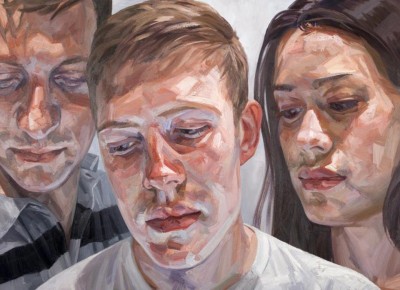
It's an odd, compelling piece, and it got me to thinking about religious art. People have different expectations of religious art and secular art, and rightly so.
Now, some folks apply an insanely rigorous standards to religious art. I stumbled across a blog post that heaped scorn and disapprobation on a children's book, because the illustrator drew snow on the ground near the stable where Baby Jesus was born. Snow! Even though it doesn't actually snow in Bethlehem!!!1! The blogger didn't actually call the book "heretical," but she implied that it ought to be kept out of the hands of impressionable youngsters.
That is a person who is mightily confused about art. While art can certainly be used as a methodical teaching tool (as with an anatomy textbook, or a schematic for a dryer switch), the level of slavishly factual accuracy is not what makes a piece of art either good or worthless. Heck, the history of artistic detail-fudging is as old as the Bible itself.
Most of us are fine with anachronisms in religious art, though we may not realize it. It's easier to stomach anachronisms or factual inaccuracies when the updating that the artist did is sufficiently far in the past that the whole thing, historical reality and anachronistic artistic liberty and all, are equally safely Long Ago.
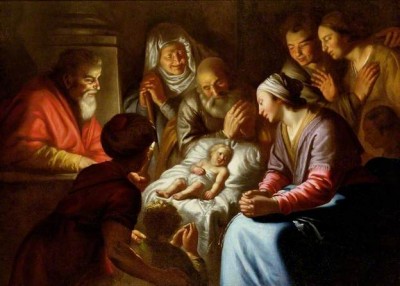
(source)
It doesn't bother us,here, that Mary and Joseph are Dutch, because even the Dutch don't dress like this anymore.
But we get a little nervous when we see religious figures wearing clothes that might be bopping around in our own dryers right now. Our sensibilities tell us it's disrespectful to show Jesus wearing pants and a modern shirt;
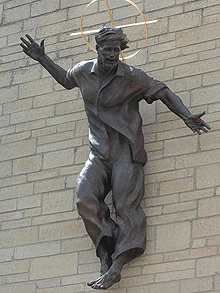
(source)
but this kind of artistic puritanicalism is pure silliness. Artists have been dressing Mary, Jesus and the saints in contemporary clothes for centuries. And surely, if Jesus were a carpenter today, he wouldn't show up for work in sandals and a robe.
Some people will argue that it's all right to update some aspects of the scene, to "bring it home;" but that, in order to qualify as religious art, it must -- absolutely must -- retain some traditional religious symbolism.
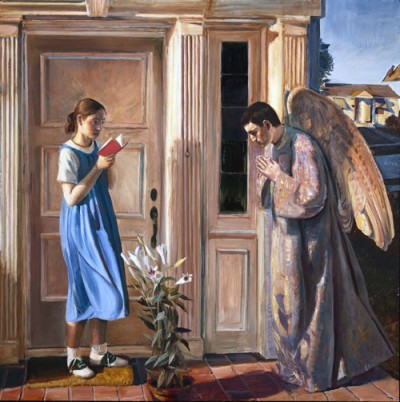
And so this lovely piece by John Collier
(source)
may be jarring to some, but at least it's easy to see that this is the Annunciation: angel, pot of lilies, blue dress, echos of Fra Angelico and all. It may not be to everyone's taste, but you'd be hard pressed to make the case that it's heretical -- that it actually teaches something false about the Faith (and many will agree that it brings a fresh and wonderful insight to a mystery that can become stale, to our ears and eyes, with less imaginative repetition).
But what happens when we not only update clothes and hair and remove the easily-recocognizable symbols, but go a little further? This, I argue, is what artist Tai-Shan Schierenberg has done in "The Adoration of the Magi,"

and I believe that he's made a work of art which is not religious at all, despite its title. It's a good piece, but it's secular. Why? Because of where the focus is.
If you will permit a short sidetrack, let me ask you something. The saints are all different from each other, right? Some are scholars, some are simple, some are strict, some are merry, some are stoics, some are complainers, and some are downright scary -- but they all have something in common: they point to Christ. That is their purpose in life, and that is why we revere them: because their lives are devoted to leading people to Christ. The saints might be interesting in themselves, but they would be horrified if someone became so devoted to them that they became distracted from the soul's true work, which is coming closer to God.
The same is true for religious art. Some of it is stark, some gentle, some lovely, some weird, and some of it just plain hideous, but it all has one thing in common: it at least tries to direct people toward God. (And of course secular art, just like someone who isn't even religious, is also capable of leading people to God, often unintentionally.) You'll notice that this is a very broad goal. There are as least as many paths to God as there are human beings, and what works for one person might seem like pure crap to another. But all religious art that strives for that title has the goal of leading people toward God.
So let's look at this "Adoration of the Magi." Is it a problem that these "Magi" are not kings or wise men, that they're not even all men, that they don't have historically accurate clothes or hair, or that they don't show any signs of bearing gifts or of having traveled afar? Not necessarily. These departures from more traditional art may irritate or perplex you, but they aren't enough, in themselves, to disqualify this painting as religious art.
The reason I call it a secular painting is because it kind of . . . doesn't have God in it. The Magi's faces take up most of the canvas; but that's not what I mean. I mean is that this painting is about the "Magi" themselves, and not about God. A depiction of the Adoration of the Magi might have all sorts of elements in it, but it absolutely must contain at least an indication that what they are adoring is God. This is what is lacking in this picture, and that is what makes it not religious art.
You can tell by the shadows and highlights that the light source is above and to the right, out of the frame. As I've discussed before, what light is doing in a painting is -- well, enlightening. In a traditional piece of art depicting the Magi, the light would be emanating from below, from the Christ Child, or from above, from the divinely-appointed guiding star. In this painting, there is a significant break: the light -- late morning sunlight, from the looks of it -- is from above, from behind the faces, and to the viewer's right. And it's pretty clearly just the sun. Why this innovation, if not to make a point?
You can see very plainly that these three are looking, with tenderness and some deep thought, at a baby -- or at least at something smaller than themselves, something which is causing them to think deeply. This is no mean feat, depicting a face (never mind three) which is indisputably seeing something, thinking something. The viewer fully believes that there is a child there, several feet down and to the left, beyond the frame of the picture.
But what is the expression on their faces, as they look at him? They are withholding judgment. Their oddly prominent lips are closed and at rest, without anything to say. This is not a meaningless, mute painting, though. It portrays very poignantly the religious experience that so many modern people have: they have come to see what the fuss is about. And there it is. They look at God, and they don't know what to think.
These are modern magi: exceedingly clean, healthy, and decent, confident but courteous. But do they adore? I don't see it. I don't think they see God, at all.
There is nothing wrong with this painting. It's not immoral and it's not heretical; and as I said, I like it. It's interesting and well-executed. But I wouldn't call it a piece of religious art. I might call it "art about a religious subject" -- but that's not the same thing. I just wish that today's religious art had more art in it, and today's secular art had more God in it. I wish religious people loved beauty more, and good artists loved truth more.
What do you think? Are you familiar with Schierenberg's art? Do you see something I'm missing? Should someone revoke my L.S.S. degree?


Comments
Post a Comment
The “Hey, Dudes! It’s me - Jesus!” statue made me LOL.
All I could think of after seeing that statue of Jesus was “The Buddy Christ.” That’s about as profound as my art critic side gets today sadly.
TaaaDaaaa! Is Jesus! I believe there is a BVM statue similar to that one too…
Gosh, there’s a lot to think about here. Thomas Aquinas had some standards for art that I’d like to study more. I won’t list them here, because it would be so obvious I don’t really know what I’m talking about.
You made me think of The Golden Children’s Bible, which is the main text we use in our homeschool. Even as a child, it always bothered me that it depicts Jesus with blond hair. Then I spent 2 years as a lay missioner in Japan. I thought depictions of a Japanese Madonna and Child were so cool! Later I realized my inconsistency. If it’s cool for Asians to depict Jesus like themselves, why is it bothersome when Europeans do the same? Now I see it as inculturation, and it doesn’t bother me any more.
http://contemplativehomeschool.wordpress.com
Faith-based education, Carmelite spirituality
I’m not familiar with Schierenberg’s art, but I think I agree with your assessment—it’s an interesting picture and, I think, well-executed, but when I first looked at it, I thought, “Where’s the rest of it?”. I thought you had just posted a detail of a larger painting. The looks on the ‘Magi’s faces—that sort of mild interest—just leaves me with a question—what exactly is the artist trying to say?
I agree with you. For “The Adoration of the Magi” to be religious art, there would need to be some visible *adoration* in their faces. One shouldn’t be able to say that they could also be looking down at a tree where a fireman is rescuing a stranded cat, or medical students watching a woman being delivered of a twelve pound baby.
Looks more like they are staring at a dirty diaper wonder how they can get the other person to change it.
Simcha, that is wonderful. The Magi painting is devestating—it breaks my heart to look at it. But you are dead on, art is not defined so much by its subject matter or even its style, but its mastery over us, and what it is leading us to as apprentices to its reality. Religious art leads us to God, or it is not Religious art. Indeed, I think that is a useful measurement as to whether something is Religious Art or Religious Kitsch as well—does it lead US to God, or does it make US feel better about ourselves, whether it is through warm and fuzzies, national identity, familiar nostalgia, or whatever. Does it master us, or do we master it?
I, also, thought you were just showing a piece of a larger painting. I would never have guessed that it had anything to do with the magi - especially the woman; she almost seems to be drawing away from whatever she is seeing. I actually like the modern version of the Annunciation; it still feels reverent to me. That Jesus statue is just ridiculous.
Showing what kind of life I lead, I thought that the bluish light on their faces made it look like they are hovering over a computer screen, thereby making this a social commentary of how we ‘worship’ computers. Instead of frankincense, they would come bearing gifts of USB cords, wireless mouse, and air-in-a-can.
Simcha I love when you write about art. It makes me interested in learning more. Thank you!
You’r right - it’s not religious art. Just 3 teenagers looking at something.
Analysis spot-on, I think. What little Google has turned up about Schierenberg does not suggest a particular affinity for religious art, more a concentration on human persons in themselves.
Moving on to religious art proper: if you’ve never seen his work, Daniel Mitsui (http://www.danielmitsui.com/) is a fabulous artist and illustrator who has done some neat things including a fabulous rendition of St. Michael as a samurai:
http://www.danielmitsui.com/artwork/mirigo.html
Simcha, you are dead on. @ Rosie – my response precisely.
However - this picture reveals an artistic conundrum – how does one engage the unbeliever in the Christian dialogue? I came to Christ in my 40s. It was quite unintentional! It was an accident of circumstances. As a result, as a writer, I have a heart for writing pieces that deal with God indirectly in all of His aspects, among them, truth, love, beauty and justice. Many converts have met God and Christ first through a “secular” appreciation for truth, and from there being drawn to its ultimate source finally revealed as the Creator. Others, travel from beauty to God…and so on. If expecting secular people to open the door overtly to faith, the Christian faith in particular, we will never see many of them crack the door, even the slightest. But if we open the door without expectation, they may actually back into faith, first unawares, and thus, quite amazed…both at their first sight of God and that it took so long to see Him.
This artist may be hoping to engage the secular person through the title, “The Adoration of the Magi.” The title may engage and draw selected people to inquiry, and thus to faith. For other non-believers, it may “only” be a seed planted that must be tended by future paintings, stories or song. Or the author may just want to express personal emotions of being transfixed by the Babe in the manger, being unable to do anything other than watch and adore. While I agree that this piece on canvas is secular in isolation from the title, I am willing to believe its meaning can be more expansive than that for many who view it.
While we are looking for Christ more overtly revealed in sacred art, this piece may reveal just what is needed to open the heart and mind of an unbeliever. And it may console many a believer in the shared emotions of gazing upon the Christ child. Art may only speak in its fullest sense to one person, but that may be enough.
The woman is the Magi painting looks like one of the escorts at the local PP clinic when she sees my group of 4 kiddos- not angry, just sort of filled with dread
I would like a print of the modern Annunciation
“Jesus in Pants and shirt” is not something I want to see in my parish church, but it’s kind of intriguing. It might be a good and worthy point of meditation to view an excellent, rendition of Jesus (and Mary for that matter)in contemporary clothing but embodying manliness, strength, modesty, virtue, and a *Kingly* stature. This might actually be a great thing for our husbands and sons to contemplate—in a gallery.
I am not familiar with this particular artist’s work but it looks like he is using real subjects for his paintings. All artists like to be free to work as they wish no matter. Certainly even composers have been subjected to criticism: Glazunov, Tchaikovsky, Prokofiev, Stockhausen(sp?) and many more. There is no way to tell right off if this a religious work of art or not. If he says it is then it is to him.
I’m not sure about Bethlehem, but I definitely know it snows in Jerusalem.The children’s book’s illustrations might have been correct after all.Even if not, it’s pretty petty for critics to complain about.
Nice article. Thanks!
two other modern artists I know personally whose art is definetly religious:
Andrew Wilson Smith, who is doing stonework for Clear Creek Monastery in Oklahoma:
http://www.andrewwilsonsmith.com/Andrew/Welcome.html
Gwyneth Holston, who has done paintings at various Churches:
http://gwynethholston.com/
They are also just great human beings!
[slightly off topic]
None of the images of the art show up in Firefox 17.0.1; neither does the capcha image (I had to open http://www.ncregister.com/blog/simcha-fisher/are-there-rules-for-religious-art in Google Chrome to leave this comment). Updated to FF 18, didn’t help.
So in case anyone else is wondering “How can I discuss the art if this article isn’t showing it?!!”, try a different browser. ^_^
Hmm. I thought the “woman” was an Asian man. I think I kind of see a five o’clock shadow. Anyway, I’m not sure I like the “blocks” of color. I think I’ll have to look at it a while to see if I get used to it.
I don’t mind that different cultures represent religious figures differently, and I can take a little license with the story as long as it’s framed as, “maybe it was like this,” and it is understood that it is just an imagining, but at some point I have to remind myself, and my children, that these people, even Jesus, really lived human lives and had human faces and clothes and really did look like something. I mean that I think it’s important, at least for me, to remember that this really, really happened. After the resurrection, Jesus ate some fish. He showed actual wounds to Thomas. A real flesh and blood body that had real features. And that’s part of what makes it awesome.
@sara mcd, good point on the fact that Jesus really did look a particular way. He’s not just a mythical figure. He was (and is forever) flesh and blood.
Completely unimportant, but wouldn’t modern kings/princes, or scientists, wear exactly such clothes? :)
I really like the modern Anunciation!
That modern picture of the Annunciation is really interesting-looking. A bit shocking looking at how young Mary appears, but since she was only supposed to have been about 15 or so (I believe I have that right?), then the painting does a good job of using that to highlight how dramatic her choice to serve God would have been.
I’m with you, Simcha, in wishing religious people loved beauty more, and good artists loved truth more. I’m always disappointed when people bag on things that are clever/beautiful/glamorous/etc., as if those things in themselves are sinful, or indicate that the artist isn’t focused on God, when in fact God is the source of beauty, so as His children, we should embrace it!
As a side note, in terms of art, I always find it a little funny looking at all the many paintings depicting Jesus, Mary, or really, most of the Gospel characters as white. Especially when they’re very pale and have red hair, lol, but I understand the depiction of Biblical characters in art in the style of the particular people/culture of the artist.
Great piece, Simcha. The Jesus they depict in the shirt and pants looks like he is saying, “Crucifixion? Eeeh, forget about. Let’s head down to the coffee house and catch us a poetry reading.”
The problem I have with Collier’s “modern” Annunciation is that it’s only modern in the sense that it’s not from 100+ years ago but it is, style-wise, from 60 or so years ago. No 14 year old girl has dressed that way since, what, the 1940s/50s? If an artist were to really paint a modern annunciation, what would Mary wear? How would her hair be styled? Would it work?
Interesting, I actually thought the lighting was from a bright star since it is white and not yellowish. To me I see the idea that in a small way we are all like the Magi. We all have gifts we bring (or should bring) to adore God. I work with the teens in our parish and can see them relating to this picture. The idea that today’s youth have gifts that they need to offer to God.
I found this-snow in Bethlehem? Sure enough:
CNN
January 30, 2000
“Jerusalemites frolic in a rare, heavy snowfall
...The snow was even stranger for tourists, who frankly never considered theyd find the white stuff covering Middle Eastern sands.
Back in Sweden we have no snow today, said one such visitor, so we go to Bethlehem and find snow.
The snow brought a new look to Palestinian controlled areas as well. In nearby Bethlehem, a shout of Allah Akbar God is great heralded a rain of snowballs.
In a scene that might look more familiar to North Americans accustomed to a snowy winter, a snowman guarded the entrance to Bethlehems Church of the Nativity, the traditional location of Christs birth.”
The annunciation paining is one of my favorites. Thanks for bringing it to others’ attention.
Perhaps this is a failed attempt to convey a religious meaning, but in that “Adoration of the Magi”, I was immediately struck by the lighting—I assumed that some of it came from whatever they were looking at: a baby or a computer screen. While the lady does appear to be more fixated on the middle’s ear lobe, I find their expressions to be those of when you simply stare at a baby for a long period of time, such as when they are sleeping. You are not always smiling, you simply, quietly take it(him or her, rather) in. Not that I would put this in a church, though neither would I place that version of the Annunciation.
One thing I like about art is that it can lead to interesting discussions. I think the only thing religious about the magi picture is the title. I thought Mary looked like Dorothy Gale in a suburban setting. I am not into that particular Jesus statue. But it’s interesting to see how different people interpret traditional subjects. And even if I’m not thrilled with a painting or sculpture I can appreciate the talent because I can’t draw, paint or sculpt as well as those artists can.
And if that’s the Annunciation, why doesn’t Mary put down her book and pay attention to the Angel?
Simcha, thank you so much for this thoughtful discussion! I love it when you sit in the armchair of art theory!
I’m going to be contrary and present two cents in defense of “Adoration of the Magi.”
I’m not familiar with the artist’s work or mission—but if we take on faith that the he intended to depict the magi and didn’t choose the subject and the title for ironic purposes, then I think the painting could indeed qualify as religious art. The key is that the work must be taken together with its name, which locates the event and identifies the internal action of the subjects. The name stands in place of the traditional imagery of the the manger with the gifts, the star, etc.—those ques that tell us that what we’re seeing is a ‘proper’ depiction. We must trust the name—these really are the Magi and they really adore.
From this trusting perspective, I think the merits of the picture become more apparent. I find that the faces _are_ lit from below—-it’s that cool bluish light that Ann O’Nymous identifies as a computer monitor**. It’s subtle—fainter than the sunlight—so that it’s almost felt rather than seen. But it’s there and it serves to emphasize the importance of the Person who is the object of the Magi’s attention. Its presence also indicates that the artist has not wholly broken with tradition. (This diminuation of the light doesn’t seem like so much of a departure when you think of the difference between the gothic halo and the baroque head glow)
As for the absence of adoration—-well, the expressions on the Magi’s faces are quite difficult to read. They seem a study in neutrality. I wouldn’t be surprised if the artist asked his models to assume a neutral expression. It’s easy to read scorn or withdrawal because there’s no overt joy. But try imagining that they’re all about to break into tears, and then the painting takes on a different tone. The neutrality of the expressions invites a deeper contemplation of the Magi’s experience, and thereby leads to a deeper contemplation of what it is to encounter God. After all, adoration may not have taken hold of the Magi all at once—they may have needed a moment before apprehending Who they were seeing. By presenting neutral faces, the artist has created room for the imagination to work. The painting reminds us that an encounter with God is not necessarily accompanied with rays of light or swoons of ecstasy. It’s also a reminder that the eyes can only see so much—we might not be able to see on the surface the great events happening in the heart.
Perhaps this is still too much about the Magi and not about Christ, but it seems like the painting could get the viewer in the right territory for prayer—in the same way that the depiction of an individual saint gets you in the right territory. And there are plenty of great works of religious art with neutral or dour-looking holy people!
Does “The Adoration of the Magi” belong in a church? The proof of the pudding is in the eating. From the comments, it seems that most people might find this painting too distracting to be helpful for in prayer. For my part, I think that if presented properly, the painting’s presence in a church could lead to some productive thought and prayer. The image departs from tradition, but I believe (again, assuming the artist acted in good faith), that the departure has the potential to be spiritually productive. It gives those of us who have become too comfortable with golden babies and turbaned kings something to chew on. Perhaps my standards are a little low. I’d certainly rather see this painting in my church then the dismal abstract piece that’s hanging there now.
Thanks again for this great post!
**Ann’s comment reminded me that many of us get our first glimpse of a new loved one via a photo on a computer monitor. Though seeing a picture of a new grandchild on a screen certainly pales in comparison with seeing the Savior in person, it may be the closest reference that many people have—so perhaps the blue tint of the light is appropriate for a modern audience!
“I just wish that today’s religious art had more art in it, and today’s secular art had more God in it. I wish religious people loved beauty more, and good artists loved truth more.”
Exactly. I’m going to quote you over at Mark Shea’s, Simcha. I hope that’s okay.
The art seems to be yet another good example of a “secular” person learning about Christianity, getting inspired by it, trying to create art about it and getting it completely wrong because they still have their secular blinders on without even realizing it. Or maybe they do realize it and are trying to make a point—which further clarifies just how little they get Christianity. This sort of art makes me shake my head with a laugh and wistful sigh. It reminds me of that Depeche Mode song that was popular not too long ago called “Personal Jesus.” Clearly, the band found the idea of Jesus being someone’s personal savior kind of cool. So what do they do? Write a song where they, too, want to be someone’s “Personal Jesus.” Oh, FACEPALM.
Simcha, I absolutely love it when you talk about art. I was an art major in college and I miss it.
The “modern annunciation” looks like it was painted by John Geoghan in prison, like a Gacy clown.
I imagine that if Jesus came down in modern dress he would look a lot more like Clark Kent, and a lot less like Jimmy Olsen.
Wow, I really disagree with your assessment of the Magi painting. This painting is an artistic gamble because everything is riding on those facial expressions. You’re right that until you read the title, you wouldn’t think it is the arrival of the Magi. If I saw this on a wall, I’d be too lazy to stop and try to figure it out without looking at the title. But to me the picture immediately evokes the question “what are they looking at?” Once you read the title, I think the subtle signs are there evident on their faces: it has made these young people stop in their tracks and be still and silent. What you interpret as an aloofness and curiosity to see what the fuss is about, I think is a quality of solemnness. They are faces in quiet contemplation of the sacred. I like that you can’t really see their eyes; the focus is not on them but on whatever is capturing their attention so completely. So even without Christ obviously in the picture, Christ is still the focus.
I get what you are saying about adoration being an essential requirement, and perhaps if the artist had bowed their heads a bit more, there would be a stronger sense of that. But then part of the expression on their faces would have been obscured. Many teenagers today are noisy and self-absorbed, constantly in motion and electronic communication, lacking purpose, self-discipline or a desire for quiet contemplation (disclaimer: not your kids). What is striking about this painting is that something beyond the edge of the canvas has made all of that stop. These kids are clearly thinking about something outside of themselves.
I think the light coming from the right is supposed to be the Star of Bethlehem. You can argue that it is more theologically correct for the light to be emanating from the Child in the manger, but perhaps because the painting is not so obviously depicting the arrival of the magi at the stable, the artist chose to include that well-known clue. At the very least, I think it falls within artistic license.
I wouldn’t hang it on my wall, but I think this is actually one of the more intelligent and subtle pieces of modern religious art.
How did Ms Fisher, or any of the commenters, guess that the people in the Adoration of the Magi are looking down at a baby? Apart from the name of the painting, of course. If I had to pick a name for the painting, it would be “Three Nondescript People Looking At Something.” The placement and appearance of the woman at the back doesn’t suggest baby to me at all. “That’s the point, you idiot!” I hear someone say. “Don’t you get it? There are no kings, stable, oxen, star, baby, camels, adoration, meaning, relevance, drummer boy, shepherds, gold, frankincense or myrrh. Nothing to make you think Adoration or Magi. Nothing remarkable at all! That’s why it’s so nifty!” Sorry, I don’t get it. Three uninteresting people inexplicably grouped together and inscrutably looking at an unidentified something. Well, at least I got tricked me into thinking about what the point of the picture is. I’m still not thinking about Wise Men in Bethlehem, however.
Simcha, Papa Ratzinger delves into the differences between sacred and religious art in his book The Spirit of the Liturgy. It’s a heavy book, but his point on this topic is that the art in the West has tended to incorporate secular themes since the 13th century or so. The Renaissance featured humanism, while the Mannerist and Baroque periods for instance depicted the post-Renaissance mindset, and the disorder that seemed to come upon the Roman world since the Protestant Reformation(remember Rome had not been sacked for five centuries, and not so thoroughly since antiquity. Christendom is also gone forever)The religious themes, such as beauty, grace, light and darkness, etc still dominated, but were colored by these ideas. It is much like when the texts of the Mass, are set to music that cannot be sung in church such as opera, full-orchestra, or even jazz. That picture isn’t even sacred art. Eastern iconography does not have this distinction, and while he did not call for an abolition or styles- after all, he believes in preserving the organic developments in both the East and West- he wants us Latin Catholics to bear in mind what the East has done better.
these so called modern art is nothing but secular garbage…if Jesus would appear today, he wouldn’t be wearing a robe or sandals??? the picture of Mother Mary with the angel dressed as a 50’s at-the hop???.nothing but secular garbage….in all the apparitions of Jesus or Mother Mary they are all in long robes and Mary with a veil over her head…think of Lourdes, Fatima, the Divine Mercy image etc..all have one thing in common:PURITY AND HOLINESS. Most of these posts liking these pictures of today shows how far the modern day world has merged with the Church..no sense of the Sacred, just be like me, I’m hip and up to date.
Simcha, you are dead on. @ Rosie – my response precisely.
However - this picture reveals an artistic conundrum – how does one engage the unbeliever in the Christian dialogue? I came to Christ in my 40s. It was quite unintentional! It was an accident of circumstances. As a result, as a writer, I have a heart for writing pieces that deal with God most directly in all of His aspects, among them, truth, love, beauty and justice. Many converts have met God and Christ first through a “secular” appreciation for truth, and from there were drawn to its ultimate source finally revealed as the Creator. Others, travel from beauty to God…and so on. If expecting secular people to open the door overtly to faith, the Christian faith in particular, we will never see many of them crack the door, even the slightest. But if we open the door without expectation, they may actually back into faith, first unawares, and thus, quite amazed…both at their first sight of God and that it took so long to see Him.
This artist may be hoping to engage the secular person through the title, “The Adoration of the Magi”. The title may engage and draw selected people to inquiry, and thus to faith. For other non-believers, it may “only” be a seed planted that must be tended by future paintings, stories or song. Or the author may just want to express personal emotions of being transfixed by the Babe in the manger, being unable to do anything other than watch and adore. While I agree that this piece on canvas is secular in isolation from the title, I am willing to believe its meaning can be more expansive than that for many who view it.
While we are looking for Christ more overtly revealed in sacred art, this piece may reveal just what is needed to open the heart and mind of an unbeliever. And it may console many a believer in the shared emotions of gazing upon the Christ child. Art may only speak in its fullest sense to one person, but that may be enough.
Your art analysis posts are some of my very favorites. I would love to see more of them in the future.
Posted by robert waligora on Wednesday, Jan 9, 2013 8:32 AM (EDT):these so called modern art is nothing but secular garbage… the picture of Mother Mary with the angel dressed as a 50’s at-the hop???.”
*********************************************
Actually, I see alot of homeschoolers dressed just like this.Maybe not the shoes, so much.
General PS: I checked it out & yes, it can snow in Bethlehem.Not terribly often, but it happens.
Actually there are canons of the church that govern religous art. It’s a sourse of division with the orthodox who rightly hate most of out art
@Matt: They’re looking down, thus implying that whatever they’re looking at is smaller or lying at a lower level, and the expressions on their faces are tender, as if they’re looking at something helpless and weak but human—I don’t think that they would look that way at a newborn baby chick, not all three. To me it seems that they are looking at a baby, but of course one’s perceptions may vary.
We ought to distinguish between devotional and liturgical religious art. Of course it is the Bishops who have the responsibility to determine what is liturgical art, but the ‘Catholic nose’ of the laity can be a good guide.
However, it appears as though overall taste has declined greatly, with both experts and the laity having trouble judging art.
But education should help. At one time, the arts were a core part of the educational curriculum for most students. This book on the liberal arts, by a member of the Order of Preachers, has an extensive discussion of the arts:
http://web.archive.org/web/20101230042458/http://www.domcentral.org/study/ashley/arts/default.htm
I would point out that icons (for which there are strict rules!) do not (at least when they follow the rules) depict the Father. You might see a bright light half off the top of the icon, as in icons of the Nativity, or possibly a hand extended down in benediction. The fact that the Father is out of our view does not mean that He is *absent*, though.
Likewise, we never see the face of Jesus in the movie Ben Hur. In fact, we see Him in only a few scenes—yet the title is not wrong in calling it “A Tale of the Christ”.
Ann O and matt, I believe you are both onto something. What is it that we, people of the world today, worship? It is possible the artist used the title to force us to think about that. Many artists make use of historical paintings to make a point today. Many non-religious artists use Catholic iconography in their work to get a message across. It is a language familiar to most of us, a language we are able to read, which makes it possible for the artist to communicate even a secular message.
Although there are men in parts of the Middle East who still wear robe-like clothes, if we want to be super accurate about what Jesus would wear if he were alive today, we could look at Orthodox Jewish men of Israel. Same with Mary. If the angel came to a Jewish girl today, we could reason she would come from an observant family and she would be wearing a longish skirt, plain clothes, modest dress. As you can see, it depends on what the artist is trying to say, the audience he wants to reach, and so on. There are canons for sacred art along with freedom for the artist.
Interesting thoughts, Simcha. Just as an aside. There is probably snow on the ground right now in Bethlehem being that unusually cold weather has hit Israel. My late teacher, who was from Lebanon, once told our class that it can snow in Bethlehem in the winter.
If baby Jesus was looking up at the Magi this is what He might well have seen. I think as long as the painting is clearly described somewhere as “Adoration of the Magi”, on a plaque on the original frame or printed at the bottom of a print, that the painting could qualify as religious. The expressions on the faces are remarkable, just what adoration should look like. If so identified, there would be no mistake about who these “magi” are and who it is they are adoring.
FWK, why can’t we conclude that, if Jesus came today, he might be born among the backwater rainforest villages of Malaysia, or in an African mud hut, or in a Mongolian yurt? I don’t follow your reasoning.
Simcha
I did not read the comments section, so I don’t know if I’m repeating someone else’s thoughts. I’m only addressing your understanding of the painting. You might be right, but there is another way to look at it. It could be that the “Magi” are experiencing a profound religious experience. In the biblical story all the Magi know is that a king will be born in Bethlehem. They do not know that this king will be transcendent and divine. When they get there their experience is profound, penetrating to the soul. The biblical story doesn’t go into detail, only that they “prostrated” themselves before our Lord. The question is what did this profound experience constitute? Did they suddenly realize their whole lives have been working toward the wrong end of holiness? Is their new life, after the epiphany, a burden now after new knowledge?
This is not unprecedented. Read TS Eliot’s poem “The Journey of the Magi.”
http://allpoetry.com/poem/8453741-The_Journey_Of_The_Magi-by-T_S__Eliot
There is burden in the journey and there is burden in their new life. It is a realization of a new cross they have to bear. Here’s the last stanza:
All this was a long time ago, I remember,
And I would do it again, but set down
This set down
This: were we led all that way for
Birth or Death? There was a Birth, certainly
We had evidence and no doubt. I had seen birth and death,
But had thought they were different; this Birth was
Hard and bitter agony for us, like Death, our death.
We returned to our places, these Kingdoms,
But no longer at ease here, in the old dispensation,
With an alien people clutching their gods.
I should be glad of another death.
Now getting back to the painting. It depends on whether the artist is being cynical in the title with “Adoration” or whether “Adoration” is encompassing a deeper, total Truth that projects toward the crucifixion. The shadows can suggest that and can suggest the burdens of their personal sins and the cross they now will bear.
What really strikes me about the modern Annunciation piece is that Mary is not acting completely shocked or intimidated by the angel. I get the impression that she was reading (probably Scripture), and just happened to look up and see the angel standing there.
It’s the angel’s posture that I like. He’s bowing to her as if she is the one worthy of respect, and as he is about to tell her, she is.
I absolutely love the Annunciation photo! I love the idea of putting Biblical scenes in moderns settings, just to show that (to a certain extent) they are timeless. I’ve been thinking lately that if I had any talent in the way of drawing or photography, it would be interesting to do a series of pictures depicting the Holy Family in modern dress and in the circumstances we also don’t think of much: maybe Mary being mocked for being pregnant before she was married; Joseph trying to figure out how to break it to Mary that she’ll have to give birth in a stable; Mary absolutely exhausted from caring for a Baby.
@Andy, Bad Person: I thought Mary looked a little surprised and worried, actually—the way she’s hunching back a little, and her face looks apprehensive, with a little bit of “Um…who are you?” I hadn’t noticed the angel’s posture before, though—you’re right, that’s brilliant!
*Annunciation painting. Sorry, not a photo. xD
For us to say something is beautiful is to imply that there is such a thing as objective Beauty. In a sense, there is such a thing as ugly or even awful and we should not be afraid to speak of it.
Also, it was providential for Christ to be born exactly where He was born. It was also providential for Him to be born exactly when He was born too. That is my problem with the buddy Christ in thrift store clothes or scrubs.
*her face looks apprehensive, with a little bit of “Um…who are you?”*
Voice of God, or dirty birdy? I definitely have to stop reading Ezekiel after lunch. MOM!!!
My parish was merged with another in 2010 and, as a result, the new entity became St Gianna Beretta Molla Parish. How fortunate we were to be named after this beautiful saint! The merge left us with one worship site that retained its name; however, we wanted to have something inside the church that reflected our new parish and its patroness. The result was a bas relief of St Gianna based on the artist’s already existing sculpture, the depiction of which is the saint on a picnic with her children. Yes, that’s right – a picnic. When I inquired about how the decision was made, I was told that the committee was unanimous in that they wanted the saint’s pro-life message to be represented, but that they “didn’t want to hit people over the head with it.” Well, the result is that parishioners and visitors alike turn to each other and ask, “Who’s that? And why is she on a picnic? I don’t get it.” Uh huh. I don’t get it either!
Here’s my biggest question: how did a small committee, right or wrong in their thinking, get the pastor’s approval and, after the pastor, the bishop’s approval? When expenditures are big ones, common sense would dictate that the responsibility of a pastor and a bishop would be to choose sacred art over any other kind, especially something that will be admired inside the church (as opposed to outdoors). It’s not like the artwork will be removed or altered anytime soon. We are “stuck” with a judgment call.
Pray for priests!
John Collier was born before 1920. That explains why the girl looks from the 50’s.
I’m chiming in a bit late on this one - so just going to say how much I really enjoy it when you discuss art, Simcha. You could do posts like this every week…
Chesterton observes that the Victorian period was the first in which clothing was so ugly and unnatural that it felt shameful to dress religious figures in modern garb. Looking at the above pictures, I don’t think the situation has improved since his time.
Great article, Simcha! I always find your thoughts on art fascinating and clarifying. You help me put my own thoughts in order.
I’m privileged to know John Collier and his lovely wife Shirley a bit because I went through RCIA with them. They are a very devout, gracious family — some of the most loving, Christ-centered people I have ever met. On top of that, they are very effective and active evangelizers in their day-to-day lives. We need more of that!
According to his website, John was envisioning Mary in The Annunciation “reading from Isaiah about the Virgin who conceives and bears a son.”
I love John’s sculpture and crucifixes especially – he was the sculptor for the 9/11 Catholic Memorial at Ground Zero in NYC. You can see a bit more of his work, get prints, etc. at http://www.hillstream.com . He was recently inducted into the Society of Illustrators Hall of Fame, but he’s now concentrating as much as possible on creating religious art for the Church, including sculpting and painting for parishes.
Simcha, thank you so much for this thoughtful discussion! I love it when you sit in the armchair of art theory!
I tried to post this two days ago but ran into technical difficulty. I haven’t had the opportunity to catch up on the comments, so forgive me if I’m going over trodden ground.
Here’s two cents in defense of “Adoration of the Magi.”
I’m not familiar with the artist’s work or mission—but if we take on faith that the he intended to depict the magi and didn’t choose the subject and title for ironic purposes, then I think the painting could qualify as religious art. (Though perhaps not in the canonical sense.) The key is that the work must be taken together with its name, which locates the event and identifies the internal action of the subjects. The name stands in place of the traditional imagery of the the manger with the gifts, the star, etc—those cues that tell us that what we’re seeing is a ‘proper’ depiction. We must trust the name—these really are the Magi and they really adore.
From this trusting perspective, I think the merits of the picture become more apparent. I find that the faces _are_ lit from below—-it’s that cool bluish light that Ann O’Nonymous identifies as a computer monitor**. It’s subtle—fainter than the sunlight—so that it’s almost felt rather than seen. But it’s there and it serves to emphasize the importance of the Person who is the object of the Magi’s attention. Its presence also indicates that the artist has not wholly broken with tradition. (This diminuation of the light doesn’t seem like so much of a departure when you think of the difference between the gothic halo and the baroque glow)
As for the absence of adoration—-well, the expressions on the Magi’s faces are quite difficult to read. They seem a study in neutrality. It’s easy to read scorn or withdrawal because there’s no overt joy. But try imagining that they’re all about to break into tears, and then the painting takes on a different tone. The neutrality of the expressions invites a deeper contemplation of the Magi’s experience, and thereby leads to a deeper contemplation of what it is to encounter God. After all, adoration may not have taken hold of the Magi all at once—they may have needed a moment! By presenting neutral faces, the artist has created room for the imagination to work. The painting reminds us that an encounter with God is not necessarily accompanied with rays of light or swoons of ecstasy. It’s also a reminder that the eyes can only see so much—we might not be able to see on the surface the great events happening in the heart.
Perhaps this is still too much about the Magi and not about Christ, but it seems like the painting could get the viewer in the right territory for prayer—in the same way that a depiction of an individual saint gets you in the right territory. And there are plenty of great works of religious art with neutral or dour-looking holy people!
Does “The Adoration of the Magi” belong in a church? The proof of the pudding is in the eating. From the comments, it seems that most people might find this painting too distracting to be helpful for prayer. The image departs from tradition, but I believe (again, assuming the artist acted in good faith), that the departure has the potential to be spiritually productive. It gives those of us who have become too comfortable with glowing babies and turbaned kings something to chew on. Perhaps my standards are a little low. I’d certainly rather see this painting in my church then the dismal abstract piece that’s hanging there now.
Thanks again for this great post!
**Ann’s comment reminded me that many of us get our first glimpse of a new loved one via a photo on a computer monitor. Though seeing a picture of a new grandchild on a screen certainly pales in comparison with seeing the Savior in person, it may be the closest reference that many people have—so perhaps the blue tint of the light is appropriate for a modern audience!
ExOttoyuhr ,
It makes a case for traditional, regional forms of dress as in Austria,Russian,Hungary, the Middle East etc. I think historically, it was more the upwardly mobile folk who became slaves to fashion while “lesser” folk’s costume changed little.
You can look at Our Lady of Guadalupe’s garments & see little difference between them & a modern day Palestinian woman in traditional dress even though centuries separate them.
Nina, don’t fight statuary; emote with it!
Whimsy,
John Collier was born in 1948.
Frank, (Re Collier) Maybe instead of an idealized portait of his daughter, [the annunciation] is really an idealized portrait of his mother?
I don’t have anything of importance to say, other than I really loved the “modern” version of the Annunciation. Perhaps it is just me, but it speaks volumes to me. I love the look of surprise/apprehension on Mary’s face, her innocent pose, and the reverent posture of the angel. I think the painter captured the exact moment she first saw the angel, just before he told her “be not afraid”. :) Like you say, we often forget (or *I* forget), that Jesus conception and birth are timeless events, even if they happened in a particular place in history.
Lovely, lovely piece!
Kathleen,
Traditional styles of dress in the West were much the same as traditional styles in Eastern Europe (look at the Dutch painting above), at least before the 18th and 19th centuries. Western Europe didn’t always dress in a manner nearly as ugly as it does today; 300 years ago, to put Christ or the Apostles in modern dress wasn’t horrifying or ugly, it was simply the natural thing to do.
ExOttoyuhr ,
Yes, I’ve seen old National Geo. photos from the 1950’s & earlier that show folk in Holland,Germany & France still dressed in traditional costume-at least for feast days & special occasions.And I know women & girls dressed in dirndls (spelling?) for Sundays in Austria at least as recently as the 1970’s. My son, who travels much more than I do, said that’s becoming more popular again.There’s hope.Dirndls beat spandex any day in my book.
Hello all
Thank you for your comments about my Annunciation. Actually, I was born in 1948. I am a living Church artist. The John Collier some of you found from years ago was Sir John Collier ( British) a Pre-Raphaelite, -also a painter.
If you would like to see other works , I am happy to pass along my agents web site:
www.hillstream.com
Oops, I forgot to add, the painting was made around 2001 or so. I used a friends daughter as my model. She attended a Catholic girls school near us which has saddle oxfords as part of their uniform. The girl came home from school late, the sun was almost down so there was only time for her to change into a blue dress she had.
Was her name Miss Molly?
Sacred art is meant to move you. To make you understand God and reflect His mysteries. This is why sacred art was used as a communication and teaching tool, from past times, where the written Word was not accessible.
Its not meant to make a political statement or even a cultural statement that dishonors the primary purpose of sacred art being a way of bringing us closer to God.
We have, in contemporary times added a new category and called it “religious art” or “secular religious art”, and the lines have become blurred and the intention missed.
Anyhow..
For me, the annunciation that you posted borders on silly- because it doesn’t depict Our Lady in a graceful manner worthy of respect and veneration. Its naive in it’s execution, whilst ironically trying to be clever in it’s method of depicting Mary as a studious school girl (Mary probably couldn’t read), and with the bad clothing, trying to evoke the innocence, youth and simplicity of Mary. It fails to depict the respect and awe that is Mary. On the other hand even though the Dutch nativity painting is not historically accurate to Jesus time the postures and the ambience in the photo is both moving , solemn and respectful. Especially that of Mary. For me, The Annunciation painting misses that in Mary’s depiction.
“the Adoration of the Magi” I think is the artists attempt at making a cultural statement rather than to spiritually uplift. When you have to psycho analyze the artists intentions and dissect a painting, to convince yourself it’s spiritually uplifting you, I think it’s safe to say the painting fails at being sacred art.
I think, also sacred art should stick close to facts- because they aren’t meant to depict mythological stories, but actual FACTS in the history of Christianity. So, the inclusion, of a woman in the Magi line up is silly, not because I’m “anti women” (I am myself a woman), but because the Magi weren’t female, or young teenagers. It’s one thing to include Dutch clothing and snow, but it’s completely another thing to change the characters in the story completely, which is what this artist has done. And I think he has done it to stir the pot rather than to show respect and to spiritually uplift the viewer.
What next? A female Jesus?
Sacred art is meant to move you. To make you understand God and reflect His mysteries. This is why sacred art was used as a communication and teaching tool, from past times, where the written Word was not accessible.
Its not meant to make a political statement or even a cultural statement that dishonors the primary purpose of sacred art being a way of bringing us closer to God.
We have, in contemporary times added a new category and called it “religious art” or “secular religious art”, and the lines have become blurred and the intention missed.
Anyhow.
For me, the annunciation that you posted borders on silly- because it doesn’t depict Our Lady in a graceful manner worthy of respect and veneration. Its naive in it’s execution, whilst ironically trying to be clever in it’s method of depicting Mary as a studious school girl (Mary probably couldn’t read), and with the bad clothing, trying to evoke the innocence, youth and simplicity of Mary. It fails to depict the respect and awe that is Mary. On the other hand even though the Dutch nativity painting is not historically accurate to Jesus time the postures and the ambience in the photo is both moving , solemn and respectful. Especially that of Mary. For me, The Annunciation painting misses that in Mary’s depiction.
“the Adoration of the Magi” I think is the artists attempt at making a cultural statement rather than to spiritually uplift. When you have to psycho analyze the artists intentions and dissect a painting, to convince yourself it’s spiritually uplifting you, I think it’s safe to say the painting fails at being sacred art.
I think, also sacred art should stick close to facts- because they aren’t meant to depict mythological stories, but actual FACTS in the history of Christianity. So, the inclusion, of a woman in the Magi line up is silly, not because I’m “anti women” (I am myself a woman), but because the Magi weren’t female, or young teenagers. It’s one thing to include Dutch clothing and snow, but it’s completely another thing to change the characters in the story completely, which is what this artist has done. And I think he has done it to stir the pot rather than to show respect and to spiritually uplift the viewer.
What next? A female Jesus?
Yes. So much so does this art reflect the kings of today - I had to write about it. http://pegponderingagain.com/2013/01/11/the-adoration-of-the-magi/
I’ll be honest - a lot of what is approved and used as sacred art doesn’t do Jesus or the saints justice and some are so bad it’s enough to turn you iconoclastic (joke). However, the works shown in this article probably wouldn’t qualify as sacred art as they don’t accurately depict the historical persons they are supposed to represent. Are they attractive works of art? Yes. Are they accurate? Probably not. I recommend the works of Carl Bloch as some of the best of sacred art. Modern art can be sacred, but it sure helps to be accurate.
Hello All,
Ez has a good point. Mary must be honored in a painting of her. Also, I understand the hope expressed here that a religious painting be accurate- by that I think they mean faithful to the first century. The problem is that there never was or ever could be such a painting. There were no artists there when it happened. Every painting you have ever seen on the subject ( at least the good ones I am aware of) uses the artists own experiences and times to help him in his efforts. A painting can’t say everything that can be said about Mary in one go, anyway . Ten thousand paintings have not been enough so far. I don’t think it is a good idea for new paintings about the Annunciation to use 17th century props. The event is timeless. It happened to a specific person at a specific time in history but that isn’t all that needs to be said about the event. With too much attention to historicity the saint is pushed away from us. Away from everyday us and our everyday problems. In a well meaning attempt to produce respect in the mind of the viewer by making it look old and brown, that well meaning artist says, ” this saint is not like you and OF COURSE the saint gave everything to God, it must have been so easy to do so in those times of sepia images.” I painted Mary and Gabriel in a modern setting to say that this wonderful , miraculous thing happened in an everyday place to a person you wouldn’t think twice about if you passed her on the street. That one day in Nazareth you might have rang your neighbors doorbell and the Mother of God answered the door.
The three magi in this painting look like all men to me. If you look carefully at the bridge of the nose on the long haired one, you will notice it is a man.
It’s funny that people always make this big deal about how all the Christmas art depicting Jesus’ birth with snow is wrong because “It never snows in Bethlehem!” Actually, it does; not much, but an inch or two about once a year (and we just recently had a monster storm with 8 inches of snow)! People should be more concerned with the fact that Jesus was born in a cave, not a wooden stable structure, and no one in the Western world knows that!
I have to disagree with the assessment of the painting…
What this painting does reveal, is the look on the “kings” of the world today, who, for the first time, are realizing Jesus Christ truly is King. Psalms 72:11, “May all kings fall down before him, all nations serve him!.” We are all kings in our own right, and in His, we are only children. Ask yourself, honestly, what will be the frist thing I do, when I see His face for the first time. Yes, you will be amazed, but the moment you realize He is Lord, the soul is thrown into a deep state of “Repentance”. Purgatory on earth for those who find Him now, Purgatory for those who did not, after death of the body, do. The moment begins with the understanding that you hurt Him through your sins and lack of love. You sought the things of this world rather than Him first. In every moment in your past, in everything you have done and didn’t do, you missed His love. You didn’t listen to Him. You didn’t do everything He told you to do. The reflection of yourself, in the Son of God on the Cross who became sin but had no sin in Him. Seeing yourself as you truly are. A sinner. Seeing Him as He truly is. THEE same Innocent Child who when we see Him, we understand as the centurion “Surely he was the Son of God!”. This is the beginning of Fear of the Lord. I feel the painting captures the “look”, quite honestly.
“Do not think that your present state is a punishment from Heaven, because you would be wrong, but be certain that your present state is willed by God for the salvation of your soul.” ~St.Padre Pio
Remember the scene from Raiders of the Lost Ark, when the Ark is opened for the first time. The “Bad Guys” were captivated in Wonder and Awe at first, but then “melted”. Yeah, it’s just like that. Our hearts “Melt” from being frozen in sin and we realize the answer to the question God asks, “What have you done”. Genesis 4:10 The answer: Psalm 51:4 “Against you, you only, have I sinned and done what is evil in your sight.”
I had that look on my face for many years and at times even now, still do. He has taught me through repentance, that He is still with me and joy and hope overtakes the “look” every time. In His time. In His suffering. In His forgivness.
Reminds me of the opening song in Les Miserables; “Look Down”. As many do need to “”Look Down” from their personal thrones on high, they have placed themselves in.
Take into account not what the The Kings brought Him, but what they walked away with after seeing Him. They ( The Wise Men) didn’t go back to King Herod (the sinful way). No. They took a different route.
Where did Judas run back to after seeing His Face? “So Judas threw the money into the temple and left. Then he went away and hanged himself.” Matthew 27:5
Turn to me and be saved, all the ends of the earth, for I am God unrivalled. By my own self I swear it, what comes from my mouth is truth, a word irrevocable: before me every knee shall bend, by me every tongue shall swear. – Isaiah 45:22-23
http://pegponderingagain.com/2013/01/11/the-adoration-of-the-magi/
Post a Comment
By submitting this form, you give The National Catholic Register permission to publish this comment. Comments will be published at our discretion, and may be edited for clarity and length. For best formatting, please limit your response to one paragraph and don't hit "enter" to force line breaks.
The time period for commenting on this article has expired.