Print Article | Email Article | Write To Us

The Temptation of Pilate

Monday, November 26, 2012 5:20 AM Comments (63)

When I read the Bible for the first time when I was in my 20s, I had a hard time getting into it. With little knowledge of Christianity and no knowledge of Judaism, I often felt that an impenetrable gulf separated me from the events depicted on the wispy pages of my brand new book. Even the New Testament seemed foreign; it took a while before I was able to feel a connection even to the figure of Christ himself. But there was one exception. One event described in all four of the Gospels jumped off the page to me in its vividness, because I felt an odd connection to one of the main people involved: Pontius Pilate.

When Pilate came on the scene for the first time in the Gospel of Matthew, I sat up in bed, transfixed by what I read. I found the scenes that involved him to be some of the most fascinating that I'd encountered yet, though I couldn't put my finger on why. As I went on to read the accounts of his actions in the books of Mark, Luke and John, however, I came to the unsettling realization of why this person had so captured my interest:

Because he reminded me of me.

Of course I'd heard the name of Pilate before, and knew that he was somehow involved in Jesus' crucifixion, but I'd always pictured him to be nothing more than The Bad Guy, an evil cardboard character, a one-dimensional figure with motives no deeper than that of a B-movie villain. But then I read of his back and forths with the crowds on that fateful Friday, and saw the hesitation in his words even 2,000 after they were spoken. I realized that he was a different person than I'd imagined, that the motives for his choices were complicated, disturbing...and familiar. More than anyone else in the Bible, I saw in him someone whose thought patterns and actions I recognized in an intimate way.

"There is nothing this man has done to deserve death." (Luke 23:15)

Pilate said to them the third time, "But what crime has he committed?" (Luke 23:22)

"You take him, then, and crucify him. I find no reason to condemn him." (John 19:6)

Pilate knew what was right. He knew that this was an innocent man, and seemed to suspect that this might even be someone very special. But with the massive momentum of the crowd barreling down upon him and his political future to consider, there was a lot of pressure to make a certain decision. So what does someone like Pilate do when he or she stands in the face of this kind of temptation? I knew before I read it:

Pilate asked the crowd, "Which one of these two do you want me to set free for you?" (Matthew 27:21)

Pilate wanted to set him free, so he appealed to the crowd again… (Luke 23:20)

You test the water a few times. You keep flirting with the prospect of doing the right thing, hoping against hope that maybe this time it will be easy. But, all too often, there is no easy way out, and you find yourself face-to-face with a choice: You can stand up for what you know to be good and true, or you can be respected by the world. You cannot, however, have both.

He tried to find a way to set Jesus free. But the crowds shouted back, "If you set him free, that means that you are not the Emperor's friend!" (John 19:12)

And when you determine that it's just too difficult to take the high road...

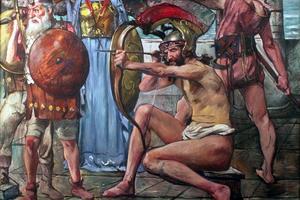
He took some water, washed his hands in front of the crowd, and said, "I am not responsible for the death of this man! This is your doing!" (Matthew 27:24)

...You pass the buck. You pat yourself on the back for trying, loudly assure yourself that you would have really liked to stand up for what you knew to be right, but, alas, it would have caused you too many problems. You confuse passivity with innocence, cowardice with blamelessness, and you go wash your hands.

I thought of all this yesterday at Mass, when Pilate made an appearance in the Gospel reading. As our culture becomes more and more hostile to age-old Christian values, any Catholic who openly practices his or her faith is increasingly considered not to be a "friend of the Emperor." We are constantly faced with the same temptation that Pilate faced there in front of the crowds, to wiggle out of uncomfortable situations, to appease the world, and to make excuses for doing so.

Maybe it's wishful thinking, but sometimes I imagine that Pilate eventually experienced profound regret for his despicable actions, and begged for forgiveness from the God whom he literally turned his back on. If so, perhaps he prays for those of us in times like these, as one who understands that no earthly gain is ever worth keeping silent when it's time to stand up for the truth.

 

Filed under

Comments

Post a Comment

So true!  Relativism can also be traced back to Pilate…

Thanks,so much,Jennifer, love this post; it’s all so glaringly true. I especially, love your wishful thought for Pilate, I, too, hope, in the end, he repented and turned his life over to the Lord.
I was recently pondering his infamous utterance “What is truth?” Pilate, who was, literally, staring Truth in the face would not or could not allow himself to see the Truth.  Jennifer, it seems to me, many of our brothers and sisters appear to be plagued with the same temptation today.

Wow.
Just wow.

Great post, thanks.

Listening to the reading from John’s gospel in Mass yesterday, I wondered: was Pilate merely mocking Christ with his questions? Was he genuine? My own impression is that he was pretty shaken (why, I’m not sure - it’s not as if Christ threatened him at that point), but trying to hide it.

Pilate is one of the most fascinating characters in Scripture, there’s no doubt. I would probably have done the same in his situation.

I was talking to my kids about this exact subject yesterday, when we discussed the Gospel reading from Mass.  We talked about how Pilate knew that it was right to let Jesus go, and that it was wrong to put Jesus to death, but that Pilate chose the wrong thing because doing the right thing was hard.  I talked to them about how important it is to do the right thing even when doing the right thing is hard.
.
By the way, I recommend the novel “The Spear” by Louis de Wohl.  It tells the story of Christ’s crucifixion, but mostly from the viewpoint of some peripheral characters (such as Longinus the centurion, Pontius Pilate’s wife, and the woman found in adultery).  Pontius Pilate is well-characterized in that book, and I thought of that book when I read this post.

When I first clicked on this link I misread the title and thought I would be reading about “The Temptation of PILATES.” Expecting to finally find divinely-inspired reasoning supporting my aversion to fitness pursuits, I was, needless to say, confused. Fortunately, the Pilate version did not disappoint and will have me reflecting all afternoon.

Another great post!

For some REAL details on Pilate’s train of thought, read Bl. Catherine Emmereich’s visions, in Volume 4 of the Life of Christ.  VERY vivid.
God Bless.

@Edward

His wife was even more shaken, having had a dream about Jesus.  Romans, like most people of that day, believed in omens.

The Coptic (Egyptian) Orthodox and the Abbysinian Orthodox Churches believe that Pilate repented and was martyred, so that he is now a saint.  This would be great if it is true, but the failure of that tradition to take hold in the Catholic and Byzantine traditions makes me doubtful.

Thank you, Jennifer.  Thanks for your insight!  I hadn’t piece together the events with the rationale.  In Jesus’ wake, one could easily suspect several lost souls as talked about in the New Testament especially.  I’ve often wondered if those people were lost for good.  I’m happy to read your take on such a seemingly condemned person as Pilate.

Thanks for such a great post! I often have trouble relating to Biblical figures, but Pilate really does stand out. The line that always gets me is, “What I have written, I have written” (Jn 19:22). I hope he did repent one day.

Jennifer, i have felt the same way when reading scripture. I remember growing up with the Weber/Rice JCSuperstar and how they made the Judas character somewhat misunderstood, kinda the wrong place at the wrong time. But Pilate seems to take a very big hit.  I have always found it ironic that Pilate washes his hands and tells the crowd that he doesnt want to be forever remembered as the guy who killed an innocent man and then we have a Creed that mentions Pilate (never a mention of Abraham, Moses, The Baptist, Peter, Caiphas, Paul,Joseph, etc) at every Sunday mass accross the world. For two thousand years.

The actor’s portrayal of Pilate in Mel Gibson’s “The Passion” was well done.

OK, Earl Thompson:  what claim do you have to “scientific truth”?  I ask because I have been a physics professor since 2000, and my experience is that people who really know science never talk that way.

So far, Earl, your claim “I have scientific truth” is coming up empty.  You appear to have no serious acquaintance with science at all, and now you are trying to quote Wikipedia as a source.  Something, I might add, not even Pontius Pilate tried to do. ;-)

Seriously, there are huge problems with your approach.  The Internet is full of people with people claiming outrageous things—such as that the earth is hollow and filled with Nazis, or that the planet Nibiru will swing through the inner solar system and destroy civilization, or that Bigfoot is a real alien from another dimension.  These people are rightly called pseudoscientists, and no scientist is willing to defend an artificial category of scientists + pseudoscientists.  In exactly the same way, I refuse to defend the category “religion”, which tries to lump together the Catholic Church, Shinto, and shamanism.  A scientist can tell you how to recognize science, and a Catholic can tell you how to recognize Catholicism; neither should be asked to defend what they do not believe.

How about a more basic definition of truth?  Something is real or corresponds to reality, or it doesn’t. Trying to break apart truth into “scientific” and “religious” categories makes no sense to me.  Something is true, or it’s not.  If it’s true, it’s factual beyond anyone’s belief or disbelief about it.  Either the sun is a miasma of incandescent plasma, or it’s not.  Either Jesus is God, or He’s not.

To use another example, even if you sincerely believe your garage door is open, if the truth is that it’s shut, you will drive your car into it.  It is strange to me that someone with a scientific background would think that truth is dependent on personal belief in any sphere.  But perhaps I did not understand your meaning.

Earl is not a scientist, he’s a troll (whose favorite source is Wikipedia, as you have noticed).  Other than tax season, when he volunteers to do people’s tax returns, he has nothing better to do with his retirement than to troll.

...troll harder… earl…

Anyway, I’ve always found Pontius Pilate to be really fascinating for the same reasons. He is extremely relatable, just like Peter when he denies Christ. You can easily see yourself, or someone you know, doing the same things…

It says a lot about fallen human nature.

Claire, I know.  I just decided to call his bluff.

Poor Pilate,  I have a feeling most of us are too much like him.  But we have some consolation.  At least we will be forgotten.

On another note, let us learn a lesson.  Never, never quote Wikipedia. 
We have seen that when you do, you make yourself a goof.

“As our culture becomes more and more hostile to age-old Christian values, any Catholic who openly practices his or her faith is increasingly considered not to be a “friend of the Emperor.”“

This is so true.
Thankfully we have Jesus to give us strength.

Read more: http://www.ncregister.com/blog/jennifer-fulwiler/the-temptation-of-pilate/#ixzz2DOGpQDPC

we’re certainly not going to win any souls by calling them names. Sure we disagree with what he says, but calling him a troll isn’t going to earn his respect of Christians, it’s only going to push him further away. What a blessing for an unbeliever to be lead to this website! Let’s do our part and be a witness, not a roadblock.

Well, to be fair, Wikipedia is not that bad a source for information on the sort of dry, technical information that people are not likely to be emotional and/or lie about.  For example, look up the article “Infinitesimal”.  The more likely an article is to lie close to the heart of a controversy, however, the less reliable it is—though I would say the same about Encyclopedia Britannica.  At any rate, for any really important purpose all an encyclopedia should be used for is to direct your search and locate source materials.

Molly:  he has referred to himself as a troll.  The definition of an internet troll is someone who comes to a thread with the intention of disrupting the thread and distracting from the topic at hand.  He has freely admitted to that purpose, and he has often referred to himself as a troll.  (This has been going on for several months now, on many of Jennifer’s articles.)  Calling someone an internet troll isn’t exactly a compliment, but it’s not exactly an insult either.  It’s really calling a spade a spade.  However, you make a very good point about it being a blessing for a non-believer to be here, and I will try to change my perspective to see it as a blessing, because I will admit that up until now I did not exactly see Earl as a blessing (although I do believe that he is a blessing to those people who he helps during tax season).

Molly, if you wish to pray for him, please do, but don’t pretend that Earl is some shy soul who was innocently reaching out for our love.  *That* kind of reaction is more likely to “drive him away”, or at least confirm him in his sense of superiority, than saying, “We know the game you’re playing and you’re being a jerk about it.  We will not play along.”

We’re all jerks from time to time.  I know I am, anyhow.  If Earl wants to contribute to the conversation in a serious manner, he will be welcomed, but in the meantime we should not act as though we are too stupid to see what he is doing.

Pontius Pilate did not listen to the pleadings of his wife (“Have nothing to do with that just man!”)and he also had Christ cruelly flogged as a ‘way’ of trying to appease the crowd, BEFORE he gave in to the demands for execution by the most barbaric method reserved for thieves and murderers. He did release a murderer first, however. SO Pilate did MUCH more than just give up ‘nicely’. He died after losing his high position and there was no sign, in records of Pilate’s later military career and death, that he ever showed the least signs of conversion. You may certainly read up on this, if you want. No need to be overly ‘sentimental’ about a conscience like his.

I just started reading this thread this morning and it appears that Earl’s posts have been deleted from this and at least one other blog. That is unfortunate. Everyone should get to say what they have to say followed by the corresponding rebuttals. I think Earl brings a lot to the discussion. Otherwise, this becomes a mutual admiration society and the truth can never be reached. For example, one might want to ask a legitimate question like “who were the eyewitnesses who conveyed these private conversations to Mark, whose gospel was used as a reference for the other three versions?

Editor: We need Earl’s input to keep everyone honest. Please do not delete it.

Earl is a troll, and he adds nothing to the discussion.  He does not promote honesty, not that anyone here is dishonest anyway. He has said on numerous occasions that he is here not for a constructive dialogue, but to troll and to annoy.  And that’s what he does.  He distracts from the topic at hand by posting insults and does so in a rude, mocking and redundant way.  People who ask legitimate questions are not deleted.  People like Earl who turn these threads into a three-ring circus should be.  This is long overdue.

I agree with you, Bill S.
I don’t care what Earl does or what he calls himself. I’m responsible for my own actions and words no matter who is rude and mocking to me. If he’s a troll, let him be a troll! You do have the option of IGNORING him if it bothers you. If you’re up for the challenge, try EVANGELIZING. if you don’t convert him on the spot it doesn’t matter because that’s not our job, that belongs to the Holy Spirit. I’m just saying let’s not make His job harder.

Molly, you can yell at me all you want. But the NCR does not owe a platform to people who want to mock Christianity, and who distract from the topic at hand.  The people who came here to discuss this article have a right to have that discussion without it being disrupted by off-topic insults.

What ever happened to “I disagree with what you say but I will defend with my life your right to say it”?  Freedom of expression is always to be preferred over censorship and the latter should only be used as a last resort. I didn’t get to read Earl’s posts but I did see the responses. I doubt that what he said deserved to be deleted. I have not seen any obscenities or abusive language that would warrant removal in anything I have read by Earl. It’s a free country. People should be allowed to state their opinions whether we agree with them or not.

I had the same connection with Pilate!!  But I probably knew more about Christianity than you did.  Plus since I’m a ancient Roman history buff, I felt a connection to a Roman in a Jewish world.  And as a manager in my career, I can understand expediency when one is trying to manage complcated situations.  And as an sort of intellectual who grew up in the modern secular world, i can understand the question, “What is truth?”  Even today I feel a sense of pity for Pilate.

Stating opposing opinions is fine.  Posting insults, and coming to discussions with the sole purpose of disrupting them and distracting from the topic at hand is another (and attacks don’t have to contain obscenities to be attacks;  for example, when he calls other people’s opinions “stupid”).  Earl didn’t oppose the specific points made in this article.  He opposed religion in general.  Yesterday I got emails from about 5 old threads where he posted very similar comments, none of which had anything to do with the specific topic, but all were just an attack on religion.  How sad that he had nothing better to do then to look up old NCR threads and copy and paste his poison on all of them.  Sure, it’s a free country.  Earl can find ample platforms for his rants.  But a privately owned blog has every right to block and delete comments from trolls.

OK Claire, you have had more experience with Earl and I accept your position on the matter. I’ll admit that he pushes the envelope. He’ll probably reappear under a new name and will be immediately recognized.

My comment on the story of Pontius Pilate is this: How is it that private conversations were recorded word for word 30 or 40 years later in the first Gospel, expanded upon in subsequent versions and are available to us as if we were eyewitnesses?  We don’t even have that kind of detail in conversations that take place in our own time.

In response to your question:  I personally don’t get too caught up in the details.  The Bible is somewhat of a historical book, but not down to the minutae of details of conversations.  Somehow someone was witness to the exchange between Pilate and his wife.  I doubt that it was recorded word for word.  The essence of it was recorded, first probably orally and then in the written form.  The overall message of it has been passed down, and that is the important thing.  Christians believe that God’s word is protected by the Holy Spirit, meaning that its overall message will be passed down correctly even if the details are unclear.

Great thoughts.  I agree 100%.  Love the last paragraph; it’s something that has never crossed my mind.  Thank you for sharing.

“In response to your question:  I personally don’t get too caught up in the details.”

That’s because your stupid.

Sorry. Couldn’t resist. You know I am kidding.

Okay Bill, it’s a tall order, but I know someone has to fill Earl’s shoes.  You get an A for effort!

(And no, blonde is not my natural hair color.)

Why make Pilate a “good guy”? He caved to a mob and let Jesus be killed. If Jesus didn’t die, there would be no Catholic Church.
.
You can’t know good without knowing evil.

There is a mountain in Switzerland named Pilatus. Legend says Pilate was so distraught after the death of our Lord Jesus, that he fled Rome and became a hermit and then died in one of the caves in this mountain.

My wish is that all of us, who played the Pilate one time or another in our lives, will be given a chance to repent of our actions.

@Bill S., Claire and Molly,

Ditto on Claire’s comments.

Bill S., like you I love disagreement.  But you offer honest disagreement for the actual point of having a discussion with the actual intent of sharing and receiving information.  As a conservative who promoted educational sexual abstinence programs for youth, I had plenty of opportunities to dialogue with “the opposition” on blogs.  It was constructive…and fun.  That is not what Earl was about.

Molly, each “right to do what I want” is balanced with another’s “right to do what they want.”  I was tempted to pay for and offer to Earl his own “Talk with Earl” domain, where he could make his points to people who wanted to “play the game.”  But, I doubt he would have wanted to invest the time and creative thought in the effort to draw people to his website.  Wild and pointless ranting on the blogs that others work to provide is not a right.  It is downright lazy and mean.

I was quite pleased to be able to read Jennifer’s column and find comments germaine to her article.  May that continue to be the norm!

Bill S—
Claire doesn’t get caught up in details because to do so would indicate a doubt in her faith.
.
The let me stay when I was nasty to you about being a “closet atheist,” but once I expressed some opposing views on some other blogs I got blacklisted.
.
Claire isn’t stupid—she is staying willfully ignorant to keep her faith. Why she would think that virtuous is only “logical” to Catholics.

Obviously, Pilate’s speeches are “known” because they are part of the script of the Bible—which you must accept at “truth” because it tells you so.
.
Opposition to the Catholic Church/faith is blasphemy—also defined by the Bible.
.
I still think being a closet atheist must be a kind of hell. I understand why you keep it quiet, but you must be lonely for someone who agrees with you. Arguing with stubborn believers may be refreshing, but it doesn’t compare with having someone understand you.

I can’t cite the exact quote and source, but, I have always been tested by this thought:

If you do not face opposition, then you are not living a bold faith.

In my life to this point, I have been able to fairly easily sail through life events in calm seas.  Where are the storms?  Maybe I have no storms to navigate because I am washing my hands and retreating to share dinner with Pilate.

Thank you, Jennifer, for another way to think about my life and the years to come…the days to come.

True Dem:  what kind of game are you playing?  Were you being nasty to Bill about his closet atheism in order to see if you would be blocked? 

I am not ignorant about my faith.  In fact, I am quite knowledgeable about it.  You completely took what I said out of context.  I was referring to details about word for word conversations.  The exact words aren’t important;  the message is important.  Regarding the conversation between Pilate and his wife, this was a discussion about truth and relativism.  I don’t care what exact words they used.  The message is valuable.

In the past you have shown that you are capable of presenting an opposing viewpoint without getting nasty about it.  How about stepping up to the plate and continuing that approach.  Earl’s approach is not something to be emulated.

Claire—I never said you were ignorant about your faith. I said you were (intentionally) ignorant about opposing views to the details of the story. This is not bad, as the quality of the story is what counts. Sorry if I did not get the literary experience of the story across.
.
The message of the “conversation” between Pilate and his wife was to emphasize that Pilate was “wrong.” There can’t be a Protagonist (Jesus) without a foil (Pilate). The “conversation” was to compare secular (Pilate) with spiritual (Pilate’s wife). Pilate’s side was to condemn Jesus because the secular world demanded it. Pilate’s wife pressed the divinity of Jesus and the wrongful killing of a “divine/human” being executed because the secular society demands it.
.
This is a literary interpretation, but I can’t think of a more pro-life position.
.
Again, I’m sorry if I come across as a pain, but it seems to me that paying attention to details reveals even more of the beauty of Catholicism. Maybe that is why not paying too close attention to detail did not get to Bill S.
/
I really do appreciate opposing points of view and a good argument, because that is how we learn when we can be wrong. I believe I wrote in an earlier post that Catholicism is not for wusses.
.
I guess that’s why some of my posts are irritating and make people angry. Bill S. expressed the same. I see my self as a lover of Jesus Christ, but extremely angry at those who misuse Him as reason to be pompous, hateful, and superior to others. I loose my cool. 
,
Please don’t get too upset with me—my upbringing encouraged questioning and I’m a rebel at heart, like Bill S.

Thank you for another thoughtful post, Jennifer!  How true, how true!

Tru Demo / Fourmoreyears: good to hear from you again. I think opposing views should be welcome just for the fact that they make for more lively conversations. Earl’s style, however, left a lot to be desired. Hopefully he can come back and discuss his views more intelligently.

But True Dem in this case I honestly didn’t perceive that there was an opposing view, so how could I try to be intentionally ignorant about it?  I thought Bill was just raising a question about how these conversations can accurately get passed down through history.  And it’s certainly a valid question.  A conversation that I have with my husband could be depicted very differently when an eyewitness describes it 5 minutes later, let alone 2000 years later.  But I didn’t see his question as an opposing viewpoint, just a valid question which I explained my take on.


And incidentally, I see a lot of value in the literary interpretation that you described.

In my believing days, I assumed that Pilate’s wife joined the Christian community and gave her side of the story. Now, I just think that Mark used his imagination and what he had learned about the incident. The others embellished the story for their own purposes.  There is a theme and a moral to the story and that is what is important. I don’t give much credence to the inspiration of the Holy Spirit or the inerrancy of the Bible. I think it has mistakes and inconsistencies like any document from that era.

Bill, I totally agree that the gospel authors sometimes embellished things to make points, and I could see that this could be the case in the interchange between Pilate and his wife.  That’s kind of what I was getting at when I said that while the Bible has historical elements to it, it isn’t always to be taken literally as a historical document.  I wouldn’t expect you to give credence to the inspiration of the Holy Spirit, since you’re an atheist.

I guess by definition, an atheist would be someone who doesn’t believe in the Holy Spirit. So I see your point.

Yes, Pilate knew what was right but, did the “politically correct” thing instead.  Convicts me of how often because of my own fear of rejection or conflict,  backed down from doing the right thing or intervened and did nothing.  Reminds me of a song by Tom Petty, “I Wont Back Down”.  A verse goes-  Well I know what’s right. I got just one life. In a world that keeps on pushing me around but I’ll stand my ground.  And I, won’t back down.  Hey, baby, there ain’t no easy way out.  Hey, I will stand my ground and I won’t back down…  Ha! Don’t know if Tom Petty’s a Catholic but, this song rings true to what I need to do.

Pilate (a Gentile pagan) did not know truth —the person of Jesus Christ.  Pilate had never heard the gospel yet was willing to engage Jesus in conversation.  Pilate was “interested” in what Jesus had to say and Jesus was very willing to dialoged with him.  On the other hand, Caiaphas the High Priest (a Jew) was NOT interested in what Jesus had to say.  Jesus already knew this and remained mostly silent before the Sanhedrin and those giving false testimony.  At the hour of their death, we can be certain Pilate fared much better than that of Caiaphas—for he was never interested.  It’s no different today for those who know the truth but have no interest.

Jennifer, you always give me such great insights into the minds of those who do not believe in Christ.  As a cradle Catholic, so many time I just don’t understand where atheists are coming from.  But you flesh it out for me.  And I love that.  It is wonderful that you point out all people really know the right thing to do, per Thomas Aquinas’ “natural law.”  The grace to do it, to overcome that need for “respect from the world” however, is the missing element, and is hopefully what we get from practicing Christianity.  Personally, I think Pilate never gave Jesus another thought, except perhaps when he gave permission to let Him be taken down from the cross.  Pilate was for us an example of how the powerful of the world disregard God and are sure that they themselves control their lives and events, and think no more of Him even if they have an encounter with Him.  It is an acknowledgement that we are free to reject Christ, as many do.  It is a foreshadowing of how The World will react to The Word.

“At the hour of their death, we can be certain Pilate fared much better than that of Caiaphas—for he was never interested.  It’s no different today for those who know the truth but have no interest.”

Casting Crowns: This story has resulted in the Romans being somewhat exonerated and the Jews being castigated along with their descendants. How can we be so sure of the contents of private conversations that were not witnessed by anyone who would have written them down?  I’m not asking this to be difficult. I would really like to know.

@Bill S on Sunday:  Caiaphas was Jew (the High Priest).  He knew the Scriptures.  Pilate was Gentile dog, a pagan.  He had never heard the gospel.  If you are now doubting what the gospel says concerning the conversation between Jesus and Pilate, what else which is written in the gospel do you also doubt took place?

@Bill S on Sunday:  btw, no one is exonerating the Romans from blame.  We all are guilty.  Your sins and mine nailed Jesus to the cross.

In general, I would doubt any story for which there were no eyewitnesses. How do you explain it?

@Bill S (regardless of which day of the week):  Oh, and you have personal knowledge there were no eyewitnesses to the conversation between Jesus and Pilate?  What other events in human history do you discount,—the execution of the House of Romanov in 1917?  Maybe Lincoln’s assasination?  Those eyewitnesses are are all dead now.  2 Peter 1:16 “For we did not follow cleverly devised myths when we made known to you the power and coming of our Lord Jesus Christ, but we were eyewitnesses of his majesty.”  It’s not my job to convince you otherwise nor do I really care when I run into people like you.  Believe (or do not) as you wish.

You come up with a convoluted answer because you really don’t know how private events came to be recorded in the Gospels.  I will tell you. The writers made up the stories like the encounter with satan in the desert, the prayer in the Garden of Gethsemini, the conversations in the Sanhedrin, etc.  I’m just telling this for your own edification. You don’t have to believe me either. Just some food for thought.

“It is wonderful that you point out all people really know the right thing to do, per Thomas Aquinas’ “natural law.””
Nope.  Your opinion is not justified by reality.

@Bonnie:  [“Pilate was for us an example of how the powerful of the world disregard God and are sure that they themselves control their lives and events, and think no more of Him even if they have an encounter with Him.”].  Bonnie, insert Caiaphas rather than Pilate.  Caiaphas knew the Scriptures.  As St. Paul writes, he was “without excuse.”  Pilate had never heard the gospel yet was seemingly interested.  Few people are instantaneously morphed into faith—at least according to what the RCIA process teaches.

Post a Comment

By submitting this form, you give The National Catholic Register permission to publish this comment. Comments will be published at our discretion, and may be edited for clarity and length. For best formatting, please limit your response to one paragraph and don't hit "enter" to force line breaks.

The time period for commenting on this article has expired.

About Jennifer Fulwiler

Jennifer Fulwiler
  • Get the RSS feed
Jennifer Fulwiler is a writer and speaker who converted to Catholicism after a life of atheism. She's a contributor to the books The Church and New Media and Atheist to Catholic: 11 Stories of Conversion, and is writing a book based on her personal blog, ConversionDiary.com. She and her husband live in Austin, TX with their five young children, and were featured in the nationally televised reality show Minor Revisions. You can follow her on Twitter at @conversiondiary.