Print Article | Email Article | Write To Us

I Am a Cosmic Killjoy

Friday, August 12, 2011 2:00 AM Comments (29)

As Chesterton famously did not observe, when people stop believing in God, they don’t believe in nothing.  They believe in anything.  One of the corollaries of this, in our time, is that loss of faith in the Second Coming and the Last Judgment and Four Last Things and angels does not mean that people believe in sputtering out their three score and ten in the cubicle job and then just being cremated and stuffed in the broom closet in an urn.  Rather it means that our whole culture busily manufactures a secularist materialist myth to replace the reality of the Christian tradition.

Take for instance, this story and see if it sounds familiar: a being descends from Heaven, assumes the identity of a Carpenter, is killed, rises from the dead, and warns the nations of the earth that, depending on our choices, Heaven will return with mercy or vengeance.  Where have you heard that tale before?  Why, it’s the plot of The Day the Earth Stood Still, of course, as well as another tale you may be familiar with.

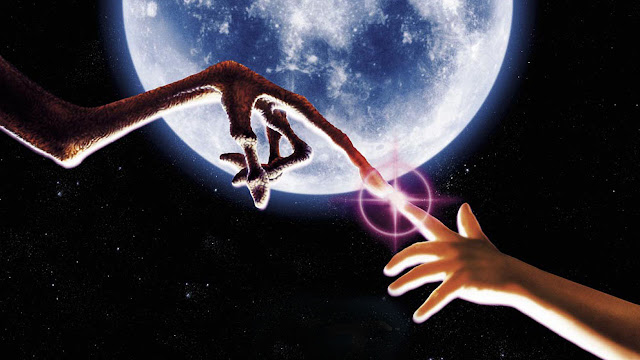
Or take take this popular tale: A being descends from Heaven, befriends children, has the power to heal with a touch, is persecuted and dies, rises from the death, and ascends into Heaven, but promises, before he goes, to dwell in the heart of his disciple.  Sound familiar?  It’s the plot of ET, as well as another rather older story.

Or consider an image like this:

A culture with “I saw the New Jerusalem coming down out of heaven” in its DNA goes on producing images like this even when the culture has lost all contact with its Jewish and Christian messianic traditions.

Similarly, we go on believing in heavenly messengers who come to say, “Peace on earth, good will to men” only we imagine they will come from other bodies around other suns, or even from other dimensions. 

That’s “scientific” you see.  So it’s not religious or anything.
In the same way, we invent imagery of judgment which looks for all the world like it is cribbed from the book of Revelation:


“And the fifth angel blew his trumpet, and I saw a star fallen from heaven to earth, and he was given the key of the shaft of the bottomless pit; he opened the shaft of the bottomless pit, and from the shaft rose smoke like the smoke of a great furnace, and the sun and the air were darkened with the smoke from the shaft. They have as king over them the angel of the bottomless pit; his name in Hebrew is Abaddon, and in Greek he is called Apollyon.”

Post-Christian culture also has eschatological dreams in a which a secular mankind spreads to the stars and establishes a peaceful kingdom of secular righteousness with no God to trouble us and everybody is clad in velour and leotards.  Transhumanists likewise dream of a resurrection for nerds in which we replace ourselves piece by piece with android parts and download our brains into Artificial Intelligence Machines and live forever (whether in our mom’s basement or on (or as part of) some machine boldly going where no man has gone before is not clear).  And eventually, we will all be transformed (one might even say “born again”) into this:

Now all of this sort of thinking is mythological, not scientific.  It is an attempt to mythologize science into a replacement for Christian eschatology and, as such, is doomed to disappoint.  The most recent disappointment was the end of the space shuttle program and the death of dreams for things like this (our supposed First Step to the Stars):
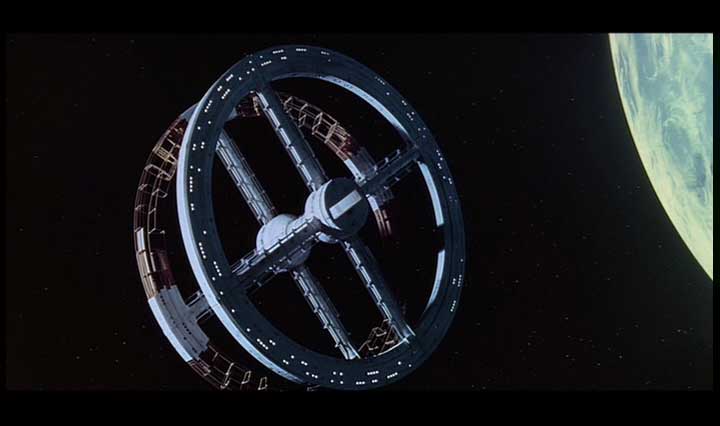
Our space program was an exciting thing as we raced to the moon.  I feel the awe still over “One small step for a man”. I would be thrilled if we get a man to Mars (and back).  It is as romantic, poetic—and practical—as climbing Everest.  But I long ago gave up kidding myself that we are going to voyage to the stars or even get a workable colony on the moon or Mars.  We’re not.  It would be orders of magnitude easier to build New New York in Antarctica.  The temperature is about the same as Mars and you don’t have to import your own atmosphere or create an eco-system from scratch. Also, you don’t have to travel near as far to get a widget if there is a serious system failure.  A fortiori, we aren’t going to the stars because stars are, you know, really far away.  As in so far away that it would take multiple generations to get to the nearest one and there is no guarantee that there would be anything like a habitable planet when the great grandchildren of our Space Family Robinson got there (assuming they didn’t murder each other on the journey).

Nor, I reckon, is anybody coming here from another planet, despite the dreams of Steven Spielberg and countless other believers in ET.  The question Enrico Fermi put to the ET enthusiast community 60 years ago still holds: “Where is everybody?”  We’ve been listening for a very long time now.  If the cosmos really teems with intelligent organic life you’d think that at least one civilization would have invented Top 40 AM radio.  But in fact, we hear nothing but static.

And this is leading some of the people who have given it some thought to wonder if, in fact, we are all alone.

Mind you, these people have no more a lock on the truth than those who imagine a densely populated night sky because, at the end of the day, we have no actual data to work with, just a fancy Drake Equation.  What’s a Drake Equation you ask?

The Drake equation states that:


where:
N = the number of civilizations in our galaxy with which communication might be possible;
and
R* = the average rate of star formation per year in our galaxy
fp = the fraction of those stars that have planets ne = the average number of planets that can potentially support life per star that has planets
fℓ = the fraction of the above that actually go on to develop life at some point
fi = the fraction of the above that actually go on to develop intelligent life
fc = the fraction of civilizations that develop a technology that releases detectable signs of their existence into space
L = the length of time for which such civilizations release detectable signals into space.

Pretty dang intimidating, ain’t it?  Only a fool would argue with a scientific-type formula like that.

Only the thing is, we cannot fill in a single one of those terms with anything like actual data.  And what indications we do have so far suggest that Earth is not the dime-a-dozen proposition many people suppose, but is actually well, Rare Earth.  That doesn’t mean it’s impossible for there to be intelligent life on other worlds.  It just means (if it’s true) that such life is so rare and so remote that, as far as we are concerned, it might as well not exist at all since we will never know of it or contact it. That is just as well since, as the history of our own race demonstrates, contact with other intelligent forms of life in remote places like America and Africa tends to lead to extermination for the weak and slave-trading for the strong.  Any superior race that encountered us would likely find it necessary to wipe us out in self-defense. Can you imagine such a first contact with these interstellar Magi?  They would approach us, full of expectant joy and ask, “It is rumored among us that the great God whom all rational beings worship actually became incarnate as a member of your species!  What glory He has showered upon you!  Please, tell us!  How did you welcome Him?”

How’d you like to be the ambassador from Earth and try to explain that one?

But such an encounter won’t happen, because the aliens aren’t coming, Jesus is.  That won’t stop the human imagination from populating the stars with Space Princesses, Barsoomians and Klingons, thank God, any more than a complete atlas of the globe stopped Tolkien from creating Middle Earth.  May we fill the universe with works of the imagination as is fitting for sub-creators.  And if there is anybody out there and they are rational creatures, then I hope one day to worship God with them and have a good laugh about it all. 

But still, my curmudgeonly heart always thrills just a little bit when materialist secular eschatologies which seek to replace God with some illusion of the Conquest of Space and Time receive a knee to the groin from the sciences.  For my hope is that, in the long run, the death of secular materialist eschatologies will lead back to the only real eschatological hope there is: the Christian one.  For, of course, saying “There’s no ET coming” is not to say there’s no created non-human intelligence out there.  There is.  We call them “angels” (though if you want to scientize their names by redubbing them as “trans-multiverse non-corporeal intelligences” I don’t see the harm of it.  The point is, there are non-corporeal beings possessing will and intelligence who move between heaven and earth (and whatever realms in between) and who exist to serve God and us.  Likewise, there are corrupt versions of these we call devils.  And we don’t have to wait for either of them to arrive.  They been here from very close to the beginning, while the God they serve has been here since before the beginning.  And despite all the false hopes of secular messianism, he will *still* come again in glory to judge the living and the dead, and his kingdom will have no end.


 

Filed under cosmic killjoy

Comments

Post a Comment

Fine post, Mark.  May I add to the ‘killjoy’ moment?

First, evolution of the human brain.  The history of the evolution of life on our planet shows that organs necessary for the survival of life evolve rapidly and repeatedly.  For example, eyes have evolved forty separate times.  As far as we can tell, human brains really have no predecessor.  If our brains confer a survival advantage then they should have evolved in other species long before us.  Dolphins don’t count since human brains require hands (manipulators, hence the origin of the word ‘man’) to develop tools and sign language.  Most evolutionary biologists (Stephen Jay Gould was a rare exception) do not thing intelligent life is common in the universe.

Second, the origin of life in general.  Remember the fabled ‘tidal pools’ where life began?  It should be pointed out that tidal pools require a moon.  Our Moon was formed from a statistically improbable collision of the Earth with another planet, with just the right geometry to cause a glancing blow.  The current Earth-Moon system quickly formed, with the Moon much closer to the Earth than it is now.  Being closer the tides were much higher, thus yielding many more tidal pools; the consequence of this is that the opportunities for life beginning became statistically much more likely.  The opposite - no large moon to cause large tides, therefore no life - may be a great scientific truth which we have overlooked.

Third, Enrico Fermi’s question is based on the concept that robotic exploration of at least our galaxy IS feasible.  He and John von Neumann calculated that with sufficient technology such exploration IS possible and in fact can be completed (i.e., have an alien robot in every solar system, including ours) within three million years of the beginning of their exploration.  These self-replicating machines should be detectable with our radio and infrared telescoped; since we see and hear nothing, and since it IS possible to build them, we must conclude their builders do not exist.

“Most evolutionary biologists (Stephen Jay Gould was a rare exception) do not THINK intelligent life is common in the universe.”

“These self-replicating machines should be detectable with our radio and infrared TELESCOPES; since we see and hear nothing, and since it IS possible to build them, we must conclude their builders do not exist.”

You and I disagree pretty totally about whether it will ever be possible for man to live off the Earth, so I don’t intend to bang heads with you over that again.  However, I do have a minor quibble on your statement regarding data to populate the Drake Equation.  I agree that there is no real data for most of the variables, however, I think it is safe to say we do have a pretty good idea about the rate of star formation in the galaxy.

Brilliant article. :)

Tom,
Regarding our moon and how “uncommon” it is.  There are at least two other fairly major bodies in the solar system with moons that are about as large (or larger) relative to their primaries as the Moon is to Earth.  Granted, Pluto and Orcus are at the edge of the solar system, but it does give us reason to pause before stating that relatively large moons must be uncommon.

Further, I think we need to keep in mind that the tidal pool hypothesis is just that, a hypothesis.

The difference between those realities and their co-opted versions is that these place man as god.  Not just all men, but the superman, be him Hitler or Stalin, Bush or Obama, Babe Ruth or Tom Landry, Justin Bieber or Madonna.  Men are always eager to anoint their superman.

Here’s a total killjoy moment, and only one a computer programming nerd would notice:  You failed to close your second nested parenthesis in the last paragraph.

Also, I disagree with the “single incarnation of Christ” theory.  Divine mercy would require a single incarnation per species.

Having said those two quibbles, nice job otherwise.

As a church musician, I couldn’t help but notice that the music in the “War of the Worlds” clip was based on the theme of the “Dies Irae” sequence.

“Divine mercy would require a single incarnation per species.”
- No. Suppose such a species had not fallen? Or suppose that God had some OTHER way of redeeming them, which, Him being God and all, He could certainly do.

Always a pleasure to rmember a scribesmanship in the tradition of GK is printing from Mr Shea, founder of the Jollity order of scribes!

I must agree with all above, which ought be no surprise, and as you’ve made the point better than I shall, I will write what I would otherwise unnecessarily say, anyway:

We culturally, societally, what-have-you-ally, have a great deal of material investment in the digital CGI farce which leaves me disappointed and wanting a refund as I exit the theaters, too.

We create with pixelated digital squares, measure with imaginary emperical values, and yet live and move and have being observing only analog…hmm, what’s the last decimal of calculating the curve of a circle again?

I’ll enjoy some more pi in my jolliness too, for our dreams evidently grow from the seed of immeasurable Truth, regardless of how we strive to square them as proverbial pegs meant for dilling an immutably immeasurable round hole, if I may draw on an idiomtic notion.

To paraphrase our friend of common sense, GK, might we be helped by a cross for our ouroboros shaped maniacs?

Sir:
  OUTSTANDING….I have to agree, God would need to Incarnate only once, no matter how many the species.  Personally I believe there are a multitude of them out there, but I’d place good $$$ betting that in the whole
multi-verse, our species was the only one that “fell” to begin with…

To respond to the dual queries:
“No. Suppose such a species had not fallen? Or suppose that God had some OTHER way of redeeming them, which, Him being God and all, He could certainly do.”

#1- how could an intelligent but finite species *not* fall?
#2- That’s my point, another way of redeeming them.  The whole point of God incarnating as a member of a fallen species is to show that *He* is not asking us to withhold temptations that he has not lived himself.  Different species have different temptations.

I think whether one or more incarnations could be debatable.  I do however think that finite species must have the capacity to not fall.  God is perfectly just, he did not create us in such a way that success was never possible.

My point is that what we deem intelligence- free will and the ability to make decisions apart from mere instinct- is in fact the cause of the fall.  It was a part of God’s plan from the beginning.  If we had never fallen as a species- we would not be intelligent- in the words of the poetry of Genesis, we would never have had the knowledge to discern good from evil.

The Fall was as necessary as the Resurrection.

“The question Enrico Fermi put to the ET enthusiast community 60 years ago still holds: “Where is everybody?”  We’ve been listening for a very long time now.”

Hmmmm…given our planet’s history, especially recently (1960’s & 70’s), they probably just passed us by looking for intelligent life forms…

Respectfully,
  By stating there might be a need for more than 1 Incarnation—assuming that more than 1 intelligent species—actually rejected God, is limiting the power of God.  The analogy to the 1500’s when there was a big argument as to whether the humans of the “New World” were “saved,” or did they need Baptism?” 

Logically, is there a difference to an intelligent species separated by 3000 miles of water ocean via 3000 light-years of the ocean of space?  God has become a physical being—fully physical / fully Divine, what need has He to come and suffer again???  IMNSHO..

There is a HUGE difference between 3000 miles of water and 3000 light-years of the ocean of space.  Evolution may be God’s engineering method, but there is no reason, say, that an intelligent species that evolved to process carbon is going to have the same emotions, motivations, and deadly sins as a species evolved to process arsenic.

The Native American- as we’ve seen- is subject to the seven mortal sins the same as every other human being on the planet.  The Native Galifryan might not.

In addition- we may be alone in the universe for, when faced with the incarnation of our God, making him suffer and die.

I was just about to say that! No, really, this is so well written and digestible! I love it!                                  My plebeian theory has been for years that God could have created life in multi-universes, but he didn’t, and that is how “special” we are here on Earth. But, because of Original Sin we just can’t fathom that amount of love being visited upon us by an all loving God. It can’t be so! We can’t be that special! We have to find others to prove that point!So we can say,“see we’renot THAT important! So we can go back into the “corner” in the “Dark” and revel in our misery. God knew that,of course, and sent a “pair of glasses” we could look through, to see his love; His Son, and through those glasses we can see forever.

Thank you for this article.  It is brilliant and I will share it with many!

I don’t know why Tolkien, a devout Catholic, received a jab in the article, particularly when his works are so germane to the discussion about the salvation of other intellegent species.

Tolkien received no jab at all in this article.  I think the world of Tolkien.

@Ted Seeber - Hahaha! I too noticed the missing right parenthesis in the last paragraph…probably because I’m a computer programming nerd. And yes, great article otherwise.

“Now all of this sort of thinking is mythological, not scientific.”

Quite so.  But then your book also fits that description.

“It is an attempt to mythologize science into a replacement for Christian eschatology”

Nah.  Just entertaining stories.  You’re just desperate for something to write about.

“contact with other intelligent forms of life”

Amusingly enough, the topic for this week’s TV show “Curiosity” is: “Could We Survive An Alien Invasion?”

“It is rumored among us that the great God whom all rational beings worship”

They’ve been watching our TV shows for years.  They would be quite aware that we are 99% irrational nincompoops.

“the aliens aren’t coming, Jesus is.”

This seems to be an assertion for which there is no “evidence”.

“secular materialist eschatologies”

In your imagination?  There are no such things?  Oxymoron?

“trans-multiverse non-corporeal intelligences”

Of course there is no “evidence” for such things.

Your comment about uploading ourselves onto computers or robots reminds me of a few things. It reminds me of the argument against the Jehovah’s Witnesses who say that souls will be annihilated at death and recreated with memories intact at the resurrection. The argument against this, as well as the idea of uploading ourselves onto a computer, is that the copy simply isn’t you. It’s a program written to act as you would, and to have similar memories. You, the real you, would go on to die, and have no benefit whatsoever from the new uploaded personality or the new created being (remember Rimmer from Red Dwarf?) The second problem with this is that the new artificial You would just as likely not be self-aware. It might be a philosophical zombie, acting as though it were conscious but really not; it could be a clever trick using statistical models of how you might react to situations or something like that, but we could never know if it is really “alive”

Sorry for the double comment, but the other thing that bothers me is, how come people seem to think the aliens will always be smarter than us and hold the key to the meaning of life? I heard as much from someone from SETI on a CNN interview. extraterrestrial life could be behind us considerably, or so different from us that we would barely recognize it as rational or even alive. I’ve always imagined a rational being made of gases and aerosols, like a living cloud. Maybe the aliens will come to earth, and when the breathless scientist in the white lab coat implores “Please, tell us the meaning of life.” The aliens will respond, “We were kinda hoping you’d tell us.”

Consider the CS Lewis Trilogy of Perelandra, Out of the Silent Planet and That Hideous Strength.
Lewis explored the possibility (thinkable in the 1930s) that a race might be fallen and never redeemed; another might never have fallen; and Earth was the third.
Although the technology in Lewis’s fiction is dated, the concept may be of interest.
teaPot562

@Teapot, I kind of disagree with CS Lewis. I cannot imagine God leaving a fallen race to stay in that state.He loves his creatures too much.

I have to say…I am with Mr. McCants on this one.  To the non-believer it’s ALL myth.  I’m not looking for something to replace Christian tradition; I’m just looking for something with enough evidence to bud considered mostly true.

I like sci-fi, including most of the items referenced in this post.  However, I don’t think any of the stories, nor their authors, purport that they are events that actually happened.

Post a Comment

By submitting this form, you give The National Catholic Register permission to publish this comment. Comments will be published at our discretion, and may be edited for clarity and length. For best formatting, please limit your response to one paragraph and don't hit "enter" to force line breaks.

Name:

Email:

Write your comment:

Please enter the word you see in the image below:


Notify me of follow-up comments.

About Mark Shea

Mark Shea
  • Get the RSS feed
Mark P. Shea is a popular Catholic writer and speaker. The author of numerous books, his most recent work is The Work of Mercy (Servant) and The Heart of Catholic Prayer (Our Sunday Visitor). Mark contributes numerous articles to many magazines, including his popular column “Connecting the Dots” for the National Catholic Register.Mark is known nationally for his one minute “Words of Encouragement” on Catholic radio. He also maintains the Catholic and Enjoying It blog. He lives in Washington state with his wife, Janet, and their four sons.