Print Article | Email Article | Write To Us

Unbroken Chain of Apostolic Succession (Plus: Bible Software)

Saturday, June 16, 2012 8:39 PM Comments (17)

In this episode of the program I answer two questions regarding apostolic succession and whether, in fact, we have an unbroken chain going back to the apostles.

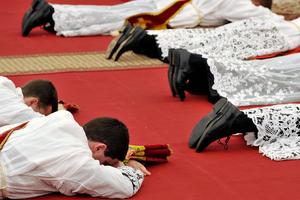
The first question comes from Marci in Mexico, who wonders about the effect that various practices have on the liceity (lawfulness) and validity of episcopal consecrations.

The second question comes from a gentleman who asks about a particular figure from the 1500s--Cardinal Scipione Rebiba--who has a very unusual property: 91% of all modern Catholic bishops trace their episcopal lineage back to him, and we're not entirely sure who consecrated Rebiba.

What are the implications of that for apostolic succession?

In the process of answering this, I invite Dr. Andrew Jones of Logos Bible Software on the show. Dr. Jones has a doctorate in medieval history, so this is right up his alley.

In the second half of the show I keep Dr. Jones on the line to update us about current Logos Bible Software projects, including the newly-released Catechism of the Catholic Church set (which you may already have--free of charge) and their forthcoming translations of certain key works by St. Thomas Aquinas that have never been translated into English before. (I'm excited about getting my hands on those!)

To read the transcript, just click the big, friendly red button.

Or click the "Play" icon to listen to the show!

 

Filed under

Comments

Post a Comment

Hi Jimmy,
The prerequisite requirements for Apostleship, as recorded in Acts: The person had to have been with Christ throughout His ministry, witnessed His death on the cross, and witnessed Him alive again. By this standard Paul fails the Apostle test, along with any like successors usurping the claim of Apostolic authority. The book of Revelation specifically numbers the Apostles as 12, there is no succession.
Jesus spoke directly to this idea of “Apostolic authority/succession”, He referred to it as “doctrines and traditions of men.” Even a casual candid read of Jesus’s words in Matthew 23, shows there is no hierarchy among Christs followers themselves, rather a brotherhood of God’s children, with Christ as their head. We have one Father in heaven, any man claiming that spiritual title, does so against Christ’s words.

Theophile,
That’s your opinion.
You’re entitled to it.
Have a nice day.

Theophile,

1) Acts 1 does not specify that these are the general requirements of Apostleship.  Rather it seems to me to list what parameters they are using to fill that one spot in that particular moment in time.  Also, why bother to fill Judas’ spot if you’re never ever going to fill another spot again?

2) A “casual candid” reading of Scripture accepts Paul’s repeated claim of being an apostle seriously.  This is despite him failing, as you point out, the criteria mentioned in Acts 1.  There are two possibilities here: Paul claimed authority he didn’t have, or your premise is wrong.  Is it just me, or does one seem a lot more likely than another?

3) At the end of the day, the biggest mistake in the Protestant theology is trying to recreate Christianity from the Bible.  Christianity predates the publishing of the New Testament.  Early Christians were not reading Acts trying to figure out how they ought to be running the Church.  Rather they wrote Acts to document how they were running the Church as they saw fit on the authority that Christ granted to them.  The very fact that there is an unbroken line of succession (see Eusebius’ Church History) positively screams that Christians accepted apostolic succession to be valid.  Really, to me, this Protestant notion is as silly as trying to recreate the USA from the original Constitution and saying that the current government isn’t valid.  Historical continuity in both cases is a pretty supreme argument.

Hi Aaron,
You said: “#2) A “casual candid” reading of Scripture”...
I contend that the one thing the high priest, the Pharisees, Scribes, Paul, and Jesus all agreed on: Scripture, is what we would call the Hebrew Bible, loosely the Old Testament. I wonder if Paul were to arrive here today, just what he would say about his letters trumping “scripture” in establishing doctrine, so wide spread today.
You see my contention with the theory of Apostolic authority is this:
We have the words of Moses, and the prophets, who Jesus said testify of Him, and we have God’s word in the flesh’s words in the gospels, and the words of men who walked with Him, and who He revealed Himself to….If we need the words of Paul, or the words of any other man coming after to explain more perfectly the truth, then, God’s words through Moses, the prophets, and in Christ Himself were insufficient, and God Himself was deficient in His attempt to show us the way Himself. This means we need man to show us “the(constantly updated)way”(insert sarcasm). This works out great for an evolving God, that needs to keep His worshipers abreast of His latest changes, but the God described in the Bible is a unchanging Holy God. His message hasn’t changed.
Tell me so I understand, when Jesus said “Moses and the prophets they testify of me”, why didn’t He say “My Apostles will guide you in the future”? Didn’t He mean search the scripture to know Him, and understand Him, in Moses and the prophets?

Well said Aaron.

“The very fact that there is an unbroken line of succession (see Eusebius’ Church History) positively screams that Christians accepted apostolic succession to be valid.”

This raises an issue that many in the Protestant world have claimed but have not thought through, and it applies to many doctrines and practices of the Catholic Church.  I have hard many times the idea that the Church went off the rails, so to speak, at some point.  Some claim, like certain Seventh Day Adventists that it happened very early on, particularly with respect to this issue of the Church heirarchy.

But if we consider that if, let us say, the first generations of Christians from the apostles got it all wrong, or mostly wrong, what does that say about the Apostles themselves and how they passed on the gospel?  Does it not throw their message in doubt as well?  And indeed, if in the first 300 years the gospel and the doctrines of the Church were twisted or corrupted, how then can we trust the New Testament at all?  For it was during that period that the canon we have was written, copied and adopted by the very Church that some claim was already a long way from the message of Jesus, and for that matter, how could anyone in 2012 even know what the message of Jesus was without trusting those first generations of Christians and what they handed down to us, Catholic and Protestant alike?

Theophile,
In 2 Peter 3:16, Peter himself refers to St. Paul’s writings as Scripture, placing them on the same level as the Hebrew Scriptures.  St. Paul referes to himself as an apostle in his writings, and St. Peter refers to St. Paul’s writings as Scripture.
Acts 1, where Matthias is chosen to replace Judas, quotes Psalm 109:8 and refers to Jesus’ prayer in John 17:12.  This particular section from Acts is a perfect example of Apostolic Succession, since if there were no such thing it would have been impossible to choose a replacement for Judas.  Scripture therefore supports the idea of Apostolic Succession.
There is a very clear heirarchy in the Bible.  Jesus confers a kingdom upon the Apostles (Luke 22:29), and the Keys to the kingdom on Peter alone (Matt 16:19).  Peter speaks for the other Apostles, as in Matt 16 and 18. Priests are appointed in Acts 14:23 to guide the people after the Missionary Apostles have gone, and Deacons are appointed in Acts 6.
A detailed reading of the Scriptures easily supports Church heirarchy, Apostolic Succession, et cetera.
We are all equal in dignity, but just as in 1 Corinthians 12 and Ephesians 4, different people are given different gifts and have different roles to fulfill.
†God Bless.

Hi Sam,
If we read IIPeter 3:15-17 we see that Peter is implying there are things hard to understand, in Paul’s letters, much as there are things hard to understand in other scripture, he then warns that since you knew these things before(from scripture?), beware lest ye ALSO, being led away….Um..This reference is not exactly a ringing endorsement for Paul’s letters, as scripture themselves, only that Paul, in the wisdom given him, wrote things that were hard to understand… and people twist it to their own destruction, much like others to theirs(perhaps the religious leaders that knew scripture but failed to recognize their messiah, but killed Him), for wresting with other scripture.
Please don’t take me wrong about Paul, he suffered greatly for Christ, and went to Rome to be killed like all Christians in the empire, until 300 years later with the classic “If you can’t beat em join em/usurp them rather” with Constantine merging Emperor, and head of the church, so to speak.
You know Sam, I didn’t have these crazy ideas until the 7th time I read the Bible through, it was that time I tried to see the whole thing from God’s point of view rather than ours. I noticed a recurring theme of “The Sabbath is a sign that a people is mine” says the Lord, It’s the only commandment we are told to “remember”, It gives God’s title: The LORD, His jurisdiction :His creation, and His authority to give commands : He created and owns His creation. Now, in Ezekiel 8:16 we find the greatest abomination to God, sun worship, In revelation Jesus addresses a letter of condemnation to a church called Laodicea. Imagine my surprise to find out every Christian, for 300 years after Christ, kept the Sabbath(even Paul insisted Gentiles return on the Sabbath, next week Acts 13:42-46), until the council of LAODICEA, a group of men claimed the new “Christian Sabbath” was at the opposite end of the week, the day of the sun god. The scales fell off my eyes, the eye salve of scripture, Laodicea! Then I recall Christ never had a good word to say about the doctrines and traditions of men, He also mentioned something about being thrust out of the synagogues(Churches), and being killed for the word of God.
Guess what! I know when Jesus is coming!!: When the last true follower is killed: Revelation6:9-11, Get it “6” 9/11? no really look it up. God Bless.

Theophile,
When St. Peter refers to the writings of St. Paul, he also refers to “the other Scriptures.”  He is thus placing St. Paul’s letters on the same level as the Hebrew Scriptures, because they could not be “other Scriptures” to St. Paul’s letters if St. Paul’s letters were not Scripture.  My point was that because St. Paul’s writings are in fact Scripture, we DO need them to explain things to us.  St. Paul wrote them to explain things he had spoken of previously, which things people had ignored, forgotten about, or misunderstood.  Even though they were written to explain things, St. Paul’s letters need proper interpretation.  Like the Ethiopian in Acts 8:31, we must ask others who have the proper interpretation so we do not fall into error.  2 Peter 1:20 tells us that Scripture is not a matter of personal interpretation.  So who do we ask for the proper interpretation?  The Church, since we learn in 1 Timothy 3:15 that the Church is the “pillar and foundation of all truth,” being guided by the Holy Spirit as in John 16:13, 14:26.  Ephesians 3:10 even says that the wisdom of God will be made known through the Church.
Christians gathered on Sunday. the Lord’s Day, from the time of the Apostles, as evidenced by Acts 20:7 (the “breaking of the bread” is the sacrifice during Holy Mass), and 1 Corinthians 16:2 (the collections). St. John was caught up in the Spirit in his first vision on Sunday, the Lord’s Day (Revelation 1:10).  St. Ignatius of Antioch, who died before the year AD 117 writes about Christians no longer observing the Sabbath but keeping the Lord’s Day instead.  Jesus himself said that the Sabbath was made for man, man was not made for the Sabbath.  Legalism is not the Christian ideal.

Theophile,
I thought the numbers assessed to the biblical verses within the bible is a man made invention to aide us in locating verses in the bible.  So how can you even used this man made effort to sustained your belief of “6” 911?  Aren’t you using the same method to prove your belief while speaking against it?  Or, am I misunderstanding you.

Hi Sam,
Actually John’s book is all about the terrible day of the lord revealed, and He would of then been “on the Lords day” in spirit. Since Jesus said heaven and earth will pass before one jot from the law,. Since the Sabbath was so central at creation, and with Moses, if God was planning to have a different day for His adopted children, why didn’t He mention it? Have You considered that Jesus said an evil generation requires a sign, and the only sign given is that of Jonah 3 days and 3 nights(72 hours)in the grave? Now the generation with Jesus had seen many miracles at Christs hand, that we would call signs. Since Jesus “gave up the ghost at 3PM, He would have risen at 3PM 3 days later(72 hours), if the tomb was found empty at sunrise by the unbelievers bringing dead body spices, on Sunday, those of us that can do math and read can plainly see Jesus rose the day before, on the Sabbath!
This is why Bibles along with their believers were burned at the stake by the Church(Foxes book of Martyrs), because round about the 7th time through reading it on your own, the doctrines and traditions of men show up, in all their error. Jesus said with great desire I have desired to eat this passover with you, at the last supper, He was God’s passover lamb. Do this in remembrance of me is surely about passover, not weekly or monthly communion, and Passover is a month day, not a week day, Herod the pagan who killed John the Baptist was the only one mentioned celebrating Easter in the Bible(other than Ezekiel 8:16), and that was while he was planning to kill Peter. We know “Easter” sometimes falls in a different month than Passover, and why would we celebrate when unbelievers discovered an empty tomb? Instead of the day our salvation was paid for, the day Jesus said to do in remembrance of Him? Or the day He actually rose, on God’s Sabbath, Blessed,Sanctified, and made holy at creation? Since Passover is the most mentioned date in the Bible, ordained by God, and is the date Christ became that Passover lamb, why does the “Christian” churches ignore it?
The way is narrow, and few be that find it…Jesus. Beware of wolves in sheep’s clothing…Jesus.
Hey good luck with that world mega church hierarchy, the graven images on the day of the sun, the men who call themselves spiritual fathers(like Paul: “I have begotten you”), mass and all it’s fixtures and Priestly traditions, I’ll take my chances with scripture and prayer.
BTW my observations of scriptural intent goes over just as well with Evangelical, Protestant, Mormon, JW’s, progressives, etc. You would think such an Ecumenical wet blanket doctrinal skeptic as myself would be welcome at the freethought/Atheist blogs, but they call be a “Tenacious Apologist for Jesus” and ban me.
@ Lindie- Hi Lindie, The context of those verses is what I was referring to, the fact that “6” as in 666 is ominous in the book of sevens(Revelation), and 9-11 the same in the news today, Kinda like the Isaiah 9:10 prophecy fulfilled at ground zero. It was tongue in cheek humor, if you will. Nothing like Gematria, Cabala, or the like.

Theophile,
St. John uses the same word for “Lord’s” in this passage as the word Paul uses in 1 Corinthians 11:20 to say “Lord’s Supper.”  St. John is very clearly referring to Sunday, as that is the day which from the beginning Christians have celebrated as the Lord’s Day.
Jesus rose on the third day, as it says in the Nicene Creed, “tertia die resurrexit a mortuis,”  “On the third day he rose from the dead.”  Mark 10:34 Jesus uses this same phrase “the third day.”  As in Friday, Saturday, and Sunday.
Your interpretation of all of these things you write about is flawed.  You have given in to serious error, and you need catechism.  Scripture itself tells you that you need the Church to guide you.  Find a patient priest who can answer your questions.  †God Bless.

The fact that Jesus said he was establishing his his Church on Peter pretty clearly shows that He was giving us someone to lead us after he ascended to the Father.  And Jesus speaks to the multitudes in parables but specifically says he explains the parables only to the apostles.  So I think it’s clear that Jesus expected his Apostles (and by extension their successors) to carry on leadership of his Church, specifically including teaching.

I find this interesting yet troubling that the NCR (Jimmy Akin) is raising questions on the validaty of the Apostolic succession of the Catholic church.  I believe that we are slowly being invaded by Martin Luther’s teachings?

I don’t personally think Mr. Akin is questioning the validity of Apostolic Succession.  When I first heard of this phenomenon, I looked into my own Archbishop’s lineage, and indeed his can be traced back to Rebiba.  I wondered what happened to the records from before his time and wondered the same “what ifs.”  The practice of co-consecrators was a comfort, and was apparently begun to make sure consecrations are valid.  I like the idea, mself, of the double redundancy.  And any way, in a religion is which true Apostolic Succession is important, I think we should be thankful that someone long ago thought of how to make sure consecrations would be valid.
I still wonder what happened to the records, though.  And I wonder what we’ll discover when they are finally found.  Will we be able to trace the lines all the way back to the Apostles?  That would be nice, I think.

Thanks for posting the transcript in full via the red button.  The internet in the sticks leaves a lot to be desired and this helps out.

theophile: Jesus did say in John’s Last Supper narrative He would send the Holy Spirit to teach them. At that point they were arguing among themselves ” who was on first” - earlier in some accounts. Peter is listed first and is the leader, spokesman, gives the pentecost sermon and his re-established as Shepherd leader in John 21. The language about him is keys and binding and loosing from David. The role he plays in Acts, even Paul challenging him on the circumcision row shows he was key- why else would Paul mention the row. The rest of the earliest documents show continuity of Apostolic Succession and Rome as important because PETER was first to profess faith in “the Christ, the Son of the Living God” in Matthew, the fullest expression stronger than “you are the Christ” etc of the other accounts. Jesus’ final promise to stay with the Church AS emmanuel at the end as in the beginning of Matthew is a promise kept. look at the total theological mess we have today within the Anglican Communion from same-gender ordination of male bishops to anything goes in morality, and then move on among the US “mainline” denominations who are pretty well sidelined today by Evangelical-Pentecostals whose social justice agenda is as far from the Consistent Ethic of the Church of Rome as possible when one sees it as a unified package,

Plain and simple - great work Jimmy!

Post a Comment

By submitting this form, you give The National Catholic Register permission to publish this comment. Comments will be published at our discretion, and may be edited for clarity and length. For best formatting, please limit your response to one paragraph and don't hit "enter" to force line breaks.

Name:

Email:

Write your comment:

Please enter the word you see in the image below:


Notify me of follow-up comments.

About Jimmy Akin

Jimmy Akin
  • Get the RSS feed
Jimmy was born in Texas, grew up nominally Protestant, but at age 20 experienced a profound conversion to Christ. Planning on becoming a Protestant pastor or seminary professor, he started an intensive study of the Bible. But the more he immersed himself in Scripture the more he found to support the Catholic faith. Eventually, he was compelled in conscience to enter the Catholic Church, which he did in 1992. His conversion story, "A Triumph and a Tragedy," is published in Surprised by Truth. Besides being an author, Jimmy is a Senior Apologist at Catholic Answers, a contributing editor to This Rock magazine, and a weekly guest on "Catholic Answers Live."