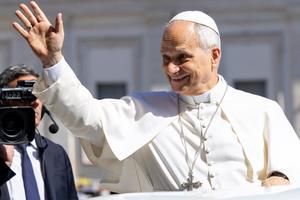
The cries echoes up from the piazza, Santo Subito! Santo Subito! Sainthood Now!
I can guarantee one thing, no one will ever hear that phrase pass my lips.
I like mail, doctor’s appointments, and State of the Union address to expeditious. But not my saints.
Saints should be like a fine wine made at some remote monastery, made with one part fruit, one part yeast, five parts prayer, and fifty parts time.
Now, if you have ever made wine, you know that there is always a temptation to open a bottle before its time but experience teaches you not to do it. You must wait.
Look at it another way. How often does popular acclaim ever lead to permanent acclaim? If popular acclaim was a reliable indicator, Mister Mister would be in the Rock ‘n Roll hall of fame. That didn’t work out.
When it comes to sainthood, slower is better. Moving the process along more quickly for the popular gives the impression, fair or not, that sainthood is a popularity contest. In fact, I think it speaks well of the Church and its process that even someone tremendously popular has to go through the same long discernment process.
Damian Thompson of the Telegraph relayed some concerns on this topic in a post the other day.
But… several Catholics have told me that beatifying a Pope a mere six years after his death gives the impression that the process is being “helped along” a little too fast. As one friend put it: “We’re reaching a stage where beatification for recently dead Popes is like a life peerage for ex-Prime Ministers.
In reality, in the last one hundred years we have only had one Pope declared a saint and one declared blessed. But the rush to sainthood gives the false impression that this is just something they do for the popular Popes.
So my advice to the Church, as if they need it, is slow down. It is better that way. We like slow saints. We can wait and so can they. I mean if a saint can’t wait, who can?

Comments
Post a Comment
Pat,
Are you not trusting the Catholic Church? Shame on you for posting this on your blog. You should be working instead for the NCReporter.
Evidently, you really didn’t understand Pope John Paul II and his mission.
You are working against the Holy Spirit and the Church.
Pat, I am glad to finally to read a sensible common sense take on this issue which I had already commented on in Ed Pentin’s blog a few days ago. I feel that if John Paul II is to be beatified at all I believe it should only take place after Pius XII and John Paul I (both have said to miracles being investigated). The reason is that this is rightly or wrongly going to be seen as clearly showing favoritism to this particular Pope in light of the fact that John XXIII was beatified in 2000 is on display in St Peters, and now 10 years later nobody the interest in “Good Pope John” is gone, and his own process for canonization has hit a snag as has Paul VI.Also Pius IX was beatified in 2000 and interest in him has also seem to have dissapeared.
Haha the comment above mine is pretty hilarious.
Pat, hasn’t popular acclaim - or, to put it another way, the faith, love and devotion of the Christian community - been a strong factor in quick canonizations in the past too? Dear St. Anthony of Padua comes to mind. So does Pope St. Gregory the Great.
Bob,
That is the funniest comment I have read in a while. Thanks!
Oops - by “the comment above mine” I meant Bob’s of course.
Interesting article. In the case of Causes one has to look to see if the procedure has been followed in its entirety and correctly. In the case of Pope John Paul II it has, the only “speeding up” was the dispensation of the five year waiting period which is there to establish if there is devotion to the person. Otherwise the Cause has proceeded as normal. The time a Cause takes has nothing to do with the Church taking it easy - it is simply the time a particular actor takes to get the work done. If the actor is efficient and has resources available to get the work done, then the Cause will proceed quickly. It is up to God to provide the miracle, if he does then it is down to the Church to investigate. In John Paul’s case many possible miracles were provided, one granted a few weeks after his death was investigated and found to be authentic. Your argument seems to suggest that even though everything is done, and done correctly, God has spoken with a miracle, we stop the Cause and leave it for a few decades (a century, perhaps), just to let it mellow like a fine wine or a good cheese. Then if devotion falls away, then we do not proceed and then say God did not want him a saint at all. No, I’m not convinced. There are numerous saints in the Church whose Causes were very quick: St Anthony of Padua was less than a year dead when he was canonised - too soon? Devotion to him has grown century by century. St Thomas a Becket was canonised very quickly also, as was St Francis. Too quickly? All of these saints were subject to popular acclaim - bad idea for the Church to listen to the faithful there? Did the Church make a mistake there, rushed in to glorify obscure figures who have now fallen away from the attention of the faithful? No. John Paul is of the stature of these saints, devotion to him has grown in the five years, not diminished. The outpouring of miracles seems to be a sign that God wants him glorified for this time and for the Church in this time. A saint is not like wine fermented in a remote monastery: a saint is an individual who has the message for the world and who is an example for the faithful. That message is as relevant for us now and not only for Catholics in a century’s time.
Thank you Pat for your sanity. I was wondering when someone would finally have the sense to say what you did. Saints should be able to stand the test of time. I don’t believe it’s enough that they are still popular a few years after their deaths. The process of canonization should not proceed like an American Idol contest. Some of the great saints of the Church were canonized hundreds of years after their deaths.
Pat,
It is not funny. The Reporter could really use someone like you. Another who doesn’t trust the Church and one who probably doesn’t understand Divine Mercy Sunday.
While I’m sure many have already seen it, Fr. Z had a pretty good run down as to why JPII’s beatification probably proceeded so quickly while others falter and drag along the way. The bottom line - there are a lot of resources at the disposal of the actor of the cause.
Link here
God’s Providence arranged for the passing of Pope John Paul II on the vigil of Divine Mercy Sunday. Pope John Paul said that he had fulfilled the will of Christ by instituting this Feast of Divine Mercy. Jesus said that the Feast of Mercy would be the last hope of salvation and Pope John Paul knew this.
Does anyone think that it was an accident that the Pope died on that feast and that his last written words, that were read on Divine Mercy Sunday, called for a greater understanding and acceptance of Divine Mercy.
His beatification on Divine Mercy Sunday is another great sign from God that “now is the time for mercy”. The Holy Spirit has quickly moved this beatification process because we are, no doubt, living in the end times.
We need to thank the Church for her wisdom and trust her!
So, proclaiming someone blessed or a saint is infallible right? Therefore, it should not matter if it’s 5 minutes after death or 500 years. Tell me what I’m missing here?
Spot on, Mr. Archbold!
Todd—it has never been officially taught by the Magisterium that canonizations are infallible proclamations.
Sheena,
Canonization doesn’t happen in strict order of a saints death; it isn’t a comparative process either. Venerable John Paul II being Beatified sooner than another is based on many factors, one of which is money. He’s really the only Pope, other than Benedict XVI, who I’m old enough to remember and due to the length of his papacy, his wide travels and the technological innovations that have taken place which allowed people to find out instantly what was going on somewhere else, together with his extensive writings, make him a beloved pope, known to many more people in a more personal fashion than any of his predecessors. These are also reasons that his Cause would have had better financing than those of his predecessors.
There are many others whose Causes for Canonization are opened and have not made it all the way through the scrutiny necessary; this doesn’t mean they’re any less of a saint, just that it isn’t the time for the world to recognize them. The fact that it may take hundreds of years for the Church to Canonize the saint has no impact on that saints holiness or the recognition they receive from individuals.
You should be aware that the length of time from death before which one could be Beatified was shortened for St. Therese of Lisieux due to her popularity and the publication of her story which increased her popularity. Pope John Paul II later shortened the time again. In any case, the current pope always has the discretion to waive the waiting period.
There are many others besides the popes you mentioned whose causes are opened but have not advanced and some people object to Canonization of popes as it may diminish Canonization itself to perceive it as automatic for popes.
JP II was very popular, he seemed very holy too. However I think crowning him with almost immediate sainthood is rushing the issue. I agree with some of the other posts here that he should get to the back of the Pope line.
Wait - if there are the appropriate number of miracles attributed to his intercession, what is the problem? Are you of the mindset that he should wait his turn at the end of the line? Do you fear that the miracles attributed to his intercession are going to prove to be fakes?
Why is it a concern of yours if he gets the earthly official title of saint at all? If he’s in heaven (and you must admit, there is more than a slim chance of this) what’s your problem with the church acknowledging that fact?!
Patt, you realize that miracles are a requirement both for beatification and canonization, right? Nobody’s cause moves forward without a miracle. For whom have Blessed John XXIII and Venerable Pius XII performed miracles?
Yup. You need a miracle, where is it? And what will be will be. The church used to move very slowly on canonization..
Should JPII go to the back of the line? No, I think there is plenty of reason for him to be ahead of JP I (lack of cult) or even ahead of Paul VI (the management of the implementation of the Council is part of the reason for the current state of the Church). However, I definitely agree that more time is needed for the process, particularly for popes. The press, particularly the catholyc “press”, is raising the question, “what about Maciel?”
It is a fair question to ask regarding the pope’s legacy (though I believe that time will prove that the pope was ignorant of Fr. Maciel misdeeds). By all means, let the dust settle before canonization!
Another point, according to trusted bloggers, the ‘resources of the actor’ is what determines the speed of the process. While I understand the necessity of an advocate to organize and present the case, the fact is this creates the image (and perhaps the reality) of a bias of the Church toward religious and clergy in the canonization process. The saintly laity are less likely to have their cause organized by as efficient a group as Opus Dei or as knowledgeable a group as the Diocese of Rome.
My impression has been that God makes saints, and eventually the Church simply recognizes the truth of the saintly life. Only us egoistic humans assign any relevance or authority to our processes. Given that, I agree with your premise: all in good time.
Amen, Amen, Greg Colley….The Holy Scriptures, all God-breathed, state very clear that WE ARE ALL SAINTS. Something tells me that Pope John Paul II, where he is for eternity, is not concerned about sainthood being expedited. Allow the Holy Spirit - and not man - control the process. What a concept.
Mrs McG, I’m not sure you’re correct on this one. I found information that says otherwise; that a canonization is an infallible act of the Church. If someone could point to official Church teaching on this, it should put the discussion to rest (if it is indeed an infallible proclamation). Anyone have this information handy?
Let me clarify my previous post. I believe it to be true that canonizations done by the POPE are infallible. Can anyone back this up or refute it?
CDNowack, actually what you said about JPI not having a cult following is not correct. Both he and Venerable Pius XII have maybe not a cult which I think is a poor word but a significant following from people all over the world. I had done a Google search and the pope with the most postings is JPI with 2 million and Pius XII with 1 million followed closely by JPII. Also, what I was trying to point in my post yesterday was that in my opinion ALL of the popes are equal in the dignity because there successors of Peter so for That purpose there should be no Favoritism towards ANY POPE for any reason. I was not talking about saints in general but only POPES. Every one of them made their mark and contribution to Church (even the anti-popes).
Sheena, I used cult in the technical sense, the devotion to and veneration of said figure. (BTW, I was unable to come close to replicating your numbers.) JPII obviously has such a following (so much so that a generation of Catholics denote themselves by his name). JPI does not have the same type of following, indeed many are interested in him not because of his life, but because of his short reign (while you are looking at search results note how many are to conspiracies about a murder).
Pius XII may have the cultus, particularly among the more traditional parts of the Church, however his canonization is held up by slanders regarding the Holocaust. Perhaps this is the best example of why I believe there ought to have been more time before the process began.
The speed of the process should not be seen as favoritism of one Pope over another. Canonization should not be automatic for Popes (or anyone), and the fact that they are recognized in an order other than their reign is a good reflection of that, and a proof of evenhandedness (even the popes must meet the standards set for canonization).
I trust the Church’s decisions. There is so much information about this past pope and people who knew him are still alive and can give better testimony than many of the former popes who lived long ago and have no more or very few witnesses to their holiness still alive. And so their process takes longer due to more research. Our present Pope of course is in favor of JPII’s beatification. I do not think he is being beatified simply from popularity, but from authentic proof of his holiness. There are so many saints that were canonized much quicker and yes the element of “popularity” was there, but yet authentic holiness ever present. We need a saint like JPII to have as an example and to inspire us.
Before the formal canonization process began around fifteenth century, many saints were proclaimed by popular approval. For hundreds of years, starting with the first martyrs of the early Church, saints were chosen this way! Gregory the Great, was pope from 590 until his death in 604. Immediately after his death, Gregory was canonized by popular acclaim. Gregory is a Doctor of the Church and one of the six Latin Fathers. He is considered a saint in the Roman Catholic Church, Eastern Orthodox Church, Anglican Communion, and some Lutheran churches. John Calvin admired Gregory and declared in his Institutes that Gregory was the last good pope!
Admittedly some saints’ stories were distorted by legend and some never existed. So the bishops and finally the Vatican took over authority for approving saints. Some souls though are given a special public mission by God and granted ordinary and some extraordinary graces like(St. Pio) and they they used these graces in heroic ways. The Servant of God John Paul II had a similiar gifts and esteem of the people of our day as St. Gregory the Great. John Paul II also was a contemplative prolific in his writings that he left for the church.
Is the Servant of God John Paul II the SPARK mentioned in St. Faustina’s Diary? “From Poland will come forth the spark that will prepare the world for My final coming” (DIARY 1732) If so the speedy canonization is in the mystery of God’s Providence!It is God himself that wants this popes sanctity to be recorgnized in the world at this time. and He doesn’t want to wait a hundred years for a reason! The present norms of the church that the future Blessed established are a undisputed Holy life, and one supernatural miracle for beatification and one more supernatural miracle for Sainthood! It is God really that is behind the timing of the future Blessed’s Canonization not men since only God can perform supernatural miracles!
Encontré este mensaje el día de hoy, mientras que en la oficina de gran utilidad envió el enlace a mí mismo y lo más probable es marcar www.ncregister.com cuando lo hacen en casa
De estos sitios web de información! Gracias grande! Gracias por un buen rato visitando www.ncregister.com. Es realmente un placer la comprensión de un sitio web como esta lleno de información agradable. Gracias!
Post a Comment
By submitting this form, you give The National Catholic Register permission to publish this comment. Comments will be published at our discretion, and may be edited for clarity and length. For best formatting, please limit your response to one paragraph and don't hit "enter" to force line breaks.