Print Article | Email Article | Write To Us

DEBATE: Is Fr. Bourgeois Right on Women Priests?

Wednesday, August 10, 2011 11:44 PM Comments (105)

At the time I did my previous post on Fr. Roy Bourgeois, I did not have access to the letter to his religious superiors in which he was said to make five argument for women priests. I would like to thank those who were able to find it and send me a link. It can be found in its entirety here.

In this post I would like to look at the arguments proposed by Fr. Bourgeois and see whether they are sound. I will offer each of his arguments, in his own words, and then respond to it so that this post takes the form of what you might call a literary debate.

Let us begin.

(1) As Catholics, we believe that we were created in the image and likeness of God and that men and women are equal before God. Excluding women from the priesthood implies that men are superior to women.

It is true that men and women are created in the image and likeness of God. It is also true that there are many senses in which men and women are equal before him. They are equally dependent on his grace. They have equal access to salvation. He loves them equally. He has endowed them with equal dignity. He had endowed them with equal responsibility and will hold them equally accountable. And in a generic and ultimate perspective they may validly be said to be equal before him.

This does not mean that they are homogenous in all respects, however. It is clear that there are differences between the sexes that are rooted in nature and that are not simply the product of nurture. Though the feminist movement has long tried to portray many gender differences traditionally regarded as innate as being merely the product of culture, numerous recent scientific studies, as well as common sense and the common experience of mankind, have shown that they are, in fact, innate. Even many in the feminist movement now admit this.

Some innate gender differences are virtually too obvious to be rationally denied by anyone. To begin with overt physical differences, men are, on average, taller and weigh more than women. They are physically stronger, particularly in the upper body. They grow facial hair. Women are on average smaller and lighter. They have less physical strength, particularly in the upper body. And they grow functional breasts. Moving to somewhat less obvious but still statistically demonstrable sex differences, women have longer life spans (which, to my mind, means they get the long end of the stick in an extremely important way that I am personally envious of). Women also have greater verbal intelligence. Men have greater spatial intelligence. There are also emotional differences. Women tend to be more nurturing. Men tend to be more willing to assume greater risk.

While many of these differences are statistical in nature (i.e., they are true of the genders on average, though they may not be true of a specific man or a specific woman; thus some women are taller than some men, some men live longer than some women), there are some sex differences that are absolute. For example: Only men can be fathers; only women can be mothers. There are no male mothers and no female fathers—not in the literal sense of these terms.

The fact that there are innate sex differences in humans means that one cannot reduce the question of ordination to the priesthood to the question of equality before God. While the sexes do have equality before God (certainly in the general and ultimate sense), the specific differences between them mean that they are—statistically or absolutely—more suited to certain roles. Statistically, men are better protectors by virtue of their strength and risk tolerance; women are better providers of childcare by virtue of their nurturing capacity and ability to nurse. Absolutely: Men are better fathers; women are better mothers.

The Catholic Church proposes that God has chosen to only authorize the ordination of men to the priesthood. Why he may have chosen this is a matter of speculative theology on which the Church has not pronounced (certainly not definitively). It may be that the priesthood displays a form of fatherhood that makes the male gender absolutely suited for it in a way women are not. It may be that the male gender displays certain characteristics that, statistically rather than absolutely, make men better suited to the priesthood and God has chosen them due to this fact. These are matters of theological speculation, however.

What is clear is that one cannot simplistically posit male/female equality as an argument that women should be ordained to the priesthood. Equality before God does not mean absolute identicality between the sexes, and if it does not mean that then it does not mean possessing identical functions in all situations—ecclesiastical or otherwise. It thus does not follow that saying God has chosen only men for the priesthood implies that men are superior—any more than it implies that God has chosen certain men for the priesthood means that these men are superior to other men. We each have our own gifts and callings, and these are not identical.

Thus this argument is inadequate. It does not prove what it attempts to.

(2) Catholic priests say that the call to be a priest is a gift and comes from God. How can we, as men, say: “Our call from God is authentic, but your call, as women, is not”? Who are we to reject God’s call of women to the priesthood? I believe our Creator who is the Source of life and called forth the sun and stars is certainly capable of calling women to be priests.

In my previous post I responded to Fr. Bourgeois’ statement regarding God as the one “who is the Source of life and called forth the sun and stars” being able to call women to the priesthood. As I pointed out there, this is fatuous grandstanding. We all acknowledge that God is omnipotent and can do whatever he chooses. But asserting that he is able to make a particular choice does not provide evidence that he has made a particular choice. As we noted then, God can make pink unicorns with sparkly eyes and rainbow manes, but if you want to claim that he has done this, you need to produce evidence for the claim, not merely assert God’s ability to do it.

Turning to the first part of Bourgeois’ second argument, it is clear that this is overly facile reasoning. This will be clear if we simply change the context of the argument, from being why men rather than women should be ordained to the priesthood to why certain men rather than other men should be ordained. Making the necessary substitutions, what would we make of an argument that says:

How can we, as certain men, say: “Our call from God is authentic, but your call, as other men, is not”? Who are we to reject God’s call of other men to the priesthood?

Unless we are prepared to accept that God has called all men without exception to the priesthood then we must be prepared to accept that he has called some and not others. Given that some men are manifestly not qualified to serve in this role (e.g., pedophiles—just to name an obvious and incontrovertible example), it would appear that his choice is rational. But if God may rationally choose between one group and another in whom he calls to priestly ministry then one cannot rely on an argument of the form Bourgeois has presented. It may identify women as a particular class and ask how it is that God might not choose them for the priesthood, just as he does not choose many men (myself included), but the appeal to pity that Bourgeois proposes (“How can we, as X, say that our call is authentic but yours, as Y, is not?”—in other words: “Have pity on Y; they are no different than we as X”) does not provide any reasons why women should be regarded as a class indistinguishable from men—or from called men. Once again, Bourgeois has failed to provide evidence for why these two groups should be treated as the same in terms of ordination.

It also should be noted that his reference to the priesthood being a divine gift actually undermines his case since, as we saw in my previous post, the gratuity of a divine gift implies that no one has a right to the priesthood and thus no one can claim injustice if they are not called to it.

(3) We are told that women cannot be priests because Jesus chose only men as apostles. As we know, Jesus did not ordain anyone. Jesus also chose a woman, Mary Magdalene, to be the first witness to His resurrection, which is at the core of our faith. Mary Magdalene became known as “the apostle to the apostles.”

Here Bourgeois finally engages the Church’s actual position regarding women’s ordination. As we saw in my previous post (and please do check it out for more detail), the Church recognizes that Christ chose only men to be his apostles and feels bound to follow this decision of her Lord and God today in the selection of ordained ministers.

Bourgeois offers three rejoinders to this argument, each of which is quite weak:

a) “As we know, Jesus did not ordain anyone.”

We know nothing of the kind. If by “ordination” you mean “sacramental laying on of hands for purposes of placing one in the priesthood” then we have no mention one way or another of whether Jesus did this. As the gospels themselves record (John 21:25), Jesus did many things that are not recorded in them. One of them might have been such an ordination-by-laying-on-of-hands ceremony.

If such a ceremony never occurred, however, this deals only with the means by which Jesus conducted ordination (the placing of an individual in a specific ordo or order of ministerial service). He most definitely did ordain, through hands or another means, his apostles to service as priests. This is, in fact, an infallibly defined dogma. The Council of Trent defines that by telling the apostles to “do this [the Eucharist] in memory of me” he thereby commissioned them to function as priests. This commission entails an ordination, whether it was performed that minute by his words alone or subsequently by the imposition of his hands.

b) “Jesus also chose a woman, Mary Magdalene, to be the first witness to His resurrection, which is at the core of our faith.”

It is noteworthy that Mary Magdalene was one of the first witnesses (not the first, as Bourgeois says, but one of a group) to Christ’s resurrection. This has notable apologetic value since women were not then considered to be trustworthy witnesses in court, yet the gospels record women as the first witnesses—contrary to what one would make up if one were fabricating the accounts. The extent to which Jesus “chose” Mary Magdalene and the other women (as opposed to allowing the action of their own free wills in this situation) is more open to discusion. However, no one has historically seen the role of Mary Magdalene as an indication that she served ordained ministry as a priest. Bourgeois is simply grasping at straws.

c) “Mary Magdalene became known as ‘the apostle to the apostles.’”

To the extent this terminology has been used for Mary Magdalene, it has always been understood in an analogous way. It has never been seriously entertained that Mary Magdalene was a literal apostle or an ordained priest. Women today may serve such analogous roles without implying literal ordination or a right thereto.

(4) A 1976 report by the PontificalBiblical Commission, the Vatican’s top Scripture scholars, concluded that there is no valid case to be made against the ordination of women from the Scriptures. In the Episcopal, Methodist, Lutheran, United Church of Christ, Presbyterian and other Christian churches, God’s call of women to the priesthood is affirmed and women are ordained. Why not in the Catholic church?

As we saw in my previous post, Bourgois is misrepresenting the document he mentions. A look at the full text of his letter only strengthens this appraisal. First, the Pontifical Biblical Commission does not represent “the Vatican’s top Scripture scholars.” It represents a number of biblical scholars, periodically chosen an rotated, who have a notable degree of esteem by the Holy See, but it does not, at any given moment, represent “the best of the best.” Second, the 1976 document in question was not an official document of the PBC. It was a draft document that was leaked to the press without authorization. It has no official status. Third, it did not conclude that “there is no valid case to be made against the ordination of women from the Scriptures.” Instead, it concluded that some scholars think there is such a case to be made from Scripture alone, some think that there is not, and that the drafters of the document in question think the question is hard to settle from Scripture alone. Bourgeois is thus grossly misrepresenting both the nature and the conclusions of the draft document.

Regarding the statement that women are ordained to the priesthood in various Protestant denominations, several responses may be in order:

a) If we wish to play a numbers game, the Protestant denominations in question represent less than a quarter of global Christendom. Why should the choices of such a minority be determinative for the majority?

b) Bourgeois seems to be misinformed regarding the practice of these groups. Most of them do not recognize the priesthood—or certainly not a sacramental priesthood—at all. So why should they be determinative of a question that involves an apples-to-oranges comparison?

c) They are non-Catholic groups and, whatever merits they may have, they cannot be regarded from a Catholic perspective as being guided by God in the same way that the Catholic Church is. Why should their ordination practices trump that of the Catholic Church, which is—from a Catholic perspective—fully guided by God in these matters?

As to Bourgeois’ query, “Why not in the Catholic church?” see the rest of this post and the previous one.

(5) The Holy Scriptures remind us in Galatians 3:28, “There is neither male nor female. In Christ Jesus you are one.” Furthermore, the Second Vatican Council’s Pastoral Constitution on The Church in the Modern World states: “Every type of discrimination ... based on sex. .. is to be overcome and eradicated as contrary to God’s intent.”

Here Bourgeois demonstrably misrepresents both St. Paul and the Second Vatican Council.

While St. Paul may be fairly characterized as stressing the equality of men and women regarding their access to salvation, Christ’s love for them, etc., this cannot be construed as an endorsement of them playing identical roles in Church. This is made extremely clear from some of the things St. Paul says elsewhere in his writings, such as:

I permit no woman to teach or to have authority over men; she is to keep silent. For Adam was formed first, then Eve; and Adam was not deceived, but the woman was deceived and became a transgressor.  Yet woman will be saved through bearing children, if she continues in faith and love and holiness, with modesty [1 Tim 2:12-15].

This passage has significant implications for the ability for women to assume the priesthood.

Even if one (wrongly to my mind) questions the Pauline authorship of 1 Timothy, the book is still part of inspired Scripture and cannot simply be set aside.

In any event, Paul’s other writings contain multiple references to men and women functioning differently in church, however equal they may be from the ultimate perspective before God. One cannot represent Paul’s “one in Christ” statement as an endorsement of women’s ordination.

Neither can one represent Vatican II’s condemnation of discrimination as such. Had the Council meant to endorse women’s ordination, it would have done so. The rejection of unjust discrimination—which is what we are talking about—does not entail the rejection of sexual differences or roles. It is not possible to give a serious reading to Vatican II and take it as endorsing women’s ordination.

The arguments used by Fr. Bourgeois thus come up lacking. If he proposes that the Church change its theology (which it can’t do, given that this is an infallible teaching) then the burden of proof is on him, and he has not presented any arguments that survive even a cursory examination.

Let us keep him, and all those he misleads, in prayer.


Filed under bourgeois, canon law, ordinatio sacerdotalis, paul, roy bourgeois, vatican ii, women, women priests, women's ordination

Comments

Post a Comment

When a man becomes pregnant, I’ll entertain the idea of women Priests.  In the meantime, I’ll continue to be glad that God saw fit to make me a woman, and to give me the nature he gave me.

Thank you for you clear and articulate response to each of The arguments in favor of women’s Ordination. We all need to pray for Father and those being mislead.

Jimmy’s argument 1 is invalid on two counts.


a. Jimmy moves from the general to the universal. This method is as valid as saying that black people should not be given the vote because (despite some exceptions), most are less educated, own less property etc.. NB I’m not saying Jimmy is racist.


He needs to find a universal reason why some men can be ordained but ALL women cannot - ever - period (or have I hit upon something there?). The only permanent and universal reason why some men can be ordained and no women can is is having testicles. I understand that this is part of the medical for seminarians. The necessity of testicles for a mainly celibate priesthood puzzles me.


b. Why is this God’s will? The lack of proper explanation will be seen as a dead giveaway, with the suspicion that there is no proper reason. The ‘in persona Christi’ explanation does not work because Christ Himself is the minister of all the sacraments including baptism and matrimony which women can be ministers of. Christ acts through women as sacramental ministers in at least two sacraments.


In the Jewish Church women could not preside at the sacrifice because of their status and because of menstruation which would have rendered them unable to perform the Sacrifice. Any attempt by a woman to do so would have been unacceptable to Jews and Gentiles alike. This is, I suspect, the historical reason why women could not have acted as priests in the early church.


As far as I can see the faithful have not assented to this proposed teaching and it is a counter-witness despite the best efforts of people like Jimmy.

As far as I can see the faithful have not assented to this proposed teaching and it is a counter-witness despite the best efforts of people like Jimmy.


What does the assent of the Faithful have to do with anything?  Since when do we vote on Church Teaching?


I have always been struck by the irony of women stomping their feet and demanding their “right” to be priests, when the very nature of the priesthood demands humility and obedience.  The actions and attitudes of these women are themselves reason enough to disqualify them.


As for Persona Christi (@ Leo)...yes, women can baptize.  But only Christ can offer Himself up to God…The sacrifice of the Mass is the High Priest, Jesus, as both Sacrifice and Sacrificer.  No woman can “play” that role because it is not a theater production.  We don’t have tryouts to see who can “act” the most like Jesus.  Jesus is actually on that altar, and while God the Father may not have the proverbial testicles, God the Son did. 


I am very tired of everyone in the world being dissatisfied with “who” they are.  The feminist movement does not want equality with men (That is a God given right) they want to BE men.  And they want men to disappear.  We raise our boys to be girls, emasculate our husbands and encourage homosexuality.  Now we want the one role that is still clearly defined as MALE to be neutered.  I love being a woman and it is sad that the greatest threat to my role as a female, is other females.  Feminists want equality?  Bulldooty.  Feminists want superiority.  At least pseudofeminists do.  Real feminists, like Our Lady, would be made physically ill by the notion that womanhood is something to be disdained.


All the genderbending, sex change operations, foot stomping and whining in the world, will not change reality.  The world we live in is forever trying to do just that.  When faced with Truths we do not like, we forgo changing OURSELVES in favor of changing TRUTH.  And that is a lie.

The anti-women position of the church is a hold over from another age. If you really believe women cannot be priests, then you must also believe that women cannot hold any job and should stay home and raise children. And please do not argue with me AT ALL if you are female. The Bible, after all, forbids that.

Please people, try to progress a century or two.

Christ did not give His Church the power to baptize rocks; the power to confer the Sacrament of the Sick on persons who are well; the power to marry persons of the same sex; or the power for a priest to transubstantiate a Hershey’s Kiss into His body and blood- and He did not give His Church the power to ordain women to the ministerial priesthood. A woman who says she has a call to the ordained priesthood is either mistaken or lying. Note-church tradition is that He first appeared to His Mother after the resurrection. Note also - Mary Magdalene went to anoint the body and she asked “where have they taken” Him-i.e., she did not have faith that He was risen.

The whole concept of priest is unbiblical.  The GREEK word should be translated elder however the Latin Vulgate translated the word elder as priest.  There is no such thing as New Testament clerical priest.  Why?  Because Christ obsoleted the Levitical priesthood and replaced it with the priesthood of all born-again believers.  Thus the argument of male or female priests is irrelevant and shows how far Catholicism has strayed from the original teachings of Christ and the Apostles.

George,

Hahahahahahaha….


You dismiss the authority of the Church that Christ instituted and you make your claims based on the alternate authority of whom?  You’re first sentence alone suffices to prove you have no idea what you are talking about.  In one breath you state that the priesthood is unbiblical and in the next you talk about the Levitcal priesthood, which I assume is biblical. 


Jesus did indeed confirm the priesthood of the people, but that priesthood was not something new.  It always existed.


What He did was establish Himself as the HIGH PRIEST.  He did not abolish the priesthood altogether. 


When you guys can show me where in Scripture it teaches Sola Scriptura, I’ll listen.  Until then you can’t even back up your own claim using the methods you endorse.

Rick,

It has already been established that women cannot hold any job that they want.  They cannot be fathers. You make staying at home and raising children sound like a punishment.  How sad.  So you are right on both counts.  We DO believe that women cannot hold ANY job that they want, and we DO believe that if a women gives birth and keeps her child then she should indeed be there to raise it.  I think the error you make is in comparing “jobs” to vocations.  Motherhood and the priesthood are vocations.  A woman can hold any “job” that a man can, but she cannot hold any vocation that he can.  It’s that simple.

Actually, Christ did ordain the apostles, but he ordained them as apostles. He almost certainly did not do so in a beautiful liturgical ritual, but the Gospels record several places where he bestowed authority on them that went beyond the grace of discipleship. The ordination may have been over several stages, much as the church for many centuries ordained a priest in several stages (porter, exorcist, subdeacon, etc.). And the early church used the same formula that bishops use today to ordain priests: the apostle or bishop laid his hands on a man’s head, breathed on him, and invoked the Holy Spirit. This is described even in the Bible.

Regarding the Greek word George mentioned: which Greek word? Presbyter or episkopos? The question is much more subtle, and there have been entire books read on this.

I have another problem with Fr. Bourgeois’s argument 1: by stating that reserving the priesthood to men implies that men are superior, Bourgeois himself is implying that priests are superior to the laity.  This is simply not so.  As recent scandals remind us all too painfully, being a priest is no guarantee of sanctity, and sanctity, not hierarchical status, is what counts in the Kingdom.  (There isn’t much debate among Scriptural scholars on *that* principle, certainly.)

Re: argument (3), points (b) and (c): the whole Mary Magdalene thing is a red herring.  Witnessing to Christ’s resurrection is not the exclusive province of apostles; it’s the responsibility of every Christian.  God’s grace in giving the honor of being the first witnesses of the Resurrection to a group of women is a wonderful last-shall-be-first affirmation of the dignity of women as *Christians*.  It doesn’t say a thing about women as *priests*, however.

Peace,
—Peter

MK - you tell them, sister!

Jimmy,
In yesterday’s post you spoke about the simulation of the sacraments, for example the priestess presiding at a “mass” or the simualtion of an ordination of priestesses.  What is the responsibility of the local ordinary when these instances occur in their diocese?  There was a simulaiton of ordination in Baltimore back in June and no word came from the their Bishop, similarly in past years the same has happened in the Rochester Diocese.  I applaud the Maryknolls for taking a leadership role in corralling Fr Bourgeois, but what about Shepherds?

If you desire to “protest” the Church teaching just have courage enough to go start your own as the 30,000 + Protestant denominations have. I respect them more for leaving and doing their own thing than those protestant-catholics heresy is the biblical word. If you are not with us you are against us. Please humble your pride to God and His Church or leave her alone.

We believe in the validity of traditions. There is no justification for a break in that tradition of priesthood entrusted to men only.  If opinions of the believers are to be given importance in such important issues , there will be contradictory opinions galore.  The Catholic Church , we believe, is not a democratic institution based on “votes” bu a divine organisation founded by Christ and guided by the Holy Spirit.  So priests or bishops or nuns or laity may have various opinions, but should be subservient to the Pope and the teaching magesterium

The arrogance and lack of obedience is what shakes my mind!  God loved each one of us in to being with a plan for our lives.  He was obedient to the Father unto death.  We are supposed to be like Christ and follow that obedience.  In that light, any argument is stupid and arrogant.

Folks, folks.


It’s an infallibly proclaimed teaching: Women cannot be priests in the ordained sense; they can only be priests in that fashion which is universal to all the faithful.


Either this is true, for some reason we don’t understand; or the teaching that the Magisterium of the Church is infallible is wrong.


Pick an option.


But I find that submitting to the teaching that women are not called to be ordained as priests is extremely edifying, even though it is one of those teachings against which I instinctively recoil.


And isn’t that usually the case? The stuff we already understand about God’s will, the stuff which comes easily to us, is not where we need to grow. It is in the hard areas that our understanding is lacking: That is why we find them hard. It is in the densest underbrush, where the best game is found.

The natural differences between men and women and the structure of the family alos help us to grasp the heirarchy and structure of the Holy Trinity. Men and Women and children are equal in all rights and yet different with different roles and structure, just as the 3 persons of the Trinity are equal and yet different.

The attempts to force illogical indoctrinations that men and women are the same always in everything and must all do the same things further distorts our understanding of God which is a dangerous thing! For people to irrationally do away with the clear differences of men and women as irrelevant further conditions them to treat God as the same as human beings and not as the divine being that He is that is unlike a human being. God knew what he was doing when He created man and woman in His image. To distort the roles of men and women is then to distort the image of God. Our Godless society today continues to hammer away at the last vestiges of this. This is why God takes pains even throughout Biblical history to set apart the roles of men and women that will define them and what they do in society while maintaining that they are equal in rights to the necessities of life.

Don’t forget that Satan was the first to demand EQUALITY with God! Rather, not equality, but identical and wanted to take God’s place! Militant-Feminism is an ideology that seeks to set itself up over that of the Church. Feminists demand rights that are impossible to give. Like the male priesthood and the right to murder the unborn.

I seriously wish EVERY Catholic, no matter what their position, took a class on Theology of the Body.  Johnno, MK, and a few others are right on the money and JPII spent a lot of time flushing it all out.  We are created equal but not the SAME.  When women start to love WHO they were created to be and stop trying to be men, this world will be much happier and well balanced place to be.  Seriously, if you have a problem with women not being allowed to be priests, it is your moral obligation to find out why and understand it, not force the Church to conform to you.  In a nut shell…in the Bible the Church is Christ’s Bride, the Priest in essence marry the Church. Nuns in essence marry Christ directly.  To better understand this go get it from the source (THEOLOGY OF THE BODY by JPII) or the easier to understand version interpreted by Christopher West.

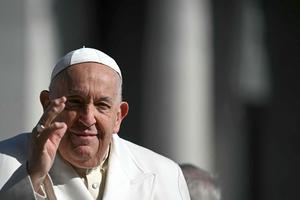
The picture shown at the head of this seems to show Father Bourgeois to be a martyr to his particular cause as he gazes off into the distance.  Maybe his work as missionary for MM became to much for him,who knows.

Any Catholic who doubts that the Church is serious about ordaining only men to the ministerial priesthood should read both “Ordindatio Sacerdotalis” and the accompanying statement, “Responsum ad Dubium.”

The Church has proclaimed definitively that she only has the authority to ordain men and that this will never change. Period.

Fr. Bourgeois has made the same mistake so many others have made during the last 2,000 years - placing his own personal authority over that of the Church and, in so doing, proclaiming himself a Magisterium of One.

I can only say to him, God bless the One, Holy, Catholic and Apostolic Church.

Thank you for giving us faithful Catholics the opportunity to support our Mother the Church in this open forum.

Those who want a more fleshed out discussion of the topic could look up Sister Butler’s book on it.  It’s short, follows Aquinas’ style:  state proposition, state arguments for, state arguments against, state author’s arguments… thorough, and written by someone who used to agitate for women’s ordination and decided she was wrong.  She goes back and looks at priesthood and roles for men and women through all of Scripture, not just the NT.  I had to get it through inter library loan, and found it very useful.

@ Leo, Rick, etc. in favor of women’s ordination,


You can say whatever you want, but you cannot refute ontological truths: men are men and women are women regardless of FUNCTION. The ONLY reason why anyone ever makes such a ridiculous argument like you are making is because they cannot see past the superficial argument that they promote. What I mean by that is you refuse to see past the fact that regardless of how any man or woman FUNCTIONS, he or she is still a man or a woman because they are ONTOLOGICALLY (i.e. big word for by their created nature) a man or a woman, period. It has absolutely nothing to do with testicles, for it is a reality that exists in our very soul. Whether or not one has a sex change operation or “thinks” he/she is the opposite sex for any reason whatsoever, one is still ontologically and objectively the same as one was created.


You absolutely cannot argue that one’s function determines their nature. If you do, you will also have to accept superiority and inferiority on multiple other levels—i.e. an adulterer’s FUNCTION is disgusting and degrading. If function determines our nature, then the adulterer is absolutely worthless and inferior to those who are chaste spouses. Do you really want to say that? Isn’t the sinner loved by God because he/she is made in the image and likeness of God? If you say yes, then what are you saying about God, for you seem to think that mere FUNCTION determines who we are and what we’re called to do! Does that mean that the “image of God” is that of a fallen nature which does tons of evil/sickeningly immoral acts? Of course not! That’s absurd! Our function when we sin has nothing to do with our nature or our objective human value in God’s eyes because He still loves us, but He does not love our sins! Thus, the obvious truth that men and women are equal in human value, but are not equal in things like the priesthood and being able to co-create new life with God during a pregnancy have nothing to do with superiority and inferiority of human value like you think they do. Read the Parable of the Talents in the Godspel. God does not give us equal gifts, but that doesn’t mean He loves some more than others, or even that some are superior to others since they have more gifts.

Odd that Fr. Bougeois would look for support to the Protestant communities, which were invented in the 16th Century and reject both the sacrifice of the Mass and the sacrificial priesthood.  Yet he ignores the Orthodox Churches, which trace their lineage back to Christ Himself, and which believe in both. 

Hmm, could it be because the Orthodox Churches stand with the Catholic Church on this issue?

Can my puppy be baptized?
Can my sister be ordained?


My puppy cannot be baptized because: they are not persons, not rational beings, capable of sin, do not have an immortal soul, members of a moral community etc.. Some puppy characteristics such as having a tail and 4 legs are irrelevant to the question that puppies are improper matter for baptism. Rational beings such as Vulcans, Klingons, and the apes in ‘Planet of the Apes’ are, in my view, capable of baptism (and ordination) - if they did actually exist. 


Are women improper matter?


Dear Menotti
I am not arguing that function determines nature. I do not deny that there are general differences between men and women. But I doubt that the difference is ontological as you claim. If men and women are ontologically different, what about human hermaphrodites? - or do you deny that such individuals exist? Not all human beings have XX or XY chromosomes, there are variations. Male and female are not absolute categories in nature, there are many hermaphrodite organisms and some which change sex. If there is life on other planets there may be more than 2 sexes.


Even if we accept that men and women are ontologically different, what bearing does this difference have on the question of ordination? Why/how does being a man necessary for ordination? Why does God make only men into priests? If women cannot be ordained, there must be a God-given reason. God is not capricious.


This is the crucial question which is crying out for an answer. Otherwise why bother with apologetics?


I don’t think that anyone can show any functional difference between men and women which is relevant to ordination. The differences suggested in JP2’s Theology of the Body and by Jimmy are only general differences which cannot be universalized to all men or all women. JP2’s description of the ‘feminine’ seem similar to the Jungian Myers-Briggs Type Indicator categories of Thinking and Feeling (about 2/3 of men are thinkers, 1/3 feelers and vice-versa for women).


The ‘feminine’ characteristics of nurturing, gentleness etc. are surely desirable in any priest and Jesus Himself manifested these ‘feminine’ characteristics to a perfect degree. “One like us in all things but sin”.


This would seem to leave some sort of representation relevance.


Some argue that only a male can represent Christ as priest. I have already show how women act in persona Christi (who was historically male) in the sacraments of baptism and matrimony.


Some argue that the Eucharist is different as far as gender is concerned. They say that in presiding at the Eucharist the priest is Christ the Bridegroom and the Church is His Bride. And therefore a priest must be male. I believe this takes these metaphors too far. For if we say Christ=Bridegroom=Male=Priest, then surely Church=Bride=Female=Communicant ie only females may receive the Eucharist! Surely a Reductio ad absurdum.


If the impossibility of female ordination is from God then it will withstand intense scrutiny which will refine our earthly understanding and be of great pastoral benefit. If it is not from God then it will not survive the sensus fidei.

Leo-It has been my experience that liberal dissenters appeal to what they think is the “sensus fidei” when all else fails, and when the Magisterium is contrary to what they call the “sensus fidei.”  And in proclaiming their dissenting “sensus fidei” only the sensus of those who agree with the anit-magisterial view count as “fidei.”  By the numbers, there are infinitely more theologians and infinitley more baptized Catholics whose “sensus” is that the Church does not have and never was given by Christ the power to ordain women. Leo, in your “sensus” who gets to vote?  And didn’t the proper authority in the church make it clear that this is NOT a matter of someone’s perceived “sensus fidei”?

well, since men cannot conceive and bear a child in womb, I guess they aren’t “equal” to women. Made in the “image and likeness of God” refers to the fact that we have intelligence and free will from all that I have read and studied. It has nothing to do with our role or function in this world. It’s so tiresome an argument, always wanting to be able to have and do and be everything that everyone else has or does or is. Even in Old Testament priests were male. If people put forth as much effort to promote the priesthood among our young men as they do to try to force the Church to change her doctrine, I think we would have lots of wonderful new clergy to lead us in these trying times. More prayers to our good Mother are in order (which brings up the question as to how anyone can think that the Catholic Church discriminates against women, when we are constantly being scorned for our great devotion to Mary, Mother of God! LOL)

@George: “...There is no such thing as New Testament clerical priest.  Why?  Because Christ obsoleted the Levitical priesthood…”

actually I don’t believe Christ “obsoleted” (not the correct use of that word, but simply following George’s usage) the Levitical priesthood. I believe the Levitical priesthood continued until the temple was destroyed and thus there was no longer a place for them to offer the mandatory sacrifices (@Jimmy Akin - please correct me if I am wrong in this). Also Jesus was NOT a Levitical priest. He was from the line of David, which is the tribe of Judah. Jesus was a priest in the line of Melchizedek, who is generally considered to be the first “priest"and this is the line of priests through which King David was “ordained”. There is some controversy, I believe, over the historicity of this man, Melchizedek, but it is the tradition. Take the time to really study salvation history and Revelation through study of the Bible, as well as the many excellent, well-researched materials about the Church. It’s enlightening. God bless you all, and pray constantly :)

have a read

MO,

Here is something for you to ponder.


The Catholic position
Peter was designated by Christ be the “universal bishop” and God intended for the Bishops of Rome to be the chair of his power in succession. This of course, is contrary to the Bible especially the Epistles of Timothy and Titus.  Timothy was the Pastor for the church in Ephesus, while Titus was a Pastor of Crete.  Each of these churches was autonomous.

The Greek Orthodox position
Orthodox believers object to Rome’s claim of universal authority because it is contrary to the recorded history of the Ecumenical councils. The very first council at Nicea (325 AD) granted equal power to initially three Metropolatans: Rome, Alexandria and Antioch. Two later councils, Constantinople (381 AD) and Chalcedon (451 AD), granted equal powers to five Patriarchs: Rome Constantinople, and Alexandria, Jerusalem, Antioch.

MO,

Looks like you are drinking the Akin kool-aid.  Better study church history instead of the revisionism that is being foisted on you by Catholic Answers.  Apologists are like lawyer, twisting evidence to support their position.  Only a fool would blindly trust Catholic Answers.

I have to say Mr. Akin’s response simply illustrates that there is no positive case to exclude women from ordination.

He seems to want to restrict a whole gender from ordination because of some statistical differences, which only could possibly suggest that some women are not suited for ordination, but then, not every man is suited for ordination, either.

He even descends to nitpicking. OK, it isn’t possible to prove a historical negative. But where is the evidence that Jesus ever ordained anyone at all? You mean you have none? Zilch? So it is quite illegitimate to propose that He did. Point to Fr. Bourgeois. Besides, Paul seemed to have called Junia an Apostle, which is the most likely reading of the text.

What about the famous symbolism argument? That women cannot represent Jesus Christ in celebrating mass?  This despite an old tradition that Mary was a priest because she gave up her son on the Cross. There is some evidence even of women bishops. Anyway, the argument that women cannot represent Christ in the Eucharist is a totally male priest centered argument, because some men think they can represent Christ but women can’t (which is nonsense, as they can administer sacraments such as baptism and marriage (the couple marry each other you know, and one is usually a woman). And from the point of view of the congregation, the recipients of the Eucharist, what possible difference can it make whether the celebrant is a male or a female? It certainly makes no difference to me or to thousands of other—say in the Anglican communities which have women priests.

The argument that ‘but we’ve never done it’ cannot be proved historically, and as I already mentioned, there is some evidence that ‘we’ have.

So, no matter what the commission said in 1976, we are still looking for a case to exclude women from ordination. Irrelevant physical difference such as (statistically) smaller size and less upper body strength, etc. do not count. So we are still left with the fact that the Church has no good arguments to exclude women from ordination.

If we can exclude women from ordination than we should also exclude Red headed, overweight male apologists from ordination.  Both are completely arbitrary and have no Scriptural support.

It strikes me as self-serving that the “judges” of who is called to priesthood are all males.  When someone senses a call to priesstly ministry, it is that person who articulates the call and through prayer and reflection and consultation allows that call to rise to the surface.  The Church(=community) makes a judgement as to the validity of that call. But the ultimate judges are male.  And the ultimate criterion banning women is that the church bans women. So what does a woman do with a call she feels deeply and is told “you must be wrong because God would never call a woman to priestly ministry.”  Does that not sound as if male churchmen are claiming to know more than God?

Jimmy, you conclude your first argument with: “We each have our own gifts and callings, and these are not identical.” Yet, male/female stereotypes rather than this “uniqueness” is what determines whether one can be a priest in the Roman Catholic Church.

Jimmy’s biggest circle in reasoning takes place when he says the apostles were all men. Who - exactly - defined that to be the case? There were always both men and women surrounding Christ. What, exactly, made the men apostles and the women not? As I understand it, there have even been stories about Christ written by the women. What , exactly, allowed the men’s stories to be included in the Bible and the women’s not?

I am convinced that cultural bias - not the word or intention of God - has been the biggest factor in this Church’s decision about “priests.” The cultural bias is changing. It has already changed in nearly every other Christain denomination.

It won’t be long, Jimmy.

“And from the point of view of the congregation, the recipients of the Eucharist, what possible difference can it make whether the celebrant is a male or a female? It certainly makes no difference to me or to thousands of other—say in the Anglican communities which have women priests.”

It changes the nature of the liturgy itself.

Please see this.

What is a Priest?

http://jandyongenesis.blogspot.com/2011/04/what-is-priest.html

http://jandyongenesis.blogspot.com/2009/01/one-priesthood.html

Many of the posters here lack an understanding of basic theology.  Too many Protestants confusing things. The question is why did God tell those countless reformation churches to get rid of the priesthood and the Mass, if God was calling them to it?

There was never a female sacrificial priesthood in temple Judaism or in the Christian church.

The priesthood is linked to the Holy Sacrifice of the Mass.

Only Catholics and Orthodox have this.

George,

Christ did not get rid of the Priesthood. You need to read the writings of the early church.

Protestant early Church historian J. N. D. Kelly writes that in the early Church “the Eucharist was regarded as the distinctively Christian sacrifice. . . . Malachi’s prediction (1:10–11) that the Lord would reject Jewish sacrifices and instead would have “a pure offering” made to him by the Gentiles in every place was seized upon by Christians as a prophecy of the Eucharist.

The Didache indeed actually applies the term thusia, or sacrifice, to the Eucharist. . . .

“It was natural for early Christians to think of the Eucharist as a sacrifice. The fulfillment of prophecy demanded a solemn Christian offering, and the rite itself was wrapped in the sacrificial atmosphere with which our Lord invested the Last Supper. The words of institution, ‘Do this’ (touto poieite), must have been charged with sacrificial overtones for second-century ears; Justin at any rate understood them to mean,

‘Offer this.’ . . . The bread and wine, moreover, are offered ‘for a memorial (eis anamnasin) of the passion,’ a phrase which in view of his identification of them with the Lord’s body and blood implies much more than an act of purely spiritual recollection” (J. N. D. Kelly, Early Christian Doctrines [Full Reference], 196–7).

George,

The Orthodox still have a valid priesthood, Mass, and seven sacraments.  That being said, I appreciate your honesty, compared to all the other posters here, who simply do not understand theological distinctions.

Well, savvy, those articles simply define “priest” as male only, excluding women, and then read it back into history.

By parity of reasoning, the argumentation excludes women from from the Body of Christ. Since God the Father is male, and his Son is male, then his Body must be male, too. It follows that women are not part of the Body of Christ. So much for the alleged equality of men and women.

The male symbolism argument is absurd. To designate God as male is philosophical nonsense.

Xenophanes,

You are confusing equality in dignity with equality in function.  We are all equal, but have different roles in the church.

The priesthood serves a particular function.

Underlying the priesthood is the belief that humans must give an accounting to God, especially for the shedding of blood. The priesthood is intrinsically linked to blood. The priest is the functionary who addresses the guilt and dread that accompany the shedding of blood.

There are two types of blood anxiety: blood shed by killing and blood related to menstruation and birthing. To archaic peoples both types were regarded as powerful and potentially dangerous, requiring priestly ministry to deal with bloodguilt through animal sacrifice and to deal with blood contamination through purification rites.

Not a single female in the Bible served in a priestly role. We can argue a case for women deacons, but the deacon is not intrinsically linked to blood. Despite the efforts of many to create an egalitarian reality, we find no basis in Tradition or Scripture upon which to argue for women priests. The Bible does not say that women can be priests because the binary distinctions that frame the biblical worldview make “woman priest” ontologically impossible.

The Scriptures do not forbid women priests because the very idea of women sacrificing animals in the Temple was beyond imagination. It would have been regarded as an affront to the Divine order.

I think we may have come to different conclusions, because the Mass is not just the last supper memorial meal, but the re-presentation of Calvary.

Put a man in front of the altar and there is no doubt that this is the eternal sacrifice of Jesus Christ being made present.

George,

Further more I would add that Rome does not deny the teachings of the Ecumenical Councils. The Apostolic Constitutions state that in order to depose a Patriarch for departing from the faith, there has to be a church court and council called to do this.

There has been no Ecumenical Council in the past 1000 years.

The Orthodox cannot make these decisions without calling a council.

You can make all the logical arguments you want, quote scripture, and tradition, but sexism is sexism no matter how you cut it.  Sounds just like all the arguments a racist would make to justify segregation.

Don R,

You are not thinking. Sacraments are not rights or political.

So, Savvy, you want “separate but equal.” Sorry, it doesn’t wash. Denying the possibility of ultimate leadership functions to women is to deny equality.

‘We’ve never done it’ is never a good argument. Of course, in the first place, it can not be proven historically, and there seems to be evidence that in fact there have been women priests.

What on earth is an “ontological distinction” in Hebrew? GMAB

A difference between human and non-human would qualify is a significant ontological distinction. So, are you denying that women have human natures? If not, then you have no reason whatever to deny women full status in the Church including the possibility of being ordained to the priesthood.

Greetings, all!

I need your help. New to the blogosphere, and working on my faith, I have read many NCR blogs, top to bottom. The vast majority of you are more educated in the tenets of our faith than I. I read, and I learn. More often than not I cannot follow the posts due to the time differential in postings. No doubt a hazard of the medium. I sometimes feel a call to post, but feel I would be swimming in water too far over my head. I also sense that it becomes too adversarial to focus on learning. I ask this with respect - is evangelization occuring through this discourse? A question, not a challenge. Please send me to Faithblog 101 if there is one. I look to learn, but I am obedient to the Magesterium. Hail Holy Queen!

With great respect to all of you…in His love.

Too bad you won’t see this kind of reasoning and/or article in the warped pages of the National Catholic Reporter (a.k.a. National Catholic Destroyer.) There they’ve practically canonized ‘Father’ Bourgeios as a Saint and declared all orthodox bishops as misogynistic heretics. As another commenter of the National Catholic Reporter once mused, “Ah, the NCR where its always 1968!”  Thank the Lord for the National Catholic Register! (...and Jimmy Akin too!)

Xenophanes,

The priesthood connected to the Holy Sacrifice of the Mass.  It should not be seen as a power symbol.

“Of course, in the first place, it can not be proven historically, and there seems to be evidence that in fact there have been women priests.”

There is no evidence to prove that women priests were ever around. What is your evidence?

Xenophanes,

This is a subject that can only be understood once you understand the Holy Sacrifice of the Mass and the priesthood in relation to it. Everything else is secondary.

Savvy, your arguments are so . . . vague. An ontological difference seems to be nothing more than that there is just “something different” about women. It seems to be so vague and mysterious. There seems to be nothing that would prevent women from becoming priests. Are women not fully human?

Tell me something sensible about the Holy Sacrifice of the Mass and the priesthood in relation to it, and why women can’t be priests. So far, all I have heard is nonsense, misogyny, and “because I say so.”

If you think there is no evidence women have ever been priests you have not been looking for it.

There was a long tradition that Mary was a priest, because she offered up her Son on the Cross.

Junia was called an Apostle by Paul according to the most probable understanding.

Everyone admits that women were ordained in the early Church. The argument is that those were only in heretical groups.

There seem to have been women priests in Celtic Christianity.

St. Brigit of Kildare is said to have been ordained a bishop.

Ludmila Javarova was ordained a priest in 1970 in Czechoslovakia.

Xenophanes,

“Tell me something sensible about the Holy Sacrifice of the Mass and the priesthood in relation to it, and why women can’t be priests.”

The Creator both gives and takes life. The priest represents the Incarnated God who atones for life-taken and sin committed.

The woman represents God who gives life.

Women were never priests because the priest took the life of the animal. The life-taking work of the priest and the life-giving work of women are binary opposites and the life-giving work is superior. This understanding is lost when women serve as priests.

The blood shed in killing, hunting, animal sacrifice stands for death. The blood shed in child-birth, sexual intercourse etc, stands for life.

The two bloods could not mix in temple Judaism and they can’t in Christianity, to keep the distinction between what stands for life and what stands for death.

The Mass atones for sin and death.

Jesus could have chosen to become female, but he became male, and as a male chose to die for our sins.

“There was a long tradition that Mary was a priest, because she offered up her Son on the Cross.”

Mary participated in her son’s sufferings a the foot of the Cross, something we do at every Mass, which makes Calvary present. This is different from being a priest.

“Junia was called an Apostle by Paul according to the most probable understanding.”

Junia was a deaconess, not an ordained priest.

“The argument is that those were only in heretical groups.”

Yes, these heretical groups denied the incarnation, either the humanity or the divinity of Christ or one of the tenets of Christianity.

St. Brigid was never a bishop, although she did start, along with the hermit Conleth, the religious community of Kildare in fifth-century Ireland. Conleth was a bishop and was the abbot for a house of men. Brigid was the abbess of a nearby convent, but was never a bishop.

Ludmila Javarova’s ordination was not officially sanctioned. She is not a real priest.

Xenophanes,

“Tell me something sensible about the Holy Sacrifice of the Mass and the priesthood in relation to it, and why women can’t be priests.”

The Creator both gives and takes life. The priest represents the Incarnated God who atones for life-taken and sin committed.

The woman represents God who gives life.

Women were never priests because the priest took the life of the animal.

The life-taking work of the priest and the life-giving work of women are binary opposites and the life-giving work is superior.

This understanding is lost when women serve as priests.”

The Mass atones for sin and death.

Jesus could have chosen to become female, but he became male, and as a male chose to die for our sins.

“There was a long tradition that Mary was a priest, because she offered up her Son on the Cross.”

Mary participated in her son’s sufferings a the foot of the Cross, something we do at every Mass, which makes Calvary present. This is different from being a priest.

“Junia was called an Apostle by Paul according to the most probable understanding.”

Junia was a deaconess, not an ordained priest.

“The argument is that those were only in heretical groups.”

Yes, these heretical groups denied the incarnation, either the humanity or the divinity of Christ or one of the tenets of Christianity.

St. Brigid was the abbess of a convent, but was never a bishop.

Ludmila Javarova’s ordination was not officially sanctioned. She is not a real priest.

Savvy, you’re not making any sense at all.

First of all, Jesus died. He was the sacrifice. He didn’t kill anyone that we know of.

Second, you give a symbolism argument which seems based on really bad biological theories.
“The priest represents the Incarnated God who atones for life-taken and sin committed.”
“The woman represents God who gives life.”

Then you add, “the life-giving work is superior.” Really, then why aren’t women superior in the Church? Why don’t they appoint and consecrate priests and bishops? Sorry, that doesn’t work. Hardly anybody in real life believes it—it puts the woman on a pedestal but deprives her of equal power and authority. Victorian age all over again. Separate but equal doesn’t work.

Women are human beings, or do you want to go with Tertullian that women were not made in the image of God, only men?

Again, I say this is totally celebrant centered, where some guys say that women can’t represent Jesus because they’re not men. But as one of the faithful, as a participant in the mass, as a receiver of the Eucharist, the gender of the celebrant makes no difference to me at all.

The argument used to be that women were inferior to men. Now the arguments are changed but the conclusion remains the same.

So you say you uphold tradition but deny the tradition of Mary Priest.

Need I add that women were the first witnesses of the resurrection and they took the news to the apostles?

You say Junia was a deaconness!! The only NT reference I can find is Rm. 16:7 and it says nothing of the sort.

I don’t think you can prove that all women priests were in heretical sects.

There is evidence that St. Brigid was ordained a bishop.

Since when do ordinations require some official sanction? Besides that of a bishop, that is. A bishop ordained Ludmila Javarova.

As I said earlier, there really are no good arguments against ordaining women as priests and bishops.

“First of all, Jesus died. He was the sacrifice. He didn’t kill anyone that we know of.”

Yes, however in the Mass, Christ is both priest and victim. It’s Christ through his ministry of priests makes present the same sacrifice that he did on Calvary. The Mass is an un-bloody sacrifice.

“Then you add, “the life-giving work is superior.” Really, then why aren’t women superior in the Church? Why don’t they appoint and consecrate priests and bishops?”

Simply, because it goes against the life-atoning work of the priest. It mixes the blood that stands for life and death, causing confusion about life and death.

“Women are human beings, or do you want to go with Tertullian that women were not made in the image of God, only men?”

These accusations have been refuted. Please see.

http://www.baylyblog.com/2011/07/carolyn-custis-james-and-the-image-of-god-in-women.html
http://www.firstthings.com/article/2009/03/003-what-aquinas-never-said-about-women-38

“Again, I say this is totally celebrant centered, where some guys say that women can’t represent Jesus because they’re not men. But as one of the faithful, as a participant in the mass, as a receiver of the Eucharist, the gender of the celebrant makes no difference to me at all.”

Makes no difference, please tell me what are your churches views on abortion- mixing life blood with death blood? or other life and death issues?

“The argument used to be that women were inferior to men. Now the arguments are changed but the conclusion remains the same.”

This was never the argument, please take a look at the links I gave you.

“So you say you uphold tradition but deny the tradition of Mary Priest.”

There is no such tradition.

“Need I add that women were the first witnesses of the resurrection and they took the news to the apostles?”

Yes, I know this, but none of them were priests. Jesus never ordained women.

“There is evidence that St. Brigid was ordained a bishop.”

There is no such evidence. She’s our saint, we would know.

“Since when do ordinations require some official sanction?”

In the Catholic church the Bishops are appointed by the Bishop of Rome, The Pope and need his approval and that of the magisterium. They act in the college of Bishops and Cardinals as a group and not alone.

“Hardly anybody in real life believes it—it puts the woman on a pedestal but deprives her of equal power and authority.”

Feminists are under the mistaken impression that the sacrificial priesthood is about power, or ordering people around. It’s not. This is they very definition of clericalism.

“First of all, Jesus died. He was the sacrifice. He didn’t kill anyone that we know of.”

Yes, however in the Mass, Christ is both priest and victim. It’s Christ through his ministry of priests makes present the same sacrifice that he did on Calvary. The Mass is an un-bloody sacrifice.

“Then you add, “the life-giving work is superior.” Really, then why aren’t women superior in the Church? Why don’t they appoint and consecrate priests and bishops?”

Simply, because it goes against the life-atoning work of the priest. It mixes the blood that stands for life and death, causing confusion about life and death.

“Women are human beings, or do you want to go with Tertullian that women were not made in the image of God, only men?”

These accusations have been refuted. Please see.

http://www.baylyblog.com/2011/07/carolyn-custis-james-and-the-image-of-god-in-women.html
http://www.firstthings.com/article/2009/03/003-what-aquinas-never-said-about-women-38

“Again, I say this is totally celebrant centered, where some guys say that women can’t represent Jesus because they’re not men. But as one of the faithful, as a participant in the mass, as a receiver of the Eucharist, the gender of the celebrant makes no difference to me at all.”

Makes no difference, please tell me what are your churches views on abortion- mixing life blood with death blood? or other life and death issues?

There is no such tradition of Mary priest.

None of the women to witness the resurrection were priests. Jesus did not ordain women.

“There is evidence that St. Brigid was ordained a bishop.”

There is no such evidence. She’s our saint, we would know.

“Since when do ordinations require some official sanction?”

In the Catholic church the Bishops are appointed by the Bishop of Rome, The Pope and need his approval and that of the magisterium. They act in the college of Bishops and Cardinals as a group and not alone.

People are under the mistaken impression that the sacrificial priesthood is about power or ordering people around. This is the very definition of clericalism. Priest’s are servant leaders.

Look 30% of priests are homosexuals.  The Catholic church makes a bigger deal about women priests while ignoring the fact that 30% of priests are homosexual.  The hypocrisy in Catholicism is legion.  Fact is that Jerome’s deliberate mistranslation of the Greek NT into the Latin Vulgate is what incorrectly promoted the priesthood.  The Greek word elder can NEVER be translated as priest.  But Catholics are too deceived to KNOW this foundational fact.  This is why Catholicism is a holding cell for all those who are waiting to be judged and sent to HELL.  Why?  The Eucharist is idolatry, for people are worshipping a wafer god created via human hands.

George,

Yes, we are familiar with homosexuality in the priesthood, and are working to root this out.

That being said, you are totally ignorant of early Christian practices and theology.

Even the Greek East calls it the priesthood.

Sola Scriptura is a 16th century invention.

Please read the writings of the early church that complied the Bible.

George,

The church is not making a bigger deal about women priests. This case has been closed.  it’s a few rebel groups that are obsessed with this and can’t let it go.

Savvy,

Your remarks about abortion are simply bizarre! What do the imaginary mixing of imaginary “life blood and death blood” have to do with anything? I oppose virtually all voluntary abortions because they involve killing a human being without sufficient justification. So does my Church.

I did not ask what the Church, or Augustine, or Aquinas, thought about male and female being created in the image of God, I rhetorically asked what YOU thought, because really, you are clearly on Tertullian’s side.

After all, you keep telling us that there is an ontological difference between men and women, the obvious meaning of which is that there is an essential difference. However, essentially, both men and women are human beings possessing human nature. As for the alleged ontological difference, there is a range between male and female characteristics, and some are even hermaphrodites. This obviously doesn’t fit in your binary scheme of things. Reality isn’t that simple.

Your remarks as to why women cannot ordain bishops and priests, and I should add, deacons, make no sense at all. You just told me that their life giving function is superior (setting aside the silly biology). Even if, given the hypothesis that women can’t celebrate the sacrifice of the mass, you have shown nothing which would be incompatible with women consecrating deacons, priests, and bishops.. The reason you offer makes no sense:

“Simply, because it goes against the life-atoning work of the priest. It mixes the blood that stands for life and death, causing confusion about life and death.”

That’s simply a non sequitur. Ordaining doesn’t involve anything like that. So no matter how you cut it, the Church authorities simply do not think women are equal to men.

Then you get to some matters where you show no signs of doing any research.

There was a tradition that Mary was a Priest. I should tell you to look it up, but . . .

http://www.catherinecollegelibrary.net/mrpriest/mpr_list.asp
“None of the women to witness the resurrection were priests. Jesus did not ordain women.”

There is no evidence Jesus ordained anyone. Hence, the argument that he didn’t ordain women has no force whatever.

Then we have this little exchange:

Xen. “There is evidence that St. Brigid was ordained a bishop.”
Savvy. “There is no such evidence. She’s our saint, we would know.”

Like Philomena? There is evidence that St. Brigid was ordained by Bishop Mel—or a legend, if you prefer. The evidence is stronger that she was Abbess in charge of a dual monastery for men and women.

“In the Catholic church the Bishops are appointed by the Bishop of Rome, The Pope and need his approval and that of the magisterium. “

Bishops ordain deacons, priests and bishops. For example, Cardinal Spellman ordained Joseph Oliver Bowers. I’m sure his selection went through a whole process of selection and approval, but that is not the essential to the sacrament as such a procedure could not possibly have been carried out in many periods of history.

”On April 22, 1953 he returned to the United States to be consecrated and to take a vaunted position in the annals of black history in the United States. In a ceremony noted around the world, Bishop Joseph Oliver Bowers SVD, DD, JCL was ordained by Cardinal Spellman at the Church of Our Lady of the Gulf in Bay St. Louis, USA, becoming the first black bishop to be so ordained in that country.”

http://www.thedominican.net/2009/06/bishop-joseph-oliver-bowers-worlds.html

The Pope is a bishop, too, of course, which is why he can ordain.

“People are under the mistaken impression that the sacrificial priesthood is about power or ordering people around. This is the very definition of clericalism. Priest’s [sic] are servant leaders. “

Fine. So why can’t women choose those who are to be ordained priests and bishops, and why can’t a woman ordain them? Why are men in ultimate charge of church affairs? As I pointed out earlier, your arguments do not even bear on this question. 

As I keep pointing out, the main opposition to the ordination of women is simply misogyny. There’s no way around it.

Xenophanes,

“What do the imaginary mixing of imaginary “life blood and death blood” have to do with anything?”

It has to do with the distinction between life and death and what takes place at Mass.

I am a woman myself and have never been told I am inferior. Men are women are equal, but are different.

Hermaphrodites would not be able to be priests. So this is a non-issue.

Women deacons have not been ruled out. This is still open to discussion. In fact we have never had more women theologians, administrators, and lay ministers.

“That’s simply a non sequitur. Ordaining doesn’t involve anything like that. So no matter how you cut it, the Church authorities simply do not think women are equal to men.”

Priests are ordained into the sacrament of Holy Orders, by the Bishops who are the successors of the 12 Apostles.

In case you do not know, only those ordained in Apostolic succession can celebrate the Eucharist and administer sacraments.

This is a document on the Eucharist and Apostolic succession.

http://www.catholic.com/library/ecclesia_de_eucharistia.asp

Mary could not have been a priest, because I already told you that the priest functions as a someone who gives an accounting for sins committed to God, on behalf of the community.

This is the definition of a priest.

“So why can’t women choose those who are to be ordained priests and bishops, and why can’t a woman ordain them?”

Actually, no lay man can choose them or ordain them either. It has to be a Bishop ordained in Apostolic succession.

In fact there have been anti-Popes who were not ordained the right way.

“Some argue that the Eucharist is different as far as gender is concerned. They say that in presiding at the Eucharist the priest is Christ the Bridegroom and the Church is His Bride. And therefore a priest must be male. I believe this takes these metaphors too far. For if we say Christ=Bridegroom=Male=Priest, then surely Church=Bride=Female=Communicant ie only females may receive the Eucharist! Surely a Reductio ad absurdum.”

I think this is an excellent point.

I also find this business about life-blood and death-blood and why men can offer atonement for the sins of the community and women cannot - all hard to understand, much less accept. This argument seems rather arbitrary. (And is it new? I have not seen this apology for the male-only priesthood advanced until now.) As a matter of fact, I have to say of all the arguments offered here, from top to bottom, that no compelling case for the male-only priesthood has yet been offered. It seems instead that those who would defend the Church on this point are having to work very hard indeed to do so.

(Somewhat tangentially, Savvy stated that the role of women as life-giving is superior. I have noticed a tendency among Catholics to throw its men under the bus in order to promote the view that the Church is pro-woman - that is, to employ sexism against men in order to counteract charges of sexism against women. Like so: “No, we don’t disdain women. In fact, we think women are better than men! And here are the perfectly Catholic theological reasons to believe men are, in fact, worse than women. Much worse, actually!” And now, Savvy wishes to dispel our concerns about sexism by pulling aside the curtain and revealing that actually, men can be priests only because they’re dirty and women aren’t. Nice. Well, I’m glad I’m not a Catholic. You can’t seem to treat either sex well. Anyway, I digress.)
 
Perhaps the trouble for Catholics is that they cannot question the Magisterium on one issue without opening the floodgates on many other issues as well.

No Convinced,

Jesus himself called his church his bride. 

You have heard of the term mother earth, this does not mean that men are not part of the earth.

This does not mean that women can only receive communion or are superior to men. 

Jesus did not offer a sacrifice because he was not holy.  it’s the blood of Christ that redeems both men and women.

Nobody is throwing either men or women under the bus.

But, celebrating what makes men and women unique in themselves.

Our culture is somehow under the impression that you cannot be equal, if you’re not the same.

In the incarnation, the creator became the creature, so the greater bowed down to the lesser.

In Mary, a humble woman became the theotokes, or the ever-virgin mother of God.

So, it’s about humility.

There are no new doctrines.

The magisterium does not create new doctrines. Languages, disciplines, etc may change. But, doctrines do not.

God is still “Father, Son and Holy Spirit” and will always be.  There is an order in creation.

C. S. Lewis argued that ordaining the male sex to minister at the Eucharist has to do with the “correct appearance” (“orthodoxy” in Greek), the proper iconography. Change that appearance, alter that icon, he reasoned, and in due time you are worshipping a different god.

Not convinced,

From the Catholic perspective it actually makes no difference who Protestant denominations ordain or not, because they don’t have a priesthood to begin with.

“Perhaps the trouble for Catholics is that they cannot question the Magisterium on one issue without opening the floodgates on many other issues as well.”


If you mean that the priesthood and the sacraments and the Mass are linked and that changing one will affect the other.  Yes it will.

One of the reasons why we are not buying the equality arguments. It will create a religion that is not Christianity.

Savvy - I realize I’ve been harsh with you. I’m sorry for that, but as you can probably guess, this is an issue that I personally find abrasive and frustrating for a host of reasons directly and indirectly related to the matter at hand. Then again, I’m sure we all feel that way on this and many other issues, whatever our respective positions may be. These are contentious times.

I appreciate your effort to explicate your views further, and it sounds like you’ve done your homework, but I’m afraid I still don’t understand. You stress that the Mass and the priesthood are closely linked and that this is the fundamental reason a male-only priesthood is necessary. And from what I understand you also consider historic views about human blood to have vital significance to the same picture. I don’t get that. Is there a book that presents the argument you are now making that I can read for further clarification?

Also, by way of bragging rights (being silly here), a good friend of mine knows Sister Sara Butler. That’s right. I am officially the coolest guy here. Hahaha! Just having some fun. :-)

“You stress that the Mass and the priesthood are closely linked and that this is the fundamental reason a male-only priesthood is necessary. And from what I understand you also consider historic views about human blood to have vital significance to the same picture. “

Not convinced,

In Judaism the priesthood was genetic, and still is.  Only a Cohen can be a priest.  Abraham’s people were ruler-priests who married the daughters of other ruler-priests.  The expectation was that out of the priestly line, the Messiah would be born.

Mary’s father was a priest.

Priests were a people set apart for this reason.

The priesthood, according to St. John Chrysostom, “is ranked among heavenly ordinances. And this is only right, for no man, no angel, no archangel, no other created power, but the Paraclete himself ordained this succession…” (On the Priesthood, 1977, St. Vladimir’s Seminary Press, p. 70).

The priesthood of the Old Testament was once and for all fulfilled in Jesus Christ.

The priesthood is much older than the Apostolic ministry.

The distinction has to do with blood. 

The Apostle Paul refers to the Blood of Jesus no less than twelve times in his writings because God makes peace with us through the Blood of the Cross. It is to HIS atoning sacrifice that the priesthood points as a sign.

If it is made to point to anything else, it becomes a broken sign.

Why should this matter to Christians?

It matters because from the beginning the priesthood points to the saving work of Jesus Christ and is Christological in nature. It is therefore extremely important that the male priesthood be preserved and that its origins be better understood.

if you want more details you can contact a friend of mine, who used to be a priest in the Episcopal church. She is now a lay Eastern Orthodox woman.

Her blog is http://jandyongenesis.blogspot.com/2008/06/index-of-topics-at-just-genesis.html

“These are contentious times”

Yes, they are.  Due, to the watering down of Christian teachings, there are many priests themselves now rebelling against the priesthood.


I can understand the confusion among the laity, but seriously it doesn’t take much for these clergy to pull out a book and take a look at what the church fathers had to say on this issue.


The fact that they don’t and continue to mislead souls, is very sad.

In The Bible, we find that God demanded an accounting for all blood that was shed.

Genesis 9:1-5

“God blessed Noah and his sons and said to them, “Breed, multiply and fill the earth. Be the terror and the dread of all the animals on land and all the birds of heaven, of everything that moves on land and all the fish of the sea; they are placed in your hands. Every living thing that moves will be yours to eat, no less than the foliage of the plants. I give you everything, with this exception: you must not eat flesh with life, that is to say blood in it. And I shall demand account of your life-blood too. I shall demand it of every animal and of man.”

The priesthood came into existence, because blood was shed.

In Jesus Christ, God himself became the sacrifice.

Jesus Christ’s uniqueness is his service as both sacrificed victim and priest.  In the one person both roles are fulfilled.

Hence, the priesthood once again points to HIS atoning sacrifice.

The relationship between Christ and His Church is said to be spousal.  When a husband and a wife enter into the one flesh union it is the man who enters into the woman. Likewise, in conception it is the male sperm that swims up to and enters into the female egg.  It seems clear that the act of entering within is a male act.  The male is the doer of intimacy.  The female is the one who receives this intimacy.  This explains why Christ came as a male, and why male terms like Father and Son are used to describe God, and why the Church is called Holy Mother Church.  In the sacrament of the Holy Eucharist during the Consecration the True Presence of Christ enters into and becomes one with the bread and the wine.  Transubstantiation at its core is a male act.  The Body and Blood in a similar fashion enter into the communicant.  This is why we say that we receive Communion.  The Holy Eucharist is a sacrament that is permeated with Christ’s maleness, and gives us a foretaste of the final nuptial union that is described in Revelation.

“(1) As Catholics, we believe that we were created in the image and likeness of God and that men and women are equal before God. Excluding women from the priesthood implies that men are superior to women.”
-
And what does excluding men from convents imply?  That there is something undesirable about being a nun?  That’s insulting.  Or assuming it *is* equally desirable—where are the legions of outraged men who were turned away from being nuns?  This assertion, from Bourgeois or anybody, is just silly.  There is nothing “superior” about being a priest versus any other legitimate vocation.
-
Rick: I really suggest you check out Proverbs 31—it is a description of female business acumen, reinvestment of profits, and philanthropy.  If the woman of this passage doesn’t have a job, I don’t know what a job is.  But the priesthood is not just any run-of-the-mill job. 
-
I agree with Guy: if a Catholic is feeling called to do something which is against the established teachings of the Church (which, as we acknowledge in the Creed is one, holy, and apostolic), the call may be coming from somewhere, but not from God!  You need to check the caller ID.  Greg: claiming to know more than God?  I think you’ve got it backwards.  We only know what God has revealed, and people who think that a woman’s “feeling” (because feelings are never wrong, eh?) about a call to ordination must be valid would seem to be claiming to know more than that.
-
Leslie: what does writing stories have to do with it?  Is that the defining trait of a priest, being a good story-writer?  You are right, anybody can do that.  But it’s not what defines priests.
-
Xenophanes, you write: “There is no evidence Jesus ordained anyone.  Hence, the argument that he didn’t ordain women has no force whatever.”
If you are looking for the word ‘ordination,’ or for some elaborate ceremony, then of course you aren’t going to find it.  But according to my memory Jesus did do at least two important things, which were to institute the celebration of the Mass (at the Last Supper) and grant the authority to forgive sins in his name.  This latter authority he did not grant to just anybody.  It’s not an ‘argument,’ it’s an observation.  Incidentally, the Church official does not make doctrinal ‘arguments.’  ‘Arguments’ attempt to persuade.  One persuades in a democratic setting.  The Church is not a democracy.
You write: “So no matter how you cut it, the Church authorities simply do not think women are equal to men.”  I see…you’ll find in favor of the premise you want, no matter what anybody tells you.
You write: “Then you add, ‘the life-giving work is superior.’ Really, then why aren’t women superior in the Church?”  Let me reiterate: being a priest does not make anybody superior, it just makes him a priest.  Envy is a sin, is it not?

Greg and Eness,

The word priest has been hijacked.

For example, is there a difference between a voodoo priest and a Christian priest, or one in Temple Judaism?

Yes, the difference is that for Abraham’s people the priesthood was an office that was created to mediate for sin and blood guilt. 

Priests were very conscious of things such as purity laws, and the like , because out of the priestly line, the promised Messiah would come.

It pointed to the coming of the One Priest Jesus Christ, who would take away the sins of the world.

Hence, the priesthood and Mass always pointed to HIS atoning sacrifice.

If Angels who rank higher than humans can bow down to the Lamb of God, then why are we so proud?

It was pride that cast Lucifer out of heaven.

Enness:
Greg: claiming to know more than God?  I think you’ve got it backwards.
**********************************************************************
No. Where did I claim that I knew more than God?  What did I say that was in error?  Holy Mother Church has said that we need use both faith and reason.  Where is my use of faith and reason in error?  A constructive critique will show a person where they are in error, and why, so that they can learn and benefit. You have given me no new seeds of contemplation.
Savvy:
**********************************************************************
I’ve been doing some work on Trinitarian image and likeness.  The interesting thing is is that Holy Orders ends up looking like it is in the image and likeness of Christ’s Hypostatic Union.

GregB,

The Mass is not just a gift for us, but also a gift to the Father.  Yes, that makes the priesthood Trinitarian.

“Bourgeois offers three rejoinders to this argument, each of which is quite weak:

  a) “As we know, Jesus did not ordain anyone.”

We know nothing of the kind. If by “ordination” you mean “sacramental laying on of hands for purposes of placing one in the priesthood” then we have no mention one way or another of whether Jesus did this. As the gospels themselves record (John 21:25), Jesus did many things that are not recorded in them. One of them might have been such an ordination-by-laying-on-of-hands ceremony.”
—-
## The response is an appeal to silence - definitely a poor argument. Neither the NT nor Tradition actually denies Jesus went to America - just as the Mormons claim He did. Are we then to infer that He went there on a full-scale preaching tour, and chose Apostles ? Why not ? If we mis-use the argument from silence, to construct in the career of Jesus all the events we need to be in it to justify our own doctrines & traditions, then there is no end to the fairy-stories we can invent and call real events in the life of Jesus. That is not responsible Christian theology or exegesis - it’s myth-making.

I buy the Church’s theological anthropology. God created male and female. A marital covenant. Christ referred to himself as the Bridgroom and his Church as the bride. Still the male and female marital covenant. A priest (male) is, like Christ, spiritually wedded to the Church (female). A female priest would not be consistent with the example/direction established by God in the beginning and confirmed by Christ.

Sad to say Father B is a great heretic, schismatic and an apostate priest in plain english. This issue was decided nearly a couple of thousand years ago when St. Peter, St Thomas etc. left their spouses and went off and died alone in many cases a martyr’s death. Most of the early clergy, bishops and popes died painful deaths at the hands of the pagan Roman’s persecutors etc.. This is why you have the male only celbate clergy in the first place.              As Jesus said you need not look back to the plow-family farm let alone the family you need to follow him, giving away your riches and income, pick up your cross and follow Jesus and his church .  While Mary Queen of Heaven and Mary Magdalene etc. were important to the early church, the Priesthood and monks were for obvious reasons of dedication to spreading the faith in a hostile pagan world ALL males and celibate.Nuns are ALL female and I a male have no more right to be a nun that women can become priests or monks. The issue is taken up in the Catholic Catechism and as the long lines of popes have stated the issue in final and decided.The church is NOT a debating society. Obviously the issues, Sacredness of ALL human life, Celibacy and female nuns and male priests-monks obedience to the magisterium are issues settled long ago by the fathers of the catholic church.                Father B. like Poust of Barcelona, McBrien(ND), Curran, McQuire(Marquette)  of the USA and Kung and the so called reform priests of Austria-Germany etc. should be bodily expelled from the clergy and the faith before they lead more of the faithfull into apopstasy and heresey. Ed M. Waterbury, Ct., USA

Ed. M., you surely are forgetting that there is more than one rite in the Catholic Church. In the Roman Rite priests are celibate, with some few exceptions for converts. However, in Eastern rites there can be and are married priests.

Moreover, you simply ignore history, as even in the West, there were married priests for centuries.

Your arguments about monks and nuns are, to be blunt, simply silly. They are both members of religious orders. Nothing comparable to ordination is involved. Both males and females can be come members of religious orders.

Manticore,

As I pointed out above, it is true that one cannot prove a historical negative, as a rule, that is prove that something did NOT happen.  However, nowadays, we tend to look at evidence FOR something. There is simply no evidence that Jesus ever traveled to the New World, to use your example. We have no evidence Jesus ordained anyone. And so the argument goes both ways. The assertion that Jesus did ordain someone is also mythmaking, to use your terminology.

Xenophanes,

I agree that celibacy is a discipline, not a doctrine. 

Jesus appointed and anointed people.

Leo: “a. Jimmy moves from the general to the universal. This method is as valid as saying that black people should not be given the vote because (despite some exceptions), most are less educated, own less property etc.. NB I’m not saying Jimmy is racist.
He needs to find a universal reason why some men can be ordained but ALL women cannot - ever - period.”
No, you’re clearly mistaken here. It is as valid as saying that people under 18 or 21 should not be given the vote (or allowed to purchase alcohol) or a person who is under 35 should not be allowed to become president. These are positive laws that do not, and do not intend to, imply that those they exclude from exercising a particular function or office are incompetent because of some accidental ‘defect’ in their humanity (being poor, etc. (what a silly comparison!)). You are implying that women *are* generally less *something*, and therefore they universally cannot *do* some related thing. That is not correct. Women universally *are* not men (just as 17 year olds universally are not over-18) and this is the reason why according to the positive law (which can be assumed to have good *general* reasons supporting it) they are *universally* excluded from certain things, just as is the case conversely.

“...just as is the case *for men*,” I meant to say.

Those who say “why not women priests?” should understand that this is like saying “why not rice krispy squares and kool-aid for communion?” You must understand: that is simply not what our faith teaches, it is contrary to our law. We can and should search in faith for an understanding of ‘why,’ but faith *demanding* understanding, *insisting* upon full understanding as a sine qua non for adherence and obedience, is simply pride and no longer real faith.

Faith genuinely seeking understanding must not fail to understand faith itself.

“Please people, try to progress a century or two.” - Rick

Ah, the argument by calendar.  I was wondering how far down I would have to read to find it.  Now I am satisfied.  Nothing determines truth so definitively as the date.

The cross is the centre that unites both men and women in the blood of Christ. 

In the Orthodox church, these blood distinctions are still kept.

If a priest should cut himself while he is in the Holy Place, he must leave. His blood cannot share the same space as the Blood that is there by virtue of Christ’s Priestly Presence.

We are neither male nor female, Jew nor Greek…

Until you can see your way past that one, you will not persuade the millions of people around the world who see that the main issue keeping women out of the priesthood is that a bunch of closeted gay priests don’t want to give up their men-only world.

trudy: bad troll! (also: bad person: slander is a serious sin, especially stupid slander, which abuses your own intellect as well as unjustly attacking others)

David,

I agree.  The Troll doesn’t get that millions of people frankly don’t care.

Well, you can concentrate on the name calling and ignore the argument that some men have decided that women cannot be priests. But of course, that’s likely to happen when people have no good arguments.

What notions are used in arguments to deny the priesthood to women?
Life and death blood, church is the Bride of Christ, metaphors at best, and an alleged ontological difference between men and women which nobody can explain. You can’t make a good argument using nonsensical concepts. Denying a vocation on the basis of symbolism is immoral.

And, in spite of somehow being ontologically different, women and men are supposed to be equal! The alleged “ontological difference is just a modern, sanitized version of misogyny. You’re quite right, savvy, you and the popes can assert that you regard men and women to be equal until you’re blue in the face, I don’t believe it. I look at what is done and that tells a different story. Men and women are not treated equally in the Church, and denying the priesthood on the basis of gender is one example. That you are a women who buys into this is unfortunate but irrelevant.

Jimmy: Great post.  But obviously it’s one of those issues that only the faithful are going to accept as truth, whereas those inside and outside the Church who want the Church to bend to the ways of the world are never going to agree with.  To ‘mk’ your first comment was right on!

Xenophanes:  Please get your head out of the sand. Trudy’s argument was clearly a stupid and slanderous ad hominem and Trudy is clearly a troll. Noting this is not at all to ignore her argument and concentrate on name-calling, it is to correctly analyze it. You are the one selectively ignoring arguments, not to mention making bad arguments of your own.

Xenophanes,

Your problem is pride.  Women saints could be very fierce when defending the Eucharist.

The English Martyrs are others gave their lives to preserve it. I have come across Catholics who do don’t believe in the real presence, why do these people even want a priesthood?

What happens at Mass is not symbolism.  It’s the sacrifice of Calvary made present.  It’s Christ own sacrifice. If it does not point to his atoning sacrifice it becomes something else.

What arguments do you have exactly? Please address the sacrifice of Christ made present.

David,

Yes, I agree.  I have spent a considerable amount of time researching the origins of the Christian priesthood. I am a little tired of people not engaging issues and responding with ad-hominem attacks on me. The repeated attacks of those who lack understanding are getting boring.

Xenophanes wrote:
What notions are used in arguments to deny the priesthood to women?
Life and death blood, church is the Bride of Christ, metaphors at best, and an alleged ontological difference between men and women which nobody can explain. You can’t make a good argument using nonsensical concepts. Denying a vocation on the basis of symbolism is immoral.
**************************************************************
The fact that you can make such statements makes me wonder if you have any grasp of the spirituality of the priesthood.  In Revelation 19:9 there is a clear reference to the marriage supper of the Lamb.  In the Old Testament the relationship between God and Israel is described of as being spousal.  Hosea was commanded by God to marry a harlot to show Israel how their practice of worshiping idols, in violation of the Commandments, had made Israel into a harlot.  Idolatry is a form of spiritual adultery committed against God.
Marital imagery is also used by St. Teresa of Avila in her work “Interior Castle,”  which is about mystical theology.  In it she talks about the mystical life as being divided into Seven Mansions where the Prayer of Union has the Spiritual Betrothal, and the Spiritual Marriage.
Your statements appear to operate more on the earthly plane of existence, and show little comprehension, or appreciation, of the more weighty issues of spirituality.  The symbolism that you scoff at is a form of spiritual road sign that points to deeper spiritual realities.
I don’t claim to have all the answers, but I do try to look for spiritual guidance from competent spiritual sources.  St. John of the Cross warns people to beware of incompetent spiritual directors.

Trudy throws in some ad hominem comments, which she should not have done, but that still leaves some substantive arguments. It’s no use ignoring Gal. 3:28, and it’s no use ignoring the fact that males have made the decision that priests should not be women. In order to argue fairly, it is necessary to state the argument of the opponent in the strongest way possible, but few wish to do that.

Savvy, savvy,

You wonder if I have “any grasp of the spirituality of the priesthood.” What you wonder about me is irrelevant and adds nothing to your arguments.

You mention “marital imagery.” Yes, marital imagery is used in the Bible and in tradition in a lot of connections. But that’s the point: it is imagery. Hosea probably married a temple prostitute, which makes the imagery of whoring after idols much more appropriate and meaningful.

“What happens at Mass is not symbolism.  It’s the sacrifice of Calvary made present.  It’s Christ own sacrifice. If it does not point to his atoning sacrifice it becomes something else.”

“What arguments do you have exactly? Please address the sacrifice of Christ made present.”

You state the Mass is “the sacrifice of Calvary made present,” it is “Christ’s own sacrifice,” and then you turn around to say “If it does not point to his atoning sacrifice it becomes something else.” Is it the sacrifice? Or, does it “point to” the sacrifice? You have summed up the problem admirably. I do not deny the Real Presence. Why do you think I do?

You recognize that we express many spiritual things in imagery, but then you turn around and stick on details of the imagery to try to argue that women cannot offer the sacrifice of the Mass.

“Incidentally, the Church official does not make doctrinal ‘arguments.’  ‘Arguments’ attempt to persuade.  One persuades in a democratic setting.  The Church is not a democracy.”

I suggest you read some of the papal documents if you think the Church does not offer arguments on doctrinal matters. Arguments are made in “Inter insigniores,” for example.

Xenophanes,

We were not talking about a job, but the sacraments. 

I have merely traced the ancient origins of the Christian priesthood and what is necessary for the Eucharistic sacrifice and why?

The church uses a certain pattern in valid development of doctrine. This was summarized by Newman in his works.

I would recommend you read An essay on the development of Christian doctrine By John Henry Newman, to understand how the church does this.

Instead of it’s the men in power stupid argument.

It won’t work with someone who has done their homework.

As for imagery, yes there’s a lot of other imagery used, but the incarnation did not take place in any of them.

In other words there needs to be a valid ‘theological’ argument made.

What is necessary for a valid Eucharistic sacrifice and why?

“it’s no use ignoring the fact that males have made the decision that priests should not be women.” - Xenophanes, since that is just another irrelevant ad hominem argument (albeit not as stupidly crude as Trudy’s), we certainly should ignore that fact. Nobody is ignoring Gal 3:28 and you your ad hominem arguments are certainly not substantive.

David ,

Gal 3:28 refers to Baptism and is fulfilled during the Eucharistic sacrifice.

The church is at the foot of the cross, during the Eucharistic sacrifice, uniting herself to Christ. The church and Christ together form the whole Christ.

When Adam stretched out his hands for the tree of death. This destroyed his relationship with God and with Eve.

When Jesus stretched out his arms on the tree of life (cross), this restored the relationship with God and with his bride.


The cross unites both men and women.

Jimmy,

I love your blog and appreciate what you have done here regarding the “debate” of women priests and explaining the Church’s infallible position.  However, it has stirred up some dissident “Catholics” into thinking that this point is actually debatable.  There is no debate, Jesus Christ, through His Holy Roman Catholic Church, has spoken.  Case closed.  Let’s us praise The Most Holy Trinity for its guidance and move on.

A priest must be a Good son in order to serve in persona Christi.

Women’s ordination to the priesthood would be an innovation, but why not revive the ancient office of the female diaconate, which began with St. Phoebe?

www.catholic.org/saints/saint.php?saint_id=115 and Romans 16:1

Phoebe was a Christian woman, described in Romans 16:1 as a “deacon” or “servant” in the church of Cenchreae. Some have called Phoebe a “servant,” using a general rather than specific translation of the text from the original Greek. Still others have referred to Phoebe as a “deaconess.”

The Greek word diakonos, used to describe Phoebe in Romans 16:1, is the masculine form of the noun, which could be translated into English as deacon rather than deaconess. Phoebe was a deacon of the church in Cenchrae, according to a strict translation of Romans 16:1. While the word diakonos is translated in other portions of the New Testament as servant, it is also translated as deacon in still other passages. The Today’s New International Version of the New Testament, for instance, translates diakonos as deacon.

So you take the fact that you can make a strict translation of Romans 16:1 and refer to Phoebe as a ‘deacon’ (fine); then you make the (rather wild) assumption that this implies the existence of an “ancient office of the female diaconate.” Hmmm… Well if you want to revive this “ancient office,” it sounds to me like you have some more research to do. How did this ancient office work? What juridical-canonical status did it have? I wonder what it is, exactly, that you’d like to revive: an actual ancient office, or merely the use of a word (which you would presumably attach to a brand new office)?

BTW, Romans 16 doesn’t seem to mention anything about *diakonos/protasis* Phoebe being *ordained*. It just seems to say she has been a great helper and that those addressed should help her in her work. I know women (and men) in regard to whom I can imagine Paul making a similar recommendation and exhortation - and they’re not deacons.

Post a Comment

By submitting this form, you give The National Catholic Register permission to publish this comment. Comments will be published at our discretion, and may be edited for clarity and length. For best formatting, please limit your response to one paragraph and don't hit "enter" to force line breaks.

Name:

Email:

Write your comment:

Please enter the word you see in the image below:


Notify me of follow-up comments.

About Jimmy Akin

Jimmy Akin
  • Get the RSS feed
Jimmy was born in Texas, grew up nominally Protestant, but at age 20 experienced a profound conversion to Christ. Planning on becoming a Protestant pastor or seminary professor, he started an intensive study of the Bible. But the more he immersed himself in Scripture the more he found to support the Catholic faith. Eventually, he was compelled in conscience to enter the Catholic Church, which he did in 1992. His conversion story, "A Triumph and a Tragedy," is published in Surprised by Truth. Besides being an author, Jimmy is a Senior Apologist at Catholic Answers, a contributing editor to This Rock magazine, and a weekly guest on "Catholic Answers Live."