How Should We Die?
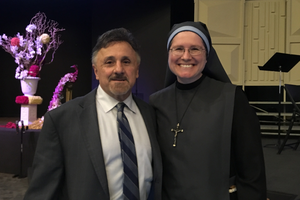
Bioethicist Father Tad Pacholczyk speaks about end-of- life issues.
Father Tad Pacholczyk serves as director of education for the National Catholic Bioethics Center in Philadelphia.
Father Pacholczyk (pronounced pa-HOLE-check) was ordained a priest for the Diocese of Falls River, Mass., in 1999. After earning a Ph.D. in neuroscience from Yale, he did postdoctoral research at Massachusetts General Hospital/Harvard Medical School. He also studied theology and bioethics in Rome.
He travels and speaks extensively on the ethical implications of embryonic stem-cell research, human cloning, end-of-life issues and in vitro fertilization.
As the nation geared up for an overhaul of its health-care system, Father Pacholczyk spoke with Register correspondent Joel Davidson.
In his March letter to the bishops of the world, Pope Benedict XVI said: “With the dimming of the light which comes from God, humanity is losing its bearings, with increasingly evident destructive effects.” Do you see this phenomenon in the area of bioethics?
If you look at the history of bioethics, the whole field has remarkably religious roots. Religious men — Catholics and Protestants in particular — were involved in founding the discipline. As this dimming occurs, which the Pope describes, those working in bioethics are looking for other points of reference, and they are trying to establish a secular bioethics — one which almost defines itself in contraposition to traditional ethics and bioethics, which have been invoked when complex questions arise. That is a new phenomenon in the last 15 to 20 years, but one that is becoming a stronger and stronger force.
We are now witnessing a certain arbitrariness that ends up characterizing the entire field of bioethics. We do not have a common language as we used to. This is a problem in society in general. This loss of a common language includes an overt attempt to exclude religion from the public square. As people accede to that move, you end up in these places that the Pope describes as a dimming. It is a fearful place, ultimately.
When the religious and moral perspective is excluded from bioethics, it seems that a very important piece of information is missing, especially when someone is struggling to make a morally sound decision about medical care, either for himself or a loved one.
Absolutely. In other words, people struggle to gain their bearings when they are only given purely medical information and the moral framework that might illuminate the best path for them is not provided.
You’ve said that a false autonomy increasingly affects bioethical decisions.
Autonomy is something that has become exaggerated in our society to the point that the exercise of autonomy is almost considered the definition of what is right — if you choose it, it must be right. But that is a completely untenable position in the final analysis. A proper understanding of autonomy means that a person chooses freely from among moral options. Insofar as that occurs, then autonomy becomes a very active and important dimension to health-care decisions.
In your work, you sometimes address ethics boards at Catholic hospitals. What do you say about how Catholic hospitals should approach the issue of autonomy?
Catholic hospitals have a duty to respect a patient’s genuine autonomy, but this never extends to the point of allowing a patient to do something that runs contrary to the moral law — to the good of the person.
This is an eminently reasonable position. It is the recognition that there are some human choices that are harmful and unreasonable. When you enter a relationship with a health-care institution, there is a kind of covenant that you enter into with those who care for you. This implies a need for communication, for honesty, for real moral information to be made available so that decisions are informed.
How can the average Catholic be assured that he or his loved ones receive care that is in accord with Catholic moral teaching?
Part of the challenge is to be involved. If you bring Mom or Dad to the nursing home and then don’t see them for the next six months, there may not be many opportunities for you to get a sense of how things are proceeding. I think the ministry of presence — being there with our loved ones — really opens up an awareness of how issues are handled. Some of this will come through dialogue with doctors and nurses.
A person may not be up to doing a lot of extracurricular reading on (bioethics), but they may still have enough Catholic formation to sense when they are dealing with an individual physician or a nurse who may have an ideological slant that appears troubling. We need to be aware of this, and there may be occasions to raise questions with hospital staff when these concerns appear. It is important to be present so you are aware when those concerns appear.
It seems that end-of-life questions are ultimately about how we should approach death. You have said that graces come in the dying process. What did you mean?
The graces of dying well are enormous, because there is a possibility for real closure and transition for everybody. For the person who dies, it is the transition into the next life. But for those who are left behind, they can feel that they did things as best they could; they did them well; they were present. Yes, it may be hard and there may be suffering, but there can also be moments of healing and moments of seeing into the person who is about to leave, things that they may have never seen before. Those moments are a part of the human journey.
There certainly will be some tensions and pain, but I am convinced that the Lord is in the details, and he knows all of this. The particular trajectory of each of our deaths, like our lives, is in the Lord’s hands, and he fine-tunes many of those details for the benefit of those around us who are perhaps approaching death for the first time or really struggling with it. This is the mystery of grace at work. The Holy Spirit is ever present in our hospitals and in our dying moments.
Joel Davidson writes
from Anchorage, Alaska.
- Keywords:
- August 23-September 5, 2009