Meet America’s First Canonized Man
"As Christ has His work, we too have ours; as He rejoiced to do His work, we must rejoice in ours also."
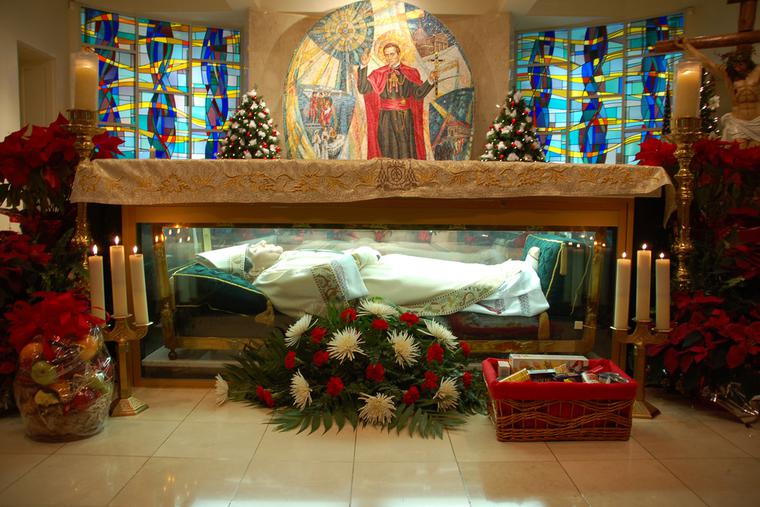
Why read about a young man prone to vanity, severely tempted to despair and passed over for ordination in his home country? Because he’s America’s first canonized male, St. John Neumann.
2011 is the bicentennial year of his birth.
Redemptorist Father Richard Boever has put together Saint John Neumann: His Writings and Spirituality, the first part of which is a biography in the first person, as if written by the saint himself. Actual words from the writings of St. John Neumann are found in italics throughout the story, and more of them are found in the second part of the book, which includes some of his pastoral and personal letters.
From the time Neumann arrived in America in 1836 to his death in 1860, his influence was seen in places such as New York, Pennsylvania and Maryland. Yet, he almost wasn’t ordained.
In his early 20s, Neumann wrote, “Lord, I am beginning to feel that awful state of depression coming over me again! I lose all yen for prayer because You have seemed to turn a deaf ear to my cries.”
Neumann found the solution to his problem by giving up his desire for consolation and replacing it with prayerful surrender to Providence. He wrote, “I no longer look for comfort from either Heaven or earth. You, Divine Master, can judge whether such are necessary for me. I propose to worry no more over the aridity You send me. You, my God, are the font of both aridity and grace.” He then expressed thanksgiving for learning this from the Lord, and proceeded to complete his seminary training.
However, because of a lack of open positions for priests in Bohemia, Neumann was not ordained. He had already been considering missionary work in America, and decided to travel to the New World to be ordained. He had originally thought of crossing the Atlantic to work with Indians, but upon his arrival found that German immigrants were also very much in need of spiritual guidance. A common opinion was that for every Indian converted, ten German immigrants fell away from the Church.
Neumann wanted to correct the problem by drawing German-speaking priests to the area, whose demands could be quite daunting. He wrote the following words of caution: “The heart of the pastor can have pleasure in nothing else other than in the salvation of souls. If he loves comfort, honor, or money, he loses in a moment patience, and with it all confidence. His effectiveness is then at an end.”
Neumann’s own effectiveness shone forth brightly in the area of education, which he knew to be essential to form soldiers for Christ. He stated plainly, “If any danger threatens the Church, it is the lack or the insufficiency of Christian education.” He countered this threat by writing what became known as the Baltimore Catechism and organizing the Catholic school system in Philadelphia after becoming bishop of that diocese. It was the first Catholic school system in the country.
While there is an apparent shortage of Neumann biographies, there is perhaps an even greater shortage of his own writings. However, in Saint John Neumann: His Writings and Spirituality specifically, there is a good share of them, and they reveal the saint’s perceptive, persevering, and pastoral soul. These qualities shine through in the second part of the book as well, which begins with a reprinted journal article very similar to the first-person bio. In fact, the article is so similar that it is mostly redundant. This is true of much of the personal letters included in the second part as well, which had been quoted at length in the bio.
My guess is that Neumann would want us to make up for an overall lack of publishing interest in part by reading some of the books he himself learned so much from. He studied spiritual classics such as The Imitation of Christ by Thomas a Kempis, The Sinner’s Guide by Venerable Louis of Grenada, and Introduction to the Devout Life by Saint Francis de Sales.
Neumann asked earlier in life in his own diary, “For what sort of a priest would I be with all the sins I have, with all my bad habits, my inflexibility and stubbornness, with my host of spiritual and bodily frailties?” His own life gives us the answer: with prayerful trust in God, he became America’s first canonized man. May God grant that many more will follow. Perhaps the next one will be Blessed Francis Xavier Seelos, who had the benefit of being directed by Neumann personally.
Register correspondent Trent Beattie writes from Seattle.
SAINT JOHN NEUMANN
His Writings and Spirituality
by Father Richard Boever, C.S.s.R.
Liguori, 2010
266 pages, $19.99
To order: Liguori.org
(800) 325-9521