Print Article | Email Article | Write To Us

The Nine Words that Make Christianity Make Sense

Wednesday, March 09, 2011 10:30 AM Comments (44)

When I talk to atheists about Christianity, one of the most common objections they raise is the existence of suffering. An atheist friend recently cited one of the more disgusting stories from the day’s news and asked: “How can you believe that there’s a loving God when something like that happens?”

One self-described ex-Christian explained it to me this way: “They always told me in church that Jesus died on the cross for me because he loved me. I used to believe that, and then my mom got cancer and my sister was killed in a car accident. Now I don’t see why Jesus’ death on the cross matters, and I definitely don’t believe that he loves me.”

I can sympathize with those feelings. Though I’ve never seriously doubted the Faith since I became Catholic, the moments when I feel most distant from God, least able to make sense of it all, are when I hear of great injustice and suffering. Just a couple weeks ago I came across a particularly horrific story from the case of Dr. Kermit Gosnell, and I was so distraught and angry that it felt like God was a million miles away. Echoing the sentiments of my atheist friends, I thought, Lord, how could you allow this?

This is why we need Ash Wednesday. In fact, I’ve often thought that if I could invite my atheist friends to only one Catholic event, it would be an Ash Wednesday Mass. Because it is there that we receive the key piece of information that makes it all make sense.

Thou art dust and to dust thou shalt return.

Those words from Genesis 3:19 are probably the one thing on which all humans from every place and time can agree. The modern parlance might be, “You are chemical reactions, and one day those reactions will cease,” or maybe “Your body is matter, made of atoms like all the other lifeless stuff in the universe, and one day it will return to being lifeless matter like everything else,” but regardless of how it is phrased it is nevertheless something we all know to be true. It is probably simultaneously the most important, most agreed upon, and most ignored fact of life. And when we ignore it—when we slide into the mentality that our eternity is here, that this world is all there is and all there will ever be—Christianity ceases to make sense.

But to hear those words is to have your priorities instantly ordered. It is to realize that all those questions about what happens here on earth—“How could God allow suffering?”, “Why does God permit injustice?”—are focused in the wrong place. We have a few short years here in the material world, and then we face eternity. A God who permits a finite amount of suffering and injustice doesn’t seem so cold when you consider that he’s leading us toward an eternity of perfect peace and justice. The incalculable value of Jesus’ death on the cross can only begin to be understood in light of a timeless future. When we adopt a heaven-centered worldview, it all starts to make sense.

Peter Kreeft wrote in this must-read article:

Quo vadis? Where are you going? That’s the most important question for a traveler. And we the living are all travelers. Death calls us all and moves us on. Stability is illusion. So those who cannot abide illusion must raise the question: Quo vadis?

If heaven is not the answer to the question, our whole faith is false, and Jesus was a fool. If it is, then there’s nothing that is more important in the whole world. Indeed, the whole world is only heaven’s womb. [emphasis mine]

This is why I love Ash Wednesday Mass each year. Thou art dust and to dust thou shalt return. I hear that simple nine-word litany, repeated as each person is marked with ashes, and I am reminded of the truth that makes it all make sense: that our lives here on earth are merely a brief stay in the womb of heaven.



Filed under ash wednesday, ashes, death, doubt, suffering

Comments

Post a Comment

Two minor points - 1) there are profound truths in the nine words, but we Christians also have to keep the truth of these words reconciled with our belief in the resurrection of the body; 2) http://en.wikipedia.org/wiki/Quo_vadis? Quo vadis are the words attributed to Jesus addressing Peter as Peter fled his own persecution giving him the courage to return to face his martyrdom.  There was a beautiful movie with the same title encapsulizing this scene.  Not sure if you were aware. :)

Indeed, we are pilgrims in this temporal life and it is an absurd to seek security here. As a fact, science tells us that we have no stability whatsoever, the universe is expanding at the speed of light, with us in it! we are constantly traveling until the last day, when we would see the eternal light of Heaven. A light which does not change because it is the perfect holiness of God and the Holy Spirit gathering it all because nothing is lost. It is there in the last judgment where the body will come together resurrecting under the eternal light for its glory or damnation. This day let’s reflect on the mistery of sacrifice and death.

Whenever my kids, friends or even myself starts complaining on how tough a situation is, how awful something has been and how cruel it all seems I say outloud - “That’s why this isn’t heaven.”

Suddenly, those words help reorient the interior compass we all have back towards God and eternity.

Those nine words—or some variation on the same idea—have kept me going or kept me on the straight and narrow for the 22(out of 44)years I’ve been Catholic. In my 20s, I would think “six decades isn’t really all that long of a time” to endure or abstain from whatever it was I needed to endure or abstain from at the time. In my thirties, it was only five decades. And now, it’s a matter of (at most, I would think) four more decades. Of course, that assumes a very generous normal lifespan. And, you’re right. If there is no heaven. It doesn’t make any sense.

I was once an atheist and had the same thoughts of “how could a god love you and still punish you”. It is simple, our country has laws just as God has laws (amazingly similar laws). It is up to us to follow them.

Does the judicial system not exist because “it lets bad people do bad things”? Did the judicial system make the person drink to much, sell the drugs, or pull out a gun in anger? Neither God nor the judicial system are at fault, it was a human who committed the crime and a human who is responsible for their actions.

Love can not be forced, it has to be given and accepted.

Hey, thanks much, Jennifer!  I’m slammed @ work and was thinking of not going to Mass today, because, ya know, it’s not a holy day of obligation and blah blah ...  Now I can’t wait to go!!! Surely the Holy Spirit guided me to your blog today (via newadvent.org)  God Bless you, Girl!!

The loss of a loved one recently neither brought be toward faith, nor made me particularly concerned about it’s truth.  The only thing that really matters is what can be demonstrated, otherwise it’s all just futile hand waving.  Did Jesus die for my sins?  How does the death of an innocent absolve me of my wrong-doing and why would anyone worship a deity that accepting such a proposition?  And how strongly or what mystical experience you felt means nothing.  Millions of people of all faiths make the exact, yes exact, same claims.  The only way past that is to ask for real evidence, and if it’s not available, why not?  Should a moral god rely on such flimsy foundations for an eternal truth?

Why does God allow evil and suffering to occur? To draw a greater good out of it. Was not Christ’s suffering and death the greatest evil in human history? After all, that’s deicide. It is only with the benefit of so much exegesis that we can easily see what good came of it: the expiation of our sins and the opening of Heaven.

The closer we are to pain or suffering, the harder it is to imagine what good could possibly come of it. But that doesn’t mean someone doesn’t learn something valuable, or that perhaps an incalculable number of Poor Souls aren’t loosed, or that someone doesn’t benefit in a Divine way we cannot comprehend.

We should always remember, however, that God’s permissive will only allows evil to occur. He didn’t create it, but He can surely use it to achieve something, somewhere, of unimaginable beauty.

That man and woman were form out of dust;God’s mark of humility because in His image He made them and He(God) is personified Jesus’incarnation while Jesus’ crucifixion made human life complete(John 10:10)

“A God who permits a finite amount of suffering and injustice doesn’t seem so cold when you consider that he’s leading us toward an eternity of perfect peace and justice.”

It strikes me as a bad idea to base our comforting thoughts on this when we also believe that God allows an infinite amount of suffering (in Hell) and that some of those who suffer on earth will never reach the peace of heaven.

None of these common “reasons” for the existence of suffering mean anything to me.  It is logically impossible for God to be both all good and all powerful.  The only answer I can accept is the answer that God gave Job.  “Where you when I laid the foundations of the universe.”  We humans are so arrogant that we think our little minds can comprehend everything.  Some things we will only understand when we see God face to face.  Why is there suffering?  I don’t know.  I don’t need to know.

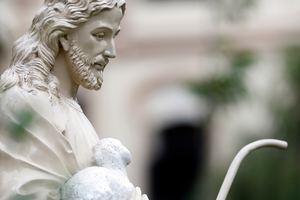
Jesus accepted His role as the Lamb of God who took away the sins of the world through His passion and death on the cross. In doing so, He did not exempt us from our own suffering and death. What he did do is to offer us eternal life through Him, by living within him, and by marrying our suffering and death with His own.

“Thou art dust and to dust thou shalt return.”

What about the soul? Is it not a part of who we are? Is the soul made of dust? Does the soul return to dust?

The idea of god seems distant and cold when one looks at the suffering in the world but heaven makes this ok - so what about hell?

God is all powerful and good but somehow people still suffer and will always suffer (in hell, that is). This seems like a contradiction to me and I challenge anyone reading this article to truly consider the implications of contradictory ideas.

Why is it that we think god exists again?

We suffer in the flesh on this earth due to sin, starting with original sin in the garden of eden. It is how we deal with this suffering and our path toward mortal death, that is watched closely by God, and determines the fate of our immortal soul in eternity.

Jacob - I’ll try to paint some broad strokes here, but take these thoughts to your local trained theologian.  God loves the sinner, even the one in Hell.  The point of Hell is that people there reject God.  As much as their suffering is, to be with God would be, for them, to suffer more.  God gave them free will and continues to do so.  But at the point of death, the nature of the soul becomes such that it takes on an irrevocable character - that of attuning itself towards God or hardening itself away from God.  The change is permanent.  In essence, the sinner in Hell condemns himself in mirror image to Satan who worshiped his own glory over God’s.  If it gives you some hope, as all Christians must hope, there are no human souls in Hell.  This is very very unlikely, but not an unproven impossibility.  God’s mercy is infinite, and it could be that all humans have learned to turn to God in the instant before death.  There are visions by saints who talk about the sinners in hell, but this could be a vision for didactic purposes only and neither are they infallible.  Therefore, we trust in God’s mercy for ourselves, and we dare hope for everyone, even such maligned sinners as Judas.  The point to remember is that the God we believe in is eternally and perfectly just (at least to the point where his perfect mercy triumphs).  Jesus’s sacrifice for our sins justified our salvation, we who are sinners.  The only way to get to Hell, therefore, is to want to deny and distance oneself from God.  Faith is a gift of the Holy Spirit, they say, so keep your heart open in case God is trying to bestow that gift on you in a special way now.

1- Hell is separation from God. Heaven is coming to Him.

2- The persistent sinner creates hell for himself, as he prefers his own will to God’s and thus separates himself. God can’t be blamed for your choice.

3- The suffering comes in because he was designed to BE in God’s presence, but has condemned himself to separation (and thus suffering the loss of his destiny by his own hand) in order to persist in his own ego.

n.b. It is free will that makes at least two things possible: love and hell.
Love, because we are thus capable of choosing Him and others above self (and thereby actualizing ourselves). 
Hell, because we can choose self instead.

We cannot choose FOR God unless we have the exercisable option to choose against Him.

oh, there is another pain in hell aside from the knowledge of the loss of one’s destiny by intentional forfeit >>> everyone else there is as self-oriented as you are!

Jesus said,“My kingdom is not of this world.” So we do not expect our experiences here to be heavenly (e.g. without suffering).

Why is suffering allowed during our earthly life? Why did the Blessed Virgin Mary not be allowed to die on the evening of Palm Sunday instead of years later, after witnessing the greatest suffering one could endure?

One polishes an ornament until it shines as desired. God gives us the chance to shine, by allowing us to accept our suffering with faith and love in Him. This is how we can fulfill out capacity for holiness. It is an opportunity given to us by a loving God.  Heaven is not much for those with no victorious battle scars.

Remember OJ Simpson. Did God finally see fit to punish him? I think the opposite is true. God loves OJ so much HE is giving him a new opportunity to repent. New buddies, new furniture, new routines, and lots of time to reflect.

My RE teacher always argued two points. 1. suffering is our test/you go to heaven. and 2.you have to have faith for it to make sense.

i really tried to have faith. i presumed god in every thought to see if it made sense. i admit, it kind of did. i prayed and tried having a personal relationship with god. but only if you presume god does it make sense, you cant escape the initial presumtion. i simply dont presume god.
and to presume heaven for those who suffer is really quite horrible. what if they go to hell? what if the atheists are right? no religious person from my RE teachers to priests have been able to answer these questions. presuming heaven is not an answer, its a presumption.

a small point i thought of the other day. say god is real, i have 100 percent chance of being wrong. absolute. you have over 99.9% chance of being wrong, considering how many gods claim to be The God. would you bet your life on a coin biased more than 99.9%? personally, humility, and acting as though we only have this life to enjoy and love and care for makes religions look like cults. free your mind, men lie, the universe doesn’t.

Too many Catholics believe this way as well.  They…as our Holy Father has said have “...accepted only the gentleness and love of God and Jesus, and quietly set aside the word of judgement”  Hence when something disturbs that euphoric state they are not able to relate it to the Cross.  The Mass too, per Cardinal Burke, has become an “occasion of sin” and “people are losing their faith” because of Father Smiley and all the “ministers” we have for every function of the day.  Bishop Sheen once wrote you cannot get to Easter without first going through Good Friday.  We want a Christ without the Cross.

I find it interesting that so many people of religion presume to understand the will of god and his purpose for us on earth. Think of the gradeur of this universe. God would be grander still, if he existed. No human being is capable of comprehending this and anyone who claims they understand is either deluded or a liar.

I spent many years trying to understand the meaning of life through the Catholic lens and I came to the same conclusion as Cal (above) - we are here as a test to see if we are worthy to go to heaven.

If this is true, what does that say about god? Why did he feel the need to create us? Are we his entertainment? Why didn’t he just create us in such a way that we would be worthy of heaven without having to suffer? Couldn’t he do this? Isn’t he all powerful?

On top of these problems, so many other religions claim to have the correct understanding of god yet all of them require “faith”. How does one choose a religion using “faith”?

Why is it that asking questions creates friction within religion? Is there something that we shouldn’t know about it? If religion were pure, correct and good, it would be an open book and all questions would have clear answers. Instead, questions are met with resistance. It seems like they might have something to hide.

For all to read. A journalist had an interview with Pope John Paul II. The interview had to be rescheduled. He was given in advance a list of ?‘s that he may be asked. To the amazement of the journalist, a carrier dropped of an envelope from our Pope. He had written out an answer to every ? on the list. This was published in a book, The Threshold of Hope- by his holiness John Paul II. I refer to this book for many ?‘s I myself can’t accurately answer. Praise be to God for such a great work. Hope this helps, my your Lenten journey deliver you to the foot of the cross.

Paul’s statement: “I am filling up what is lacking in the afflictions of Christ.” says it all. What is lacking is OUR participation in the sufferings of Christ. The suffering in the world is actually our ticket to God! Our daily struggles and sufferings, when united to the sufferings of Christ, bring ourselves and others closer to heaven.

Remember that Jesus commanded us to “take up our cross and follow him”
If we want to go where he is leading us (heaven) then we too must suffer in order to get there. Even the holiest are not exempt, in fact, in the writings of the saints that I have personally read (Mother Theresa, Sr. Faustina, St. Pio) it is abundantly clear that the closer they got to Jesus, the more they suffered. The difference between them and us, is that we reject the suffering and drag it behind us, they embraced it as Jesus embraced the cross itself. When one realizes this, you will see your suffering as a gift that is capable of saving souls-(Sr. Faustina writes about this very clearly in her diary.) And along with the pain of suffering is the grace that God gives to endure it with a joyful and loving heart. I am personally a long way from this, but I pray that I may be a shadow of the saint that St. Faustina is!

I don’t pretend to know if there’s a higher power, but I believe it is very instructive to read anything by Bart Ehrman.  In this case, just read his book on pain and suffering, “God’s Problem: How the Bible Fails to Answer Our Most Importand Question—Why We Suffer.”  In the book, Bart points out the amazing, awful stories in the Bible about how God supposedly sent his Hebrew army to kill men, women and children of other countries, in order for Israel to have a land of their own, etc.  He also explains how the Bible evolved.  It didn’t just come down from Heaven intact, but it evolved, and even has evidence of several versions of stories that were overlapped by a Bible editor in antiquity (for example, in the Book of Job)  The Bible, it is clear, is a human document, that few people seem to actually pick up and read, and even fewer that try to understand where the stories came from, how they evolved, and what they really mean in the context of their cultures and histories.  What I find unfathomable is that so many people today, apparently blindly follow the tenets of this compilation of ancient stories and myths, and then try to tell others how to live.  It’s a classic case of the blind leading the blind.  I’m sorry.  I don’t mean to be disrespectful.  I just am saying what I honestly believe, after years of careful research.  Organized religion is the problem.  It just won’t give up any of its power to influence and even manipulate the unwashed masses.

To Caligal,

If suffering brings us closer to god, what of leaders of the church? What of the pope? Why do these men live in opulence when suffering is what brings them closer to god?

If we follow your logic through, causing a person to suffer is service to them.

This was the logic behind the inquisition. This was the logic behind the witch hunts. By viewing suffering as a good thing, you are simply taking the first step back toward the dark ages.

To Jacob,
I have visited the Vatican. Although all of the pope’s needs are met, from what I could see and was told, he hardly lives like a king. More like a austere, but comfortable, spacious apartment. Besides, do not gauge a person’s degree of suffering by viewing one’s external condition.

One’s external condition may not be the only driving factor for one’s suffering but it should not be discounted.

Good job in avoiding the latter and more important part of my statement. The view that suffering is a good thing is what drove men to innovate new and terrible methods of torture for heathens and witches (who were generally innocent of the accusations). In those times, torture was the method of getting a confession - torture them until they confess or die.

-

Nothing is gained from suffering. Nothing is gained from accepting suffering. Nothing is gained from accepting the suffering of others. This world does not have be condemned to suffer. We can learn to live in peace and give our children a better place to grow up in.

@Jacob You are very confused about Church teaching…I hope you NEVER teach Catechism!  To state that you are ignorant is redundant your post clearly shows that you are…you clearly want a Christ without the Cross!

There have always been and always will be abuses within the church, resulting in suffering. Suffering is a direct consequence of sin. We are all sinners. Many suffer for the sins of others. Offering that suffering up to the One who was without sin, yet suffered for us all, allows us to marry that suffering with our Lord’s suffering, earning us special graces in the next world. Don’t let your suffering go to waste!!!

God is as frustrated by evil in the world as we are. Even the all-powerful God cannot intervene. God’s great gift to his creation was freedom. Evil is the mis-use of freedom. Turning evil into good was the ingenious idea behind the Incarnation. But we are still free to accept or reject.

@Jacob-Do not presume to gauge how much people suffer based on their outward appearance. The greatest saints hid their sufferings from those around them. This is the very judgement that Jesus warned about…
God alone read souls.

As stated be others, God does not create the suffering, but he does choose to take it to himself, share it with us, and use it to save souls-that is only if we participate in uniting the suffering to Him. Suffering in itself does nothing, only when united to the love of the cross does it hold true power.

We suffer because of Adam & Eve.  That’s when it started.  What is suffering but an even that you can’t handle either physically and/or emotionally.  No matter how bad your life is, there is ALWAYS someone worse off than you.

@Jacob & similar:
Your understanding of true Catholic teaching and history is underdeveloped. I don’t mean any disrepect, but the points are rather childish - though it may be ignorance.  At one point you may have been open, I don’t know.  You may be agnostic?  Whatever, no other religion provides the depth and answers that—but at the end of the day, we all take leaps of faith based on reasons we hold dear. Suffering is a toughy,  but ask the opposite—what would an earthly world be like where we had everything? No pains, never suffering, no struggles, no disagreements? Could humans as we know it survive?  When you get to a point that allows God into the picture, you can begin to see and appreciate the value of longer term thinking.  Short term pains, longer term gains. If the goal is union with God, are those who gain that earlier loved? Pain and suffering can allow growth. I reminded of analogies where people pray for patience, strenght, etc.  Maybe God provides oppportunities for them to improve ... versus a magical wand that grants more patience or strenght ...  and remember, as for hell, the Catholic church recognises the place, but never states who or if anytone is actually there.  We leave that final judgement to God himself.

There are people of every faith who are as certain about their beliefs as you are about yours. It was claimed that no religion provides the depth and answers that catholicism does. Have you studied all other religions? Or were you simply told this by your pastor/teacher?
-
When it comes down to it, every person of every religion makes a “leap of faith” in their belief. When you make a leap of faith, there is nothing stopping you from choosing false conclusions. You are simply rolling the dice, there is no way to know if you were right until after the game is over.
-
As for my knowledge of “true” catholic teaching being underdeveloped, I do take disrespect. I have read the bible, the catechism, the history of the church (as reported by the church and other more secular sources) and studied other religions (Lutheran, Mormon, Baptist, Jewdaism, Islam, Hinduism, Buddhism). What I found is that “true” catholic teaching, as well as the teachings of other religions, change based upon the century you take it from. How do you know that the teachings are true if a totally different and contradictory message was previously taught by the same organization with the same authority?
-
As for my points being childish, I don’t think the victims of the inquisition, the witch hunts or the crusades would agree.
-
And lastly, what if we had no pains, no suffering and no struggles? What is heaven supposed to be? Is there suffering in heaven? How do the angels handle this problem of not suffering? I think the whole idea of “no suffering” is impossible, as are all absolutes, but that does not mean we shouldn’t try to minimize it when we can.

Jacob-I sense from your last post that you are not a raving Catholic hater, but a lost soul who is just searching for the Truth. Understand that you are correct in saying that our minds cannot ever fully comprehend God. But that does not mean that the sliver that we do know about Him is a lie. Do you comprehend everything about the workings of gravity? Do you have to to believe that it really exists and isn’t in fact a lie presented by scientists who “think” they know how it works? Obviously no.- we can never “see” gravity, and it exists whether or not we “chooses” to belive in it .We can only see its effects.  So with God. Believers “see” God around them through his creation. Believing requires faith, as not everything in this world can ever or will ever be explainable by science. Expressing that faith and living it is a life-long challenge. I pray that you will persevere in your search for the Truth, and that the Blessed Mother will take you into her loving care and lead you to her Son.

As for understanding the teachings of the Church, may I suggest the works of Fr. John Corapi, as he presents a no frills, no nonsense approach to Catholicism. Find him on EWTN and even on Youtube. Also, The Diary of St. Faustina Kowalska is an excellent source for understanding (as much as we can that is) the great love of God, and the true power of suffering. May God’s peace be with you!

Actually, Jacob, you are asking the right questions, and they are good questions in my opinion.  If the answers are not satisfactory, that may be just what it is, but it might also be mistaken premises.

For example, the development of doctrine that you alluded to, insofar as the Catholic Church is concerned, (I do not pretend to know the history of the teachings of other religions) actually is a continuity of the same essential teachings.  Disciplines have changed as a response to changing circumstances and needs over 2000 years, but I am sure you are not confusing that with the doctrine.  As a convert to Catholicism, that was one of the clinching factors for me.  So I would say that if you wish to doubt the Catholic faith, that is your decision, but be aware that it is the faith of the early Christians from the very beginning.

But to the bigger question.  Science can only answer one question; “how?”  For the answer to “why?” you must go to metaphysics.  If you wish to avoid the question, perhaps it is possible to find meaning in life, so long as you stop thinking about the bigger things, like human suffering.  On the other hand, without the metaphysical answers, there is no meaning in life. 

If that lack of meaning is acceptable, then the only real goal in life must be power.  Why?  Because to the extent that one has power, one needs not have any consistent morality.  Morality is by definition what one expects from everyone, but that is only necessary to those folks without power.  It implies a universal of behavior that without a universal source, ie. God, is merely a tool to keep the powerful in check.

If you suggest, as many have, that all this does is create a need for God, fine.  But you have to recognize that if you are saying the Christian faith and the Judaism that gave birth to it, are creations of man to satisfy this need, then Abraham was a liar or fool.  The essence of Divine Revelation is that God came to man.  On his own initiative.  That began with Abraham. 

That says nothing about whether God is what we Christians believe or whether he is capricious as Muslims tend to believe.  But it is the essential beginning of faith.  Do you believe Abraham?  If he concocted the story that the creator of the universe came to him and singled him out, and as we believe for the ultimate purpose of providing a human context for his own entry into the world (the incarnation) to recover humanity, while respecting man’s free will, then you are free to find the meaning of existence elsewhere.

The accusations against Catholic Christians are what they are.  Some true, some exaggerated, some misapplied.  For example, the burning of witches was a Protestant thing, as a point of historical accuracy.  There are many ways to put it and perhaps you see it as a cop-out, but the Christian faith does not claim that Christians will necessarily be without sin in this life.  They are to strive to avoid it, they are to confess it when they fall into it, they are to denounce it in themselves first, and finally, if they are in the state of grace when they die they will eventually reach a place without sin.  But none of that changes the metaphysical and theological truth of God.  It is a red herring, bright red I’ll grant, but a red herring nevertheless, and one which many otherwise rational people fall into.

Jacob, I appreciate your follow up - but tell me why you are here?  What are you looking to gain?  You come across as a disullioned soul (which is fine) - what event(s) have lead you to were you are today?

Understand where I’m coming from: you seem to want to attack in areas that are rather baseless verus honest questions.  My bible is chocked full of pain & suffering - so the evidence of this against God is trite. Surely you can appreciate the complete and utter difference that christianity brings to us comapared to other religions. As LJ says, the incarnation & cruzifiction separates us from everything else. 

All history, especially church history, must be read in context.  As to changing teachings? You might know that customs and sacrementals may change, dogma and doctrines not so much.

Your point on perfect heaven and painless earth is interesting—but supports the point that there are truly differences in a heavenly soul in union with God and an earthly broken vessel. 

How do you feel about the works put out there by Fr. Barron?

Why is it that without a meaning of life, one must necessarily pursue power? Why would anyone who doesn’t have the same worldview as a catholic automatically want to sidestep morality? Since when did meaning and morality ever become linked in such a way?

There are MANY people who find the question of “Why?” unnecessary and yet they don’t immediately pursue power and try to exempt themselves from morality. This is probably the worst lie ever told about nonbelievers.

I can’t begin to understand God but I do know I am loved by this entity of which I, togther with all creation, am a part.  No I am not God but we are part of this thought which is playing out in the mind of God and I am convinced that no one who experiences Pure Love will ever (could ever) turn away as this is what we all desire in the depths of our being.  Yes even the perpetrators of the most heinous deeds do so only because they can see no better, more satisfying path to follow and God loves them too.  In the moment of realising what was missing in their lives I am convinced that even the most hardened sinner will accept forgiveness and understanding and blossom in the LOVE that they are part of.  How can it be otherwise?  We are but part (a very small part) of creation which has been evolving over millions of years.  Though we are at the top of the tree now we cannot imagine what lies in the future and just as a mother or father would willingly accept suffering to save their child we need to be concious of the wonderful world that is unfolding and realise the part we play in this grand design – THAT makes some suffering and sacrifice on our part worth while.

They are beautiful words, but forgive me if I don’t see in them any representation of the transcendent. As an unbeliever it’s satisfaction enough to know that long after I’m gone my constituent atoms, themselves created long ago in distant stars, will continue to form part of the stuff of the universe for the rest of eternity. I think that’s kind of beautiful, and don’t need heaven, thanks.

A nice sharing, Chris. It is wonderful to feel that we are part of the great universe and will continue to be so after our death. As a Catholic I love to meditate on this and to look at a plant or an ant and feel a relationship that we share with the universe. It also helps me to understand, vaguely, the mystery of the resurrection and to look forward to it.

Chris , what about the heat death of the universe? Say what you will about the merits of material reductionism, but beautiful it is not.

Jacob, probably the worst lie told by non believers is what you just said.

Beau, so after ‘years of research’ you came to the same conclusion as many a basement dwelling, neck bearded high school sophomore who detests all authority and is certain that any just and noble God would allow them to get a date? I refuse to accept that ultimate reality is that douchey.

Cal, you really seem to have reasoned through your atheism. So tell me, how do you deal with the problem of induction? And what is your rebuttal to the argument from reason? Or is it possible that you know deep down that atheism is self-defeating and incoherent, as explained here:
Adam Wilson/ Kayla/sandy et al., as previously explained to you, said testimony would be meaningless for lack of personal knowledge. When i first encountered sandy et al.‘s, comments, I was surprised by how little regard she/have for the actual meaning of words, but upon further reflection, this should be expected since atheism is, when carried to its logical conclusion, incoherent:
http://communities.washingtontimes.com/neighborhood/higher-things/2011/nov/19/atheism-why-it-logically-incoherent
http://www.catholicthinker.net/the-incoherence-of-atheism/
http://www.peterkreeft.com/topics-more/4-arguments-transcendence.htm
http://www.reasonsforgod.org/the-best-reasons/the-argument-from-reason/

Post a Comment

By submitting this form, you give The National Catholic Register permission to publish this comment. Comments will be published at our discretion, and may be edited for clarity and length. For best formatting, please limit your response to one paragraph and don't hit "enter" to force line breaks.

Name:

Email:

Write your comment:

Please enter the word you see in the image below:


Notify me of follow-up comments.

About Jennifer Fulwiler

Jennifer Fulwiler
  • Get the RSS feed
Jennifer Fulwiler is a writer and speaker who converted to Catholicism after a life of atheism. She's a contributor to the books The Church and New Media and Atheist to Catholic: 11 Stories of Conversion, and is writing a book based on her personal blog, ConversionDiary.com. She and her husband live in Austin, TX with their five young children, and were featured in the nationally televised reality show Minor Revisions. You can follow her on Twitter at @conversiondiary.