There are so many good things going on in the pro-life world right now. Forty Days for Life is in full swing, and Simcha Fisher recently posted a roundup of encouraging news like the closing of abortion facilities, investigations into Planned Parenthood, states fighting back about abortion funding, and poll results showing that the public is increasingly uncomfortable with abortion. The pro-life movement is making great strides right now. However, there is one area where the fight for life is not going well at all, and it happens to be one of the most important arenas for evangelizing the culture: the online world.
Web developer Craig Berry recently did an analysis of how Catholic websites do in terms of their appearance on the major search engines, and he gave the Church a failing grade (for example, only one Catholic site came up in the first page of results for the term church). Last year, Matthew Warner did something similar, with an equally concerning outcome. Inspired by this idea, I decided to conduct my own analysis of how well pro-life sites are doing in terms of search engine optimization (commonly referred to as SEO). The results were sobering.
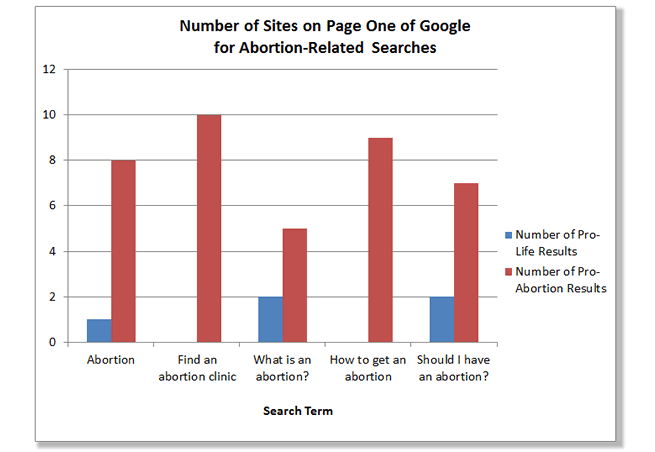
Below is a chart that shows how many pro-life vs. pro-abortion sites came up in Google search results for key terms related to abortion. In calculating the “pro-abortion” number, I didn’t count sites such as Wikipedia that simply offered information (even though many of those seemed biased toward the pro-choice position); this is the number of websites that openly encouraged women to consider having abortions. Since Google customizes search results for each individual, different people might see a slightly different set of pages, but I had friends check these terms and the ratio of pro-life to pro-abortion sites remained about the same.
And the advertisements were no better. Take a look at the ratio of ads that came up for these same terms:
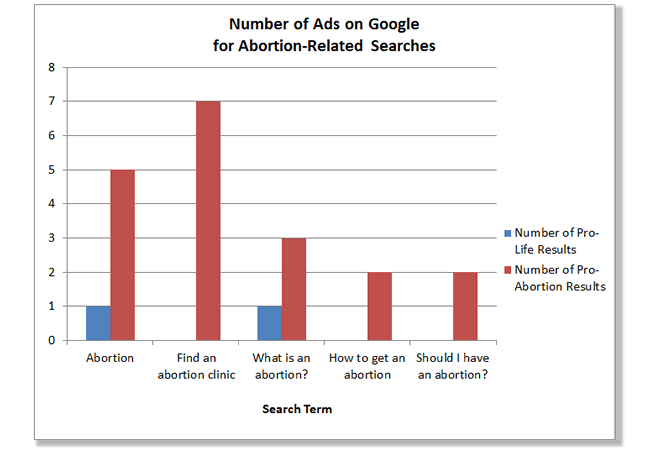
To put it bluntly: The pro-life movement is getting crushed in the SEO war, and women and their unborn children are the casualties. I’m guessing that one of the first places women turn when they learn of an unexpected pregnancy is the internet. And, as you can see, they are bombarded with sites that dehumanize their unborn children and paint abortion as a simple, easy option that will make their problems go away.
There needs to be a concerted effort in the pro-life movement to get our websites do better in online search results. It wouldn’t even be that difficult: When my husband and I started a business a few years ago, I was able to get our site to come up on page one of Google for multiple key terms, without spending any money. All it takes is some basic technical knowledge, a little bit of research, and the time to revamp your site to make it search engine friendly. I know that many pro-life organizations are already running on limited resources, but creating search engine optimized sites should be as high on the priority list as possible. Because the online world is the new battleground in the fight for unborn life.


Comments
Post a Comment
Could we have a to do list on how to make this as easy as possible? I just happen to be seeing a lady today who has all the networking and connections to make a really big impact in this area, and I would love to be able to hand her a list of practical suggestions!
Great idea, Pamela. I’ll do a follow-up post on that.
I did a conference call w/ Priests for Life about 3 years ago trying to give them the rundown on the basics of SEO, with a small action plan for slowly moving up in rankings, but I don’t think anyone in the organization ever really ran with the ideas.
I think the best thing that could happen is to form a Pro Life SEO group somewhere, and all of the efforts would be towards promoting sites like HLI, Priests for Life, 40 Days for Life, Life Site News, etc, because those sites already have such a huge foundation to work from.
It seems that there would be a huge benefit from having each of those groups have someone who would help with on site optimization, followed by a large group of Pro Life activists who would do alot of the grunt work, like tweeting likes, building one way links, writing articles with link backs, and basically functioning as a large group of bull horns, amplifying the message of these groups.
Here’s one concern I also see:
Planned Parenthood has nearly 200,000 Facebook likes.
Priests for Life has 4,000.
With the ever increasing role of social media’s influence in the SERPs algorithms, a heavy effort needs to be made in this arena. In fact, I would almost be willing to say that Priests for Life would be best served by sending out a communication to all of it’s priests tomorrow, that every priest should mention numerous times in homilies, bulletin posts, blog posts, church parish website posts, etc, that one simple way to help the Pro Life movement is to simply follow the Twitter account of PFL, and like there Facebook fan page. The same goes for HLI and 40 Days for Life.
This is so true, if I understand correctly. My employer has an anual campaign where we can contribute to charities via our payroll and I had one heck of a time trying to yahoo a good Catholic prolife site. Yet I know they are out there…
I did a conference call w/ Priests for Life about 3 years ago trying to give them the rundown on the basics of SEO, with a small action plan for slowly moving up in rankings, but I don’t think anyone in the organization ever really ran with the ideas.
I think the best thing that could happen is to form a Pro Life SEO group somewhere, and all of the efforts would be towards promoting sites like HLI, Priests for Life, 40 Days for Life, Life Site News, etc, because those sites already have such a huge foundation to work from.
It seems that there would be a huge benefit from having each of those groups have someone who would help with on site optimization, followed by a large group of Pro Life activists who would do a lot of the grunt work, like tweeting likes, building one way links, writing articles with link backs, and basically functioning as a large group of bull horns, amplifying the message of these groups.
Here’s one concern I also see:
Planned Parenthood has nearly 200,000 Facebook likes.
Priests for Life has 4,000.
With the ever increasing role of social media’s influence in the SERPs algorithms, a heavy effort needs to be made in this arena. In fact, I would almost be willing to say that Priests for Life would be best served by sending out a communication to all of it’s priests tomorrow, that every priest should mention numerous times in homilies, bulletin posts, blog posts, church parish website posts, etc, that one simple way to help the Pro Life movement is to simply follow the Twitter account of PFL, and like there Facebook fan page. The same goes for HLI and 40 Days for Life.
I think the best thing that could happen is to form a Pro Life SEO group somewhere, and all of the efforts would be towards promoting sites like HLI, Priests for Life, 40 Days for Life, Life Site News, etc, because those sites already have such a huge foundation to work from.
It seems that there would be a huge benefit from having each of those groups have someone who would help with on site optimization, followed by a large group of Pro Life activists who would do a lot of the grunt work, like tweeting likes, building one way links, writing articles with link backs, and basically functioning as a large group of bull horns, amplifying the message of these groups.
This may be a moot point because of how google and search engines choose what sites pop up first in your search - http://www.youtube.com/watch?v=WLXa1kEMooU&feature=player_embedded
Get an incoming link from a .edu web address
Raises your Google profile, or so I’ve been told (I may be wrong, and if so please correct me). Of course that requires having an incoming link from a supportive university, but they are around.
Sorry for all of the duplicate comments. I kept having issues with submitting comments this morning.
Brian,
.edu links are old techniques that were used to “game” the system years ago. Every link is valuable, provided it’s contextually relevant, but this technique is not nearly as useful as it used to be.
Planned Parenthood has 200,000 but if you search “LIFE- Let’s see how many pro-life people are on facebook.” You will find a group with over 1.7 million. :-)
Google has created the best guide to optimizing a website’s “searchability.” You can find their guide here:
http://static.googleusercontent.com/external_content/untrusted_dlcp/www.google.com/en/us/webmasters/docs/search-engine-optimization-starter-guide.pdf
It is useful to pros and beginners alike.
@Helen, I’m a member of a few of those larger groups :D My point is though, that in SEO, to gain traction across a “niche topic”, which abortion is, you need what Google considers “authority”. Sites like HLI, Priests for Life, Life Site News, and 40 Days for Life, are sites that already have ALOT of authority in that niche. Which is why I think the best way to attack this, is to form a group that’s sole purpose is to bolster all of the factors that influence authority in Google for these already well established groups.
@Helen, I’ve seen that group before too. There are a couple of other very large Pro Life Groups as well. My point though is that Google uses “domain authority” as one of the key metrics to rank for niche topics. Bolstering domain authority for sites like Priests for Life, HLI, Lifesite News, 40 Days for Life, etc. who already have quite a bit of authority built up. Getting 1 person from each organization to serve as a board of advisors, along with someone who’s an expert in SEO like Michael Myers to be the general, along with another level of catholic geeks, developers, bloggers, podcasters, etc to serve as the infantry seems to be the best way to attack a problem like this. With all that said, when it comes down to it, I wouldn’t be surprised if Google has baked into there algorithm an override for a topic like abortion, considering how liberal they are, and the controversy there was over AdSense and AdWords for abortion terms.
I think one way to make an easy difference would be an organized effort to prioritize the content we link to. We are “splitting the vote” so to speak on a lot of levels. So instead if we focused on, for example, *one* URL for each of those search terms Jennifer uses in her analysis, and all linked to it from various places and blogs and websites, we would drive that url up in the rankings.
To keep it simple to start out, I would suggest somebody (with some sway who wants to lead this up) picking one search term and then one great url/resource that we’d like to see up at the top of the rankings. Then they do a campaign that gets everyone we know to write a post or link to that url, talking about it in a relevant, natural way, but also linking back to it in the process.
It could be done similar to how I did the “Support a Catholic Speaker Month” effort back in 2009, as one example, except rather than writing posts for all different speakers, it would be written about ONE resource/url. Something like that would give this thing a boost one link at a time while also creating a lot of great content around that one topic. Then repeat.
Thanks for the great post and analysis, Jennifer!
LifeNews.com is actually in the process of working on this—getting key pro-life educational documents at the top of related topics. Anyone willing to work with us to help in this project, please contact us via http://www.lifenews.com
I too have noticed that PP and other abortion clinics have their faces out there, making themselves convenient and yet…places like the Alight center who are local to me and are against abortion don’t even have a Facebook page. I would really love to help in some way, maybe create a page of my own but I’d need support as I only have a small Blog that is not directed on the Abortion topic. Anyone interested in being a partner of some sort please find me on Facebook: Brittany A’Brial.
Thanks! We are the voice for the voice for the voiceless!
I own a web development and SEO company and I have been thinking about this for a while. There are several ways to implement a SEO campaign but this endeavor would be very challenging. I would suggest a multi-tiered approach utilizing various link building methods. #1 and easiest: Have all pro life websites add badges or ways to easily link to their site. Something like “Link to our Site” and provide them with an easy way to copy HTML code which they can then paste on their website. This can be implemented easily by pro life sites without having to do some of the more complicated SEO tasks such as upgrading their site’s SEO or implementing any social networking initiatives. #2 Start a pro life SEO group (or possibly a pro Catholic SEO Group) like Travis Boudreaux suggested. I would limit this to only conservative Catholic web development and SEO people at first. #3 Once this group is established they can then develop a “war plan” on how to best implement SEO for the various pro life websites available.
And most importantly, do everything following Google’s search engine guidelines. If you try to game their system it is very easy for a pro-abortion person to report your website to Google.
I just tested this out for the crisis pregnancy center I volunteer at and we were the second listing on the first page when I typed in the name of our City and “abortion” - glad to know we are doing this!
The President’s FY 2010 budget calls for a return to science-based initiatives and an end to federal funding for abstinence-only education programs.
The question is will Congress follow his lead?.
Hunter Stuart takes a close look at “crisis pregnancy centers,” some of which are federally funded, that often give out inaccurate medical information, prosthelytize and use shame and scare tactics when counseling women.
For eight years the Bush Administration and Congress funneled $1 billion-plus to failed abstinence-only-until-marriage programs.
So-called crisis pregnancy centers (CPCs) or fake clinics have received a substantial portion of abstinence-only federal appropriations. In fact, the number of these bogus clinics has dramatically increased because of it.
Among the most cynical of medical charades, CPCs simulate the appearance of comprehensive women’s health care facilities. While advertising under “abortion services,” CPCs routinely lure young women – especially targeting women college students and low-income women—into their facilities with offers of free pregnancy tests and “options counseling.”
.
In reality, a vast number of CPCs promote scientific and medical fallacies about the consequences of abortion and birth control to intimidate women out of seeking these services. These lies range from the most outrageous—that abortion causes breast cancer and suicide—to the most irresponsible – that condoms will not protect you from HIV/AIDS and other sexually transmitted infections.
.
These claims are blatantly false. The National Cancer Institute and World Health Organization definitively state there is no link between abortion and breast cancer.
.egardless of their political persuasion.
A review of the websites of some of the largest CPC recipients of federal funding reveals these centers perpetuate these offensive, ideologically-driven misrepresentations and scare tactics thanks to the public dole.
One federally funded CPC feigns to offer “…accurate and factual information about your pregnancy options” online.
But listed under Risk #1-Breast Cancer, the first of the ‘documented medical risks’ of abortion, the website falsely claims “…there is credible evidence to link abortion to (breast) cancer,” and “Abortion interrupts the natural process of breast development, leaving the breast with more cells that can become cancerous.”
Under Risk #4 – Suicide, the website misleadingly states, “Research shows there is an increased risk of self-harm, suicide attempts and suicide (twice as likely) for women who have had an abortion.”
Finally, under the heading “Spiritual/ Moral Consequences,” the website ominously declares, “Having an abortion may affect more than just your body and your mind – it may have an impact on your relationship with God.”
Hey it is not a sin to lie in order to prevent a worse crime.
Maybe it’s not a sin, but it is illegal.
No that’s not important—the law isn’t always right—The Pope is. We should say anything it takes to convince women who seek abortions of our truth. Abortions are evil, kill women as well as unborn children, and there is a godless liberal movement that gives false information about abortion and birth control. The only health way of birth control is abstinence, yet these clinics food women into taking them. My own sister was given contraceptives during a hospital stay for a gallbladder operation. I am furious, but there nothing I can do to change it. We have to say whatever it takes to get people to pay attention—even if it’s shocking!.
These pro-abortionists are evil and we need to do everything we can to stop them!
Katherine, sticking our heads in the sand when there has been a rise in breast cancer and not looking at all the studies is dangerous to women. Breast Cancer went down when women stopped hormone replacement therapy when all the “conventional wisdom” said at the time HRT was good for women. It stands to reason that we need to look closely at the risks. Studies around the world show a possible risk: Here is one source to look at: http://www.aaplog.org/position-and-papers/partial-birth-abortion/aaplog-statement-on-the-association-of-induced-abortion-and-the-subsequent-development-of-breast-cancer/
And what about the Pill? The World Health Organization classifies it as a Class 1 Carcinogen along with asbestos and tobacco but the medical community still prescribes it because they make loads of money off it. The fact the pill pollutes our water supply doesn’t seem to matter either. http://www.jillstanek.com/archives/2009/08/did_you_know_th.html
Recently, I read Teresa Tomeo’s Extreme Makeover that discusses all of these lies that the medical community and the media continue to promote. http://catholiclane.com/book-review-extreme-makeover/ It is quite eyeopening.
WHY SHOULD YOU CARE? WOMEN WITH BREAST CANCER ARE TAKING CONTRACEPTIVES AND LIVING SINFUL LIVES! THE SOONER THEY GET TO PURGATORY OR HELL, THE BETTER!
.
AND MEN! DID YOU KNOW THAT CONDOMS CAUSE SKIN CANCER ON YOUR JOHN THOMAS? CONFESS OR IT WON’T BE CURED!
.
I HOPE YOUR MAKE SURE YOUR KIDS KEEP THEIR HANDS WHERE THEY BELONG! YOU KNOW WHAT CAUSES INSANITY!
Marcy K.
If you are going to cite a relationship between breast cancer and contraceptive use and/or abortion, look at the most recent information. The studies described in the (why am an not surprised) pro-life. anti-contraception websites are out-of-date and the methods used in those “studies” are questionable, if not outright debunked.
If you look at articles that are not biased by religion or politics, you will find more accurate research. THERE IS NOT ENOUGH EVIDENCE TO SUPPORT A LINK BETWEEN BREAST CANCER, ABORTIONS OR CONTRACEPTIVE PILLS. .
Here are a couple of links you might want to check, if you are not afraid science may upset you:
.
http://www.webmd.com/breast-cancer/guide/pill-breast-cancer-risk
.
http://www.sciencebasedmedicine.org/index.php/abortion-and-breast-cancer-the-manufactroversy-that-wont-die/
.
And a quote from the second link:
.
Given the preponderance of evidence, although it is still possible that there may be a link between abortion and breast cancer, it is unlikely that there is, and, if there is, it’s likely to be very, very small, given that numerous epidemiological studies have failed to uncover it. In this, the evidence for the ABC link is not unlike the state of evidence regarding vaccines and autism. Early studies, not as large, well-designed, or rigorous, suggested that there might be an association, but the larger and better-designed the study, the smaller the OR became until it converged on 1.0. Current evidence does not support the ABC link, and there are enough studies to allow us to conclude either that there probably is none or that it’s very small.
.
Studies are done many times by independent researchers and peer reviewed for a reason—to rule out possible bias on the part of individual researchers. There have been many flaws in the studies on your pro-life medical blogs that make them misleading. Apparently Christian is right—you say whatever you want and ignorant people believe you. Maybe that’s Justin’s point.
Google has a total left wing agenda. Look no further than Eric Schmidt. Forget about getting better SEO rankings at Google.
Is there any way comments like those submitted by JUSTIN CASE could be eliminated? I ssuspect that it is a case of someone who is anti-life and wants to provide a distraction for those with something helpful to contribute and also as a focus for others (once labelled “gutter-snipes” before computers!). In a sense I’ve been had b/c I am commenting on it?!
Mind you, some like Justin’s do provide a little humour, at least for me since I’ve never heard a penis referred to as a “John Thomas”.
Post a Comment
By submitting this form, you give The National Catholic Register permission to publish this comment. Comments will be published at our discretion, and may be edited for clarity and length. For best formatting, please limit your response to one paragraph and don't hit "enter" to force line breaks.