Print Article | Email Article | Write To Us

A Conversation with an Iranian Ayatollah
Thursday, October 21, 2010 1:29 PM Comments (19)

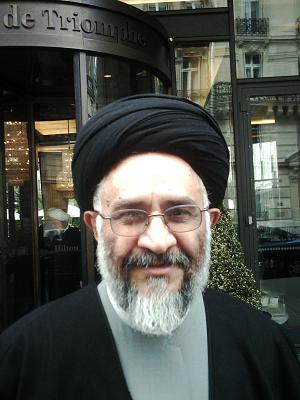
Ayatollah Seyed Mostafa Mohaghegh Ahmadabadi. He sees secularism as more dangerous than Islamic extremism.

It’s not often that an Iranian Ayatollah addresses a Synod at the Vatican – in fact, until last week, it had never happened. But on Oct. 14, Ayatollah Seyed Mostafa Mohaghegh Ahmadabadi, popularly known as Mohaghegh Damad, gave an intervention at the Synod on the Middle East currently taking place in Rome, becoming the first Iranian Shi’ite Muslim ever to do so.

Speaking with him shortly after his speech, he discussed his relationship with the Iranian government and his controversial views on Israel but he also expressed concerns that secularism is leading to godless societies without values.  A genial and somewhat eccentric Islamic scholar, he has a doctorate in law from the Catholic University of Louvain, Belgium, and currently teaches law at Shahid Beheshti University in Tehran. A co-founder of the Common Word initiative which is trying to foster closer Catholic-Muslim relations, he said he has personally invited the Pope to visit Iran.

He was speaking Oct. 15 under the supervision of an Iranian government official at the country’s embassy to the Holy See in Rome.

In your speech yesterday, you said “an ideal world” would be one in which believers of any faith could live “without fear” according to the their traditions. But how does this square with the reality in your country and in most Middle Eastern countries where there are restrictions on religious freedom?

Firstly, I [believe] that Christians are members of my country, they are brothers and sisters. A lot of Christians are friends of mine – I have very many friends who are Christian and Jewish in Iran, and there’s no problem between us. All of them live under the same protection as Muslims. They are no different. They have the right to worship, freedom of speech, freedom to go to their churches.

But Muslims who convert to Christianity are reported to suffer restrictions in Iran [some say they are treated as renegades and traitors to Islam].

Freedom to choose a religion is one thing, conversion is something else. You need to differentiate between them. What does conversion mean? If I’m a Christian, for example, and after one or two years suddenly I declare that I am now outside the faith and tell everyone that they shouldn’t be a Christian, that Christianity is a hateful religion, then any Christian person would be bothered by such statements.

Yet they should still be free to make them?

If conversion means taking action against Islam, then it’s not permissible. You are not allowed to take action against Islam by propaganda. We don’t allow such acts to be made against Christianity in Iran either.

So if someone converted quietly without making public statements, would that be OK?

Yes, nobody can ask someone else what their religion is. This is forbidden. But if they make propaganda against any religion including Islam, then that’s not allowed.

You also said in your speech that today’s rapid communications are having “a qualitative effect on the relationship between religions.” But do you perhaps see these trends also as a threat to Islam, bringing foreign thinking and influences into the religion?

No, [we] should draw on the benefits of technology to bring about brotherhood. Technology should not make us suffer. If it’s used against humanity it’s not good, not fair.

But there are some restrictions on internet access in Iran, there are reports of some censorship of blogs.

I don’t know – I can connect to any website in my home. Perhaps others can’t but I have no problem.

The relationship between Islam and politics is a close one, particularly in Iran. Just how close are you to the political class in the country?

Religion and politics were very close before [the Iranian Revolution] because every law that couldn’t be affirmed by Islam had to be removed. This is in the Islamic Republic of Iran as well.  According to the current Constitution, every election should be free, there should be a parliamentary democracy. There are some problems, but freedom of speech, freedom of writing, freedom to have political parties [are allowed] so I don’t see any difference between what we have in Iran and other democratic countries.

Do you ever speak out against government policies, for example on the nuclear issue?

That is something to ask the ambassador.

What is your view on the Israeli-Palestinian question?

The nation’s point of view, that of the people of Iran, is that they want justice and to see justice realized. In Palestine, we favour democracy. But the Iranian people also say that the government of Israel is not elected by the people of that place [the Palestinians]. It is a racial government and we can’t accept that.

Do you share President Ahmadinejad’s views on Israel?

I don’t know, I haven’t seen what he said – I was here when he went there [on a recent visit to Lebanon, Ahmadinejad said Israel was “doomed”. Previously, he has called for the nation to be wiped off the map].

You had a private audience with Benedict XVI – can you tell us what happened during the meeting?

Yes, he shook my hand, and said: “I agree one hundred percent with what you said in your speech and I wish you had more time to speak”. We’ve known each other for many years; I was his guest when he hosted a conference at the Vatican about human rights among religions. I made a presentation there. He remembered me at that event, and said he hoped to see me again. We said we hoped to see him in Iran, but that is in the hand of God!

Do you think Catholic-Islamic relations are much better than in the past?

Yes, everyday they are getting better. I cannot agree with any extremist or fundamentalist of whatever religion. In any religion there is some fundamentalist thinking. But I want to say frankly that fundamentalism was started by the Zionists in Israel. We are not fundamentalists. I, as a Muslim, condemn any extremism or fundamentalism in any religion, not only in Islam. Our contemporary time is one of negotiation and dialogue.

But people would say that Ayatollah Khamanei is an extremist.

Ayatollah Khamanei recently issued a fatwa about reducing hate speech against other religions, especially within Islam. As you know, there are many struggles between Shia and Sunni. The struggle in Iraq is deeper than Islam and Christianity, so the Ayatollah recently issued a fatwa.

What will you personally take home from the Synod?

It was very interesting for me because it was the first time that a Shi’ite from Iran attends such a gathering at the Vatican, presents a lecture at it, and in front of His Holiness. It was very important for me. I return to Iran with a very nice memory.

It’s interesting that, at a press conference afterwards, I sensed some fear of Islam among the journalists. But one of them explicitly stressed that the real fear is when Christian values are forgotten. It reminded me that in all society, the danger is that of forgetting God, forgetting love, prayer, worship, friendship between each other. This is the real danger for us – for any religion. Because what is the difference between a religious man and a secular man? I believe the difference is that a religious person believes in some values, a secular man doesn’t. So if a religious man forgets his values, what’s the difference between him and a secular man?

So this is a common concern, some clear common ground, between Islam and Christianity.

Yes, both of them believe in values, and the need to protect values. Both of us should help each other to promote these values in society.


Filed under interreligious dialogue, iran, islam, israel, middle east synod, palestinians

Comments

Post a Comment

Ayatollah said: “We said we hoped to see him [Pope Benedict XVI] in Iran, but that is in the hand of God!”

When Pope Benedict XVI steps onto Iranian soil, it will be the catalyst for the Islamic government to surrender to the people for a true and just democracy.

This presents saccharine Islam.  Mohaghegh Damad would have us believe the most fallacious statements on Islam and what it teaches about non-Muslims.  And he deliberately ignores the harsh reality of life for Christians and all non-Muslims in Iran. 

Then like a good stand-up comedian he says ‘freedom of speech’ is allowed, and then in he is afraid to answer the very next question!

Hilarious!!!!!
Freedom to choose a religion is one thing, conversion is something else. -No imam, freedom of religion includes unforced conversion.

You are not allowed to take action against Islam by propaganda. We don’t allow such acts to be made against Christianity in Iran either. -There goes your freedom of speech dear imam.

so I don’t see any difference between what we have in Iran and other democratic countries.-imam needs glasses.


Do you share President Ahmadinejad’s views on Israel?

I don’t know, I haven’t seen what he said – I was here when he went there [on a recent visit to - dear, entire world knows what he said and thinks about Israel.

I think that either he is completely brain-washed or is a good guy, who is muzzled by the system within which he needs to function.

Free speech is an idol of the decaying West. In cultures with any genuine life left in them it is unthinkable. Even in the old, rural US “free speech” was mainly an abstraction, something to be respected because its abuse was unimagined. Once mass media came into being, “free speech” became merely a convenient cover for pornographers and subversives. Read some of the popes on “free speech:” I especially recommend Pio Nono. You will find his sentiments even stronger than the Ayatollah’s.

Ok Hegel! Now stop exercising your right to free speech.

I noted the statement, “under the supervision of an Iranian government official” which made me think back to when residents of the USSR would give interviews, but always under the eye of the government. Not that I think this particular ayatollah would say anything considered traitorous by his country, but it does speak rather loudly that there was a governmental official sitting in during the interview.

Hegel said: “You will find his sentiments even stronger than the Ayatollah’s.”

Oh yes, just take a look at Iran, Saudi Arabia, Pakistan, and Sudan.

They are fine examples of what Western civilization should NOT do to avoid “decay”.

When Pope Benedict XVI steps onto Iranian soil, it will be the catalyst for the Islamic government to surrender to the people for a true and just democracy.

Yeah, just like Cuba did after Pope John Paul’s visit.

...oh, wait…

from the encyclical, “Quanta Cura,” by Pope Pius IX:

For you well know, venerable brethren, that at this time men are found not a few who, applying to civil society the impious and absurd principle of “naturalism,” as they call it, dare to teach that “the best constitution of public society and (also) civil progress altogether require that human society be conducted and governed without regard being had to religion any more than if it did not exist; or, at least, without any distinction being made between the true religion and false ones.” And, against the doctrine of Scripture, of the Church, and of the Holy Fathers, they do not hesitate to assert that “that is the best condition of civil society, in which no duty is recognized, as attached to the civil power, of restraining by enacted penalties, offenders against the Catholic religion, except so far as public peace may require.” From which totally false idea of social government they do not fear to foster that erroneous opinion, most fatal in its effects on the Catholic Church and the salvation of souls, called by Our Predecessor, Gregory XVI, an “insanity,” viz., that “liberty of conscience and worship is each man’s personal right, which ought to be legally proclaimed and asserted in every rightly constituted society; and that a right resides in the citizens to an absolute liberty, which should be restrained by no authority whether ecclesiastical or civil, whereby they may be able openly and publicly to manifest and declare any of their ideas whatever, either by word of mouth, by the press, or in any other way.” But, while they rashly affirm this, they do not think and consider that they are preaching “liberty of perdition;” and that “if human arguments are always allowed free room for discussion, there will never be wanting men who will dare to resist truth, and to trust in the flowing speech of human wisdom; whereas we know, from the very teaching of our Lord Jesus Christ, how carefully Christian faith and wisdom should avoid this most injurious babbling.”

Jack Perry said: “Yeah, just like Cuba did after Pope John Paul’s visit.
...oh, wait…”

One can hope and pray ;)

@ Hegel

Thanks for pointing towards Pope Pius IX encyclical, “Quanta Cura”. I have taken your direction and read Quanta Cura.

Let us read a snippet that provides insight and context to Quanta Cura:

Battle against false liberalism

It is astounding how fearlessly he [Pope Pius IX] fought, in the midst of many and severe trials, against the false liberalism which threatened to destroy the very essence of faith and religion. In his Encyclical “Quanta Cura” of 8 December, 1864, he condemned sixteen propositions touching on errors of the age. This Encyclical was accompanied by the famous “Syllabus errorum”, a table of eighty previously censured propositions bearing on pantheism, naturalism, rationalism, indifferentism, socialism, communism, freemasonry, and the various kinds of religious liberalism. Though misunderstandings and malice combined in representing the Syllabus as a veritable embodiment of religious narrow-mindedness and cringing servility to papal authority, it has done an inestimable service to the Church and to society at large by unmasking the false liberalism which had begun to insinuate its subtle poison into the very marrow of Catholicism.

Previously, on 8 January, 1857, he had condemned the philosophico-theological writings of Günther, and on many occasions advocated a return to the philosophy and theology of St. Thomas.”

Source: http://www.newadvent.org/cathen/12134b.htm

Reading this article turned out to be what I thought it would be - a waste of my time.

I like the comments,  they side with the voice of Bishop Beyluni who was clear about islam and its position in the middle east. The Imam said that it is “new and accidental phenomenon” of Christian persecution for their faith. What is new about it? Wait what is accidental about it? Illogical but sells good to the lukewarm dialogue obsessed west.

I don’t know, I haven’t seen what he said – I was here when he went there [on a recent visit to Lebanon, Ahmadinejad said Israel was “doomed”. Previously, he has called for the nation to be wiped off the map].

Does this imam LIVE in Iran? I have Iranian friends here in the states who say that Ahmadinejad is a mad man who thinks he is the voice of Iran.  The imam obviously doesn’t own a tv, radio, or read newspapers or he WOULD know what his dear leader has said about Israel.

I believe this Iranian Ayatollah is speaking with two tongues….

Christians cannot keep ‘opening our lands’ giving our ‘jobs’, giving ‘emigration rights’ giving ‘free health care, free education…
—  IF THE MUSLIM PEOPLE INTERNATIONALLY DO NOT START GIVING US
\‘IN KIND’ IN THEIR LANDS—-
THEN AND ONLY THEN DO I START TO BELIEVE THAT ‘DIALOGUE’ IS TRUE AND HONEST.

WE CHRISTIANS MUST WAKE UP ..—BUILD TRUE CHRISTIANITY AGAIN.. IN OUR LANDS—TAKE BACK OUR LANDS AND MAKE THEM CHRISTIAN .. IF NOT…
WE DESERVE WHAT WE GET.

Its interesting that while this interview took place, there is a christian pastor on Death Row (to be executed this weekend) in Iran for “Abandoning Islam”.

http://www.worthynews.com/

thanks for sharing, Torbenite.

The article you mentioned is found here:

http://www.worthynews.com/9710-letter-from-iranian-pastor-sentenced-to-death-for-apostasy

I’m praying for the pastor and his wife [who is serving life imprisonment].

Liar.


Conversion to Islam from Christianity can be trumpeted in the streets without fear. Conversion to Christianity from Islam, if it is not kept absolutely secret through faux practice of Islam, results in murders by outraged Muslim neighbors, prison sentences, and executions.


This is the Iranian regime’s Baghdad Bob talking, and with equal plausibility.

Pretty much of what he said are propaganda themselves.  “Freedom to choose a religion is one thing, conversion is something else. You need to differentiate between them…” There nothing to differentiate, the statement itself is pretty much contradicting.  Further, there were reports that foreigners, i.e A Catholic nun in one instant, on her stopped over at Tehran airport,  were being questioned for carrying with them, for personal use, with no intention of converting anyone, prayer books, rosary and bible.

Post a Comment

By submitting this form, you give The National Catholic Register permission to publish this comment. Comments will be published at our discretion, and may be edited for clarity and length. For best formatting, please limit your response to one paragraph and don't hit "enter" to force line breaks.

Name:

Email:

Write your comment:

Please enter the word you see in the image below:


Notify me of follow-up comments.

About Edward Pentin

Edward Pentin
  • Get the RSS feed
Edward Pentin began reporting on the Pope and the Vatican with Vatican Radio before moving on to become the Rome correspondent for the National Catholic Register. He has also reported on the Holy See and the Catholic Church for a number of other publications including Newsweek, Newsmax, Zenit, The Catholic Herald, and The Holy Land Review, a Franciscan publication specializing in the Church and the Middle East. Follow on Twitter @edwardpentin